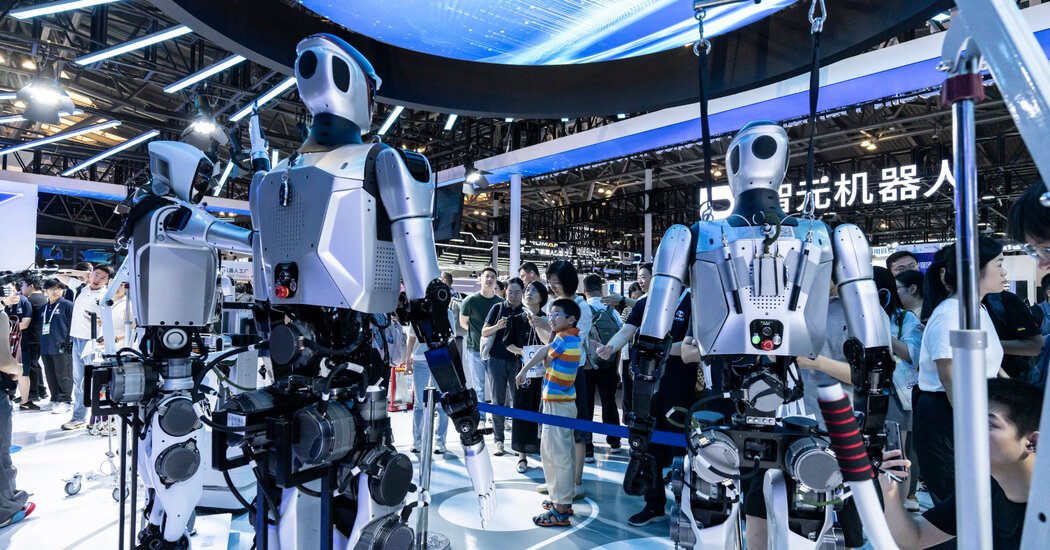
Robot trade tensions escalated on Thursday as China angrily denounced a proposal by the United States to ban imports of Chinese-made humanoid robots, calling the measure discriminatory and threatening retaliation.
In a sharply worded statement, China’s commerce ministry accused the Trump administration of launching a new provocation that would “severely undermine the stability of China-U.S. economic and trade relations, and seriously disrupt the stability of global industrial and supply chains.”
On Tuesday, the U.S. Federal Communications Commission said that it intends to restrict imports of humanoid and animallike robots on national security grounds, while promoting the development of advanced robots domestically.
Although the F.C.C. did not explicitly identify China, Chinese producers dominate the global humanoid robot industry. China’s commerce ministry said the proposal was unmistakably aimed at the country’s manufacturers, describing it as “discriminatory and suppressive against Chinese companies and products.”
The proposal thrusts the emerging robotics industry into the latest front in the technology rivalry between the United States and China, which have already imposed tit-for-tat restrictions on access to artificial intelligence systems, advanced semiconductors and other critical technologies.
China’s statement warned that if Washington proceeds with the ban, “China will resolutely retaliate to safeguard its legitimate rights and interests.” It did not specify what measures it might take.
The Trump administration argues that increasingly capable humanoid robots pose national security risks on two fronts.
First, officials contend the machines could function as Trojan horses for data collection, harvesting personal information and even sensitive government data as they become more integrated into homes, workplaces and public spaces. Second, the administration argues that advanced robotics will become a strategically important technology in an economy increasingly dependent on A.I..
China dismissed those concerns, accusing the United States of “overstretching the concept of national security.”
The F.C.C. has previously invoked national security concerns to prohibit imports of telecommunications equipment from Chinese companies such as Huawei and ZTE.
Whether restrictions on Chinese robots would be effective is an open question.
Chinese start-ups are producing thousands of humanoid robots priced below $5,000, far cheaper and at a greater scale than competitors elsewhere. While Chinese manufacturers once depended on Japanese and other foreign suppliers for critical components such as sensors and joints, those parts are now overwhelmingly produced in China.
As a result, it has become nearly impossible to build a competitive humanoid robot without Chinese-made components.
China has also established a significant lead in industrial robotics. It manufactures and installs factory robots at a pace unmatched by any other country. More than two million robots were operating in Chinese factories in 2024, with another 300,000 installed during the year — more than the rest of the world combined.