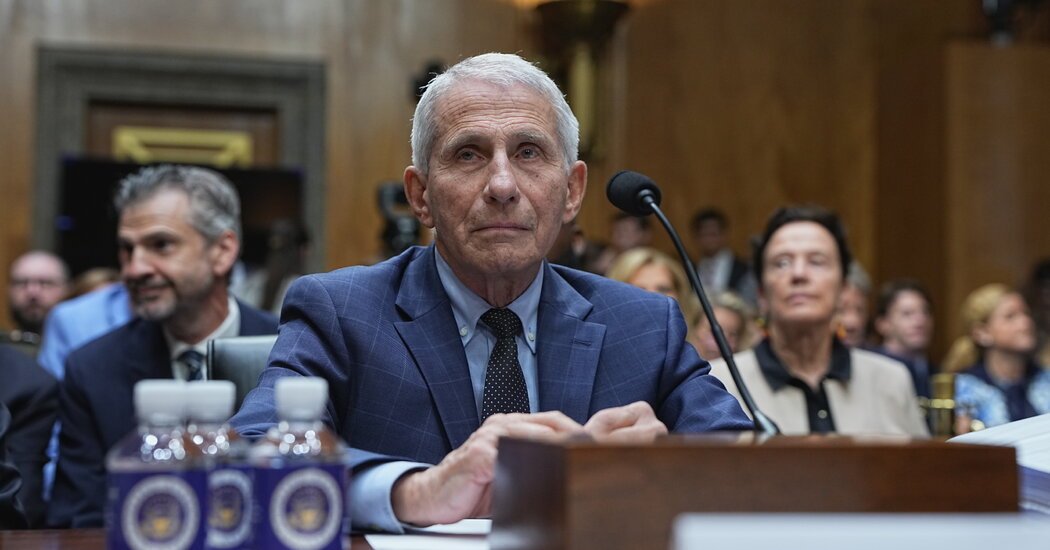
After Dr. Anthony S. Fauci invoked his Fifth Amendment right not to incriminate himself at the start of a Senate hearing on Wednesday, Republicans spent the next three hours battering him with questions and allegations as he sat in silence.
Citing thousands of pages of government records, they held Dr. Fauci, the government’s top Covid adviser during the pandemic, responsible for school closures and lockdowns; accused him of enriching himself as people died; and even mocked his interactions with celebrities. Most significantly, they accused him of funding research that led to the creation of the coronavirus that causes Covid, and of lying about it under oath to Congress.
And they threatened to hold him in contempt of Congress, saying he was not even eligible to invoke the Fifth Amendment because President Joseph R. Biden Jr. had granted him an unconditional pardon.
Because Dr. Fauci, on the advice of his lawyer, refused to respond, many people were left confused about the issues.
Why did Mr. Biden pardon him?
Dr. Fauci was one of several high-profile figures whom Republicans had vowed to pursue after President Trump won election to a second term in 2024. Stephen K. Bannon, a former to aide to Mr. Trump, had named Dr. Fauci as one of several individuals who should be prosecuted. “You deserve what we call a rough Roman justice, and we’re prepared to give it to you,” Mr. Bannon said on election night. Mr. Biden took the highly unusual step of granting Dr. Fauci and others a “pre-emptive pardon” on the last full day of his presidency, Jan. 19, 2025. The pardon covers Dr. Fauci’s activities from 2014 through that day.
Why did he plead the Fifth?
Republicans argued at the hearing that Mr. Fauci “can’t have it both ways,” by refusing to testify while under the pardon’s protection. But the pardon did not cover Wednesday’s hearing. Legal experts said that if Dr. Fauci made a single misstep, he could expose himself to prosecution for lying under oath. So he took the “better safe than sorry” approach.
Did Dr. Fauci fund research that gave rise to the pandemic?
The National Institute of Allergy and Infectious Diseases, which Dr. Fauci led for 38 years, did fund studies at the Wuhan Institute of Virology, a lab in the Chinese city where the pandemic virus started spreading. But so far, there is no evidence that those studies set off the pandemic.
Dr. Fauci’s institute faced heavy criticism in 2023 from a federal watchdog agency about errors in its oversight of that grant, reinforcing concerns about the federal government’s system for monitoring research with potentially risky pathogens.
But federal health officials have shown that the viruses being examined in those experiments were not closely related to the coronavirus behind the pandemic. Dr. Lawrence A. Tabak, a former official at the National Institutes of Health, once told a House panel that suggestions that they were the same were akin to “saying that a human is equivalent to a cow,” though he acknowledged that he did not know what other work the Wuhan institute was doing.
Researchers have identified several naturally occurring bat viruses that are much more similar to the one that ended up killing millions of people globally.
A declassified report from the Office of the Director of National Intelligence in 2023 said researchers at the Wuhan lab probably failed to use sufficient safety measures, at least some of the time. But the report said there was no indication that the lab had been in possession of the pandemic coronavirus “or a close progenitor” — a virus that could have become the one that caused the pandemic — before the outbreak.
What do we know about Covid’s origins?
“It seems now it’s more and more emerging theory that that would have come from the lab,” Senator John Fetterman, Democrat of Pennsylvania, said at the hearing on Wednesday. He was speaking for many Americans: In a 2023 poll, two-thirds of respondents said they believed that the virus definitely or probably originated in a lab.
That view masks considerable uncertainty within the ranks of government intelligence agencies about the origins of the pandemic. China has withheld crucial information that could have shed light on the question.
The F.B.I. and the Energy Department have long seen a lab leak as more likely, though each has identified a different lab as the possible culprit.
Early last year, the C.I.A. shifted its assessment toward a lab leak with “low confidence,” but the change was not based on new intelligence.
Five agencies, including the National Intelligence Council and the Defense Intelligence Agency, have considered it more likely that the virus did not originate in a lab, but rather jumped from animals to people at a wild-animal market — a so-called “wet market” — or another location.
That idea has been bolstered in recent years by scientific studies from experts in outbreak-tracing, who identified an illegal wild-animal market in Wuhan as the likely source of the pandemic.
Those studies found that early Covid cases centered on the market — a relatively tiny spot in a city of more than 11 million people — in a pattern that could not be explained by chance. Researchers then studied where investigators found the virus within the market, including in swabs taken from walls, floors and other surfaces, and found that those samples clustered in an area of the market where live animals were sold.
Some of those swabs showing genetic traces of the coronavirus were later found to contain genetic material from animals, too, including raccoon dogs, which are known to be able to transmit the coronavirus — a scenario that researchers said was consistent with the pandemic originating in an infected animal being dealt through China’s illegal wildlife trade.
Did Dr. Fauci mislead the public about Covid’s origins?
On Jan. 26, 2020, Dr. Fauci wrote in a diary kept on his work computer of doubts that the pandemic had originated in a wild-animal market in Wuhan.
“Now we know the market was not the source, it was the amplifier,” he wrote. “Having said that, somewhere the virus jumped from animals to humans.”
Senator Rand Paul, the Kentucky Republican who released the diary over the weekend, posted only the first sentence of that quote on social media, using it to imply that as early as Jan. 26, Dr. Fauci was covering up private suspicions that the virus leaked from a lab.
The records show a fast-moving scientific debate, in which Dr. Fauci at first discounted a lab leak, then entertained the idea of it, then said it was highly unlikely.
On Jan. 31, Dr. Fauci wrote in his diary that some scientists he respected had alerted him that a lab leak might have been possible; they thought certain features of the virus could have been the result of human engineering. Among those was the furin cleavage site, a feature that helps the virus get inside cells. They had not seen those features in related viruses from nature.
Dr. Fauci urged one of the scientists to convene a conference call of top evolutionary biologists and other top experts to consider the theory. If their fears were borne out, he wrote, the scientists would need to alert “appropriate authorities,” including the F.B.I.
The conference call took place on Feb. 1, 2020, at 2 p.m. In a diary entry afterward, Dr. Fauci said that only two of the 11 scientists at that meeting dismissed the idea of a lab leak out of hand.
But in the days afterward, those researchers have said, they worked quickly to conduct more extensive analyses of data from coronaviruses found in other species, like bats and pangolins, and found that the suspicious-looking features were in fact present in related, naturally occurring viruses.
That changed their view of the likelihood of a lab leak. So did historical precedents: Two decades earlier, the first SARS outbreak had emerged in connection with markets selling live animals. Dr. Fauci felt relieved, the records show.
Dr. Fauci has always said that while he is open to the possibility of a lab leak, he believes the virus was zoonotic in origin — meaning it jumped from animals to humans.
Still, there remain questions about whether government officials were sufficiently transparent with the public about their early inclinations that the coronavirus could have leaked from a lab. Some have suggested that officials like Dr. Fauci were reluctant to discuss the lab-leak theory for fear of drawing attention to federal funding for gain-of-function research, in which scientists genetically alter a virus to see whether that makes the pathogen deadlier or more contagious.
Did Dr. Fauci use government staff to pursue lucrative prizes?
“You were using federal employees with taxpayer money to apply for and solicit cash prizes for you personally, cash prizes totaling over $1 million,” Senator Josh Hawley, Republican of Missouri, said at the hearing. “You did all of that during the pandemic, didn’t you?”
The records show that beginning in 2018, Dr. Fauci actively pursued prizes and honors that carried cash awards. There is no evidence so far that he violated federal law, which bars government officials from accepting prizes that might influence them in the course of their duties, or come from an entity that does business with the government.
Dr. Fauci had email conversations with two prominent academic scientists who had been funded by his institute — Dr. Barton Haynes, a vaccine expert at Duke University, and Dr. Charles A. Dinarello of the University of Colorado Anschutz — to encourage them to nominate him for awards, including one for $1 million from the Dan David Foundation, based in Israel. Greg Folkers, Dr. Fauci’s chief of staff, also worked on the nominations.
“There is another one that looks possible for me if you are willing to do it,” Dr. Fauci wrote Dr. Haynes in 2018. “As usual, I will supply all of the material. It is the Dan David Prize. I will send you their email separately in a minute.”
The N.I.H. ethics guidelines note that its “employees make outstanding contributions to the biomedical sciences that are recognized by outside organizations in the form of awards.”
The guidelines require government ethics officials to approve any gifts in excess of $200. People who work with Dr. Fauci say that he was scrupulous in following them, and that it is common for scientists in academia and government to nominate one another for awards.
Dr. Fauci won several of the awards. After review by government ethics officials, he was allowed to keep some, including the Dan David Prize, but required to decline others. He wrote that he was “very pleased” to accept the prizes that were allowed. As for the others, he wrote, “I will accept the honor and they can give the cash to charities of their choosing.”
Was Dr. Fauci responsible for lockdowns and school closures?
“The haphazard information you released and pushed on the American people with little research is appalling,” Senator Rick Scott, Republican of Florida, said to Dr. Fauci, adding, “You forced people to watch their loved ones die alone.”
Dr. Fauci did not have the authority to force anyone to do anything. State and local officials were responsible for shutting down businesses and schools. But the opinions Dr. Fauci offered in his role as an adviser to both Mr. Trump and Mr. Biden carried a lot of weight. And when Mr. Trump grew angry at officials from the Centers for Disease Control and Prevention early in the pandemic, Dr. Fauci became the face of the public response.
He was deeply involved in making public health recommendations, including urging Mr. Trump to initiate his March 2020 “Fifteen Days to Slow the Spread” — a campaign that stretched out for months in some parts of the country.
Dr. Fauci offered direct advice to Mayor Bill de Blasio of New York and an aide to Gov. Gavin Newsom of California. On March 18, 2020, just days after Mr. Trump declared a Covid national emergency, Mr. de Blasio asked Dr. Fauci whether he should shut down the entire city, over the objections of Gov. Andrew Cuomo. “I advised DeBlasio to go ahead and do it,” Dr. Fauci wrote in his diary. “I will try to speak with Cuomo.”