I’m not a Christian, but I was desperate. I wrote to Oliver Ferrari, a monastic brother in the community, and we settled on several days that December. As the date approached, my thrill at the prospect of unspecified liberation turned to terror. I had never been alone with myself for that long.
The retreat had been started in 1987 by two friends: Fay Key, a civil-rights advocate who longed to enact Jesus’ command to “come away to a lonely place and pray,” and Steve Bullington, a Methodist pastor. I arrived to find a chapel and several modest residences bordered by fields for soybeans and hay. It’s the kind of place where the shower doesn’t shoot straight and the communal jar of almond butter has marks from every spoon that has used it, a sanctuary as plain as its setting. “No majestic mountains, no roaring sea,” as Fay once wrote in a memoir. “I sometimes say there is nothing here but God.”
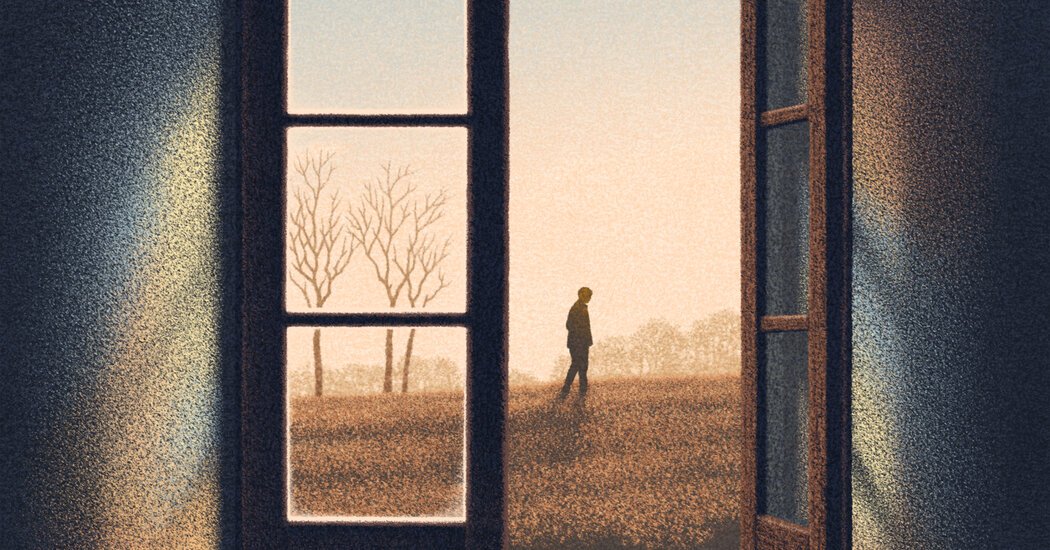
I was placed in a one-room cottage flanked by a statue of St. Francis and a lowland of sweet gums and broomsedge. It had a twin bed, a wall-mounted propane heater and a compost toilet. The only sound came from pecans thumping the roof. I handed over my laptop and phone and, suddenly, there was nothing to do. I decided to go outside and, Georgia weather being generous even in winter, walk the soybean field. After I circled it, I kept going. I wanted to feel more of the soil and the sun, so I took off my shoes and shirt. Perhaps because I had finally stopped talking, I heard the call of birds. At one point, I stood on an oak uprooted by Hurricane Helene, its bark like the scales of a prehistoric animal, and just surveyed existence.
I was rediscovering the physical world — so this is what all those people meant by being present. No object was too humble to convey the glory of its existence. Passing an ancient Toyota Corolla, I thought, “That steering wheel is solid and true.” The last time I thought such a thing, I was a very stoned undergraduate — that is, more open to the essence of things. I remembered why I was always telling my students that concreteness was sacred in fiction. That week, I sat with myself, in silence, far longer than I imagined I could. “The law of growth is rest,” as the British ecclesiastical artist Caryll Houselander once wrote.
Out in the world, I was always focused on the next move. Here, so little was necessary to feel not only content but ecstatic: simple meals that concluded with prayer and readings; fields to walk in the quiet and warmth; sincerity in the way I was asked after; acceptance when I dared to answer honestly. (At the retreat, meals are largely silent — quiet is the default — but communication isn’t forbidden.) Between the sometimes transactional nature of my professional life and how busy we all seem to be, it had been a long time since anyone had looked me directly in the eyes, as Fay, Steve and Oliver did.