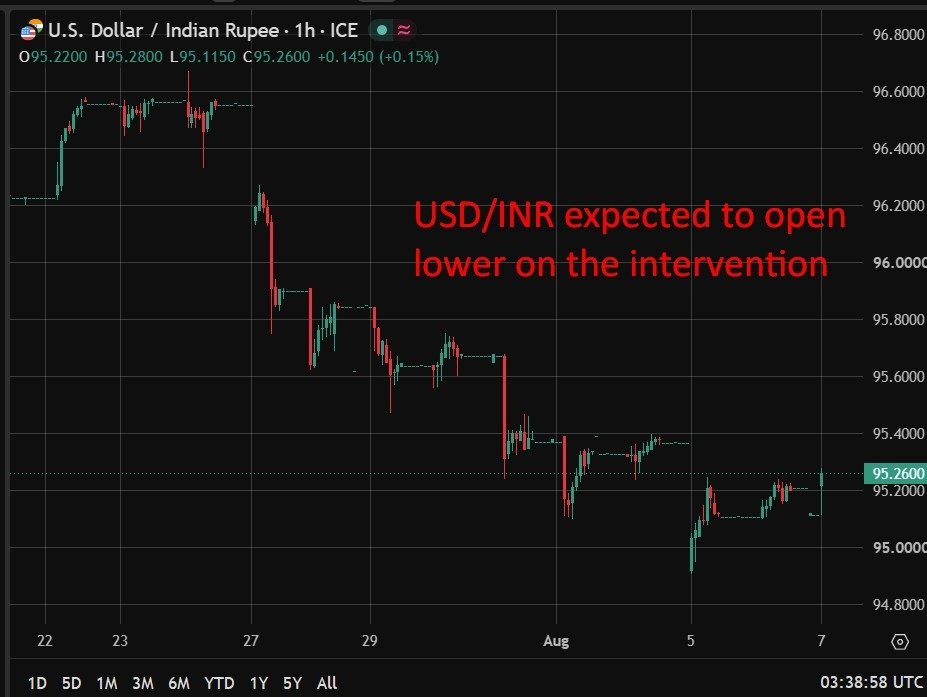
Continued RBI dollar selling signals the central bank retains a clear line in the sand around current levels and is willing to draw on its substantial reserves to defend it, which should limit further near-term downside in the rupee barring a fresh shock. The intervention comes alongside a more favourable backdrop of softer oil prices and reduced expectations for a September Fed hike, both of which have taken pressure off emerging market currencies broadly. Continued FII outflows and the drag from steep US tariffs on Indian exports remain the key structural headwinds, meaning any renewed spike in crude or hawkish Fed repricing could quickly reverse the currency’s recent stabilisation. The rupee’s path also bears watching as a read-through for other current-account-sensitive Asian currencies facing similar oil and capital-flow pressures.
India’s central bank is once again leaning on its dollar reserves to hold the line under the rupee, buying time against a currency that has been battered by tariffs, oil shocks and capital flight for most of 2026.
Three traders told Reuters the Bank was selling USD/INR. Immediate catalyst is the rise in oil prices.
Summary:
- The Reserve Bank of India is selling US dollars against the rupee to support the currency, which has been trading near record lows this year
- The rupee weakened from around 90 to near 97 per dollar earlier in the year before recovering somewhat with RBI support, and rose around 1% last week aided by near-daily central bank dollar sales
- Steep US tariffs on Indian exports, reported at up to around 50% on a range of goods, have weighed on export competitiveness and dollar inflows through the year
- Sustained foreign portfolio investor outflows from Indian equities and bonds have added to dollar demand and rupee weakness
- Elevated oil prices tied to Middle East tensions have worsened India’s import bill, given the country imports around 70% of its crude in dollar terms
- India’s foreign exchange reserves stand at roughly $680 to $690 billion, giving the RBI substantial capacity to continue intervening if needed
- The RBI has kept its repo rate on hold at 5.25% for a fourth straight meeting, maintaining a neutral policy stance while raising its growth forecasts
The Reserve Bank of India is selling US dollars in the foreign exchange market to support the rupee, continuing a defence of the currency that has been running for much of 2026 as it has traded near record lows against the dollar. The rupee weakened sharply this year, sliding from around 90 per dollar in January toward a record intraday low near 97 in May, before recovering somewhat as the central bank stepped up near-daily dollar sales, helping the currency rally around 1% last week alone.
The rupee’s weakness has stemmed from several reinforcing pressures. Steep US tariffs on Indian exports, reported at levels up to around 50% on categories including textiles, gems and jewellery, and machinery, have hit export competitiveness and reduced dollar inflows from trade. At the same time, foreign portfolio investors have pulled significant sums from Indian equities and bonds this year, a trend that increases dollar demand each time positions are unwound and funds repatriated. Elevated oil prices, driven by Middle East tensions including disruption risk around the Strait of Hormuz, have compounded the pressure further, since India imports roughly 70% of its crude oil and pays for it in dollars, directly worsening its import bill whenever crude prices spike.
The RBI has responded with sustained intervention across both spot and offshore markets, drawing on foreign exchange reserves that stand at approximately $680 to $690 billion, giving the central bank considerable capacity to keep defending the currency if pressure resumes. The central bank has also taken complementary steps during the year, including measures to curb speculative arbitrage and forward contract manipulation, alongside incentives for external commercial borrowing aimed at attracting more stable capital inflows.
On the monetary policy side, the RBI has kept its repo rate unchanged at 5.25% for a fourth consecutive meeting, maintaining a neutral stance while raising its growth forecasts for the coming fiscal years despite softer business activity. That steady policy backdrop, combined with a recent pullback in oil prices and reduced market expectations for a Federal Reserve rate hike in September, has helped shift sentiment on the rupee from fears of a slide beyond 97 per dollar toward a view that the currency may have found a firmer floor, though the underlying pressures from tariffs, capital outflows and oil dependency remain far from resolved.