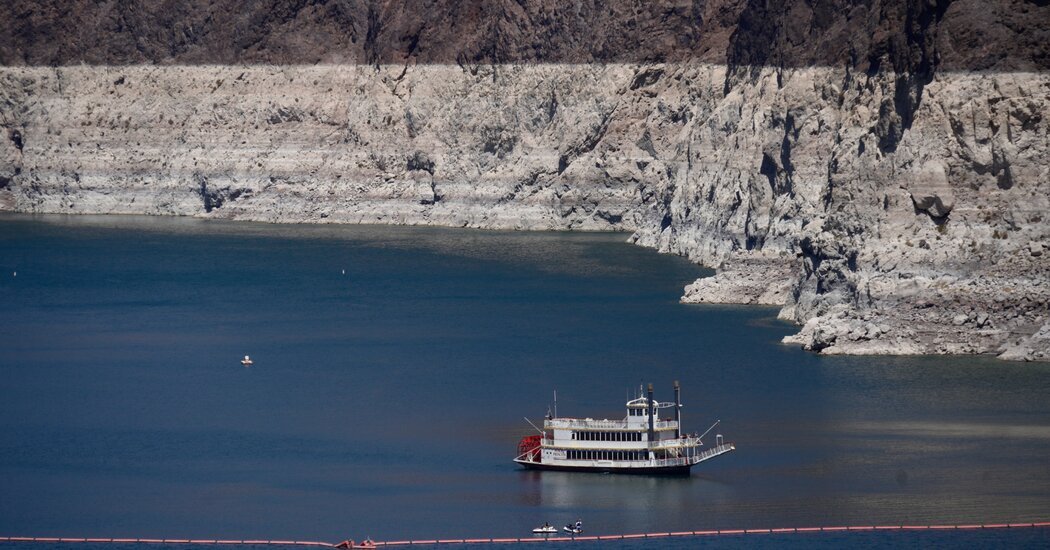
Lake Mead, the nation’s largest reservoir and a vital source of water for more than 25 million people across the Southwest, has dwindled to its lowest levels ever as the region struggles through a punishing drought.
The record, first broken on Thursday night and then again on the following days as the water level continued to fall, is the latest warning of the Colorado River’s dire condition.
The river system, a lifeblood for much of the Western United States, is threatened by rising temperatures and decades of overuse. The seven states whose cities and farmers rely on it are locked in tense negotiations over how to divvy up what little water remains.
Lake Mead’s milestone is a reminder that the clock is ticking.
“This is a significant wake-up call,” said J.B. Hamby, chairman of the Colorado River Board of California and the state’s lead negotiator. “We need to have long-term solutions that are going to get us away from the precipice.”
But long-term solutions have been hard to hammer out. The states in the upper river basin — Colorado, New Mexico, Utah and Wyoming — and the states in the lower basin — Arizona, California and Nevada — have spent years fruitlessly negotiating how to allocate the water. After the states blew through a deadline in February, the federal government said it would impose its own plan.
The Trump administration’s initial framework, released in July, threatened drastic cuts for the lower basin. Communities across the Southwest are now bracing for details from the Bureau of Reclamation — part of the Interior Department — which will outline the specific reductions states must make over the next two years.
The crisis, which has developed steadily during a decades-long drought, was exacerbated by this year’s warm winter, which failed to deliver crucial snow that would have refilled water supplies as it melted.
“It’s tragic timing,” said Kathryn Sorensen, the director of research at the Kyl Center for Water Policy at Arizona State University. “There’s a lot at stake, and tensions are very high.”
Water first flooded into Lake Mead in the 1930s, after the construction of the Hoover Dam, a concrete colossus that stands taller than the Space Needle in Seattle and the Gateway Arch in St. Louis. At full capacity, the reservoir’s surface sits more than 1,220 feet above sea level. On Sunday it was at 1,040.3 feet, inches below the previous record low set in 2022.
If the water level dropped by another five feet, the dam’s hydropower generation capacity would plummet by 70 percent, the Bureau of Reclamation has cautioned. The agency projects that Lake Mead may hit that point in the coming months.
If the water dropped further, to around 900 feet, the reservoir would hit “dead pool,” the point at which its level is so low that no water flows downstream. That would be disastrous for the lower basin states, cutting off supplies to critical farmland, Native American tribes and cities like Los Angeles, Las Vegas and Phoenix.
“We need more water to be left in the system to give us a buffer against catastrophe,” Mr. Hamby said.
As the reservoir’s water level has dropped in recent years, it has also reshaped the experience of the millions of people who visit the area to swim, fish or zip around in speedboats. The receding water has left behind a distinct chalky bathtub ring that marks the heights it once reached.
And surprises have emerged from the shallows, including a sunken World War II-era vessel; the body of a homicide victim, stuffed in a barrel; and, most recently, rock spires from the flooded mountains below.
Perhaps the best way to see how the desert landscape has changed is from above. Satellite images document the transformation from a full, deep-blue lake to a shrunken, teal-tinged body of water.
At the same time, Lake Mead’s sister reservoir, Lake Powell — impounded behind the Glen Canyon Dam upriver — is also hurtling toward record low levels. In July, a group of researchers found that there was less water in Lakes Mead and Powell combined than at any point in their shared history.
Lake Powell has also undergone a metamorphosis. This summer, boating managers relocated an entire marina to deeper waters in an attempt to keep up with the reservoir’s retreat.
Earlier this year, federal officials decided to reduce water flows from Lake Powell in order to keep its level high enough to avoid damaging Glen Canyon Dam infrastructure. The decision cut the water flowing into Lake Mead, effectively sacrificing it to save Lake Powell, said Eric Kuhn, a former general manager of the Colorado River Water Conservation District.
It was understandable, he said, because Lake Powell was closer to reaching the point below which its dam could no longer produce power. But, he added, with climate change bringing ever warmer and drier conditions to the region, such strategies can go only so far.
“At some point,” Mr. Kuhn said, “we may not have a cushion in either Powell or Mead — unless we reduce use.”