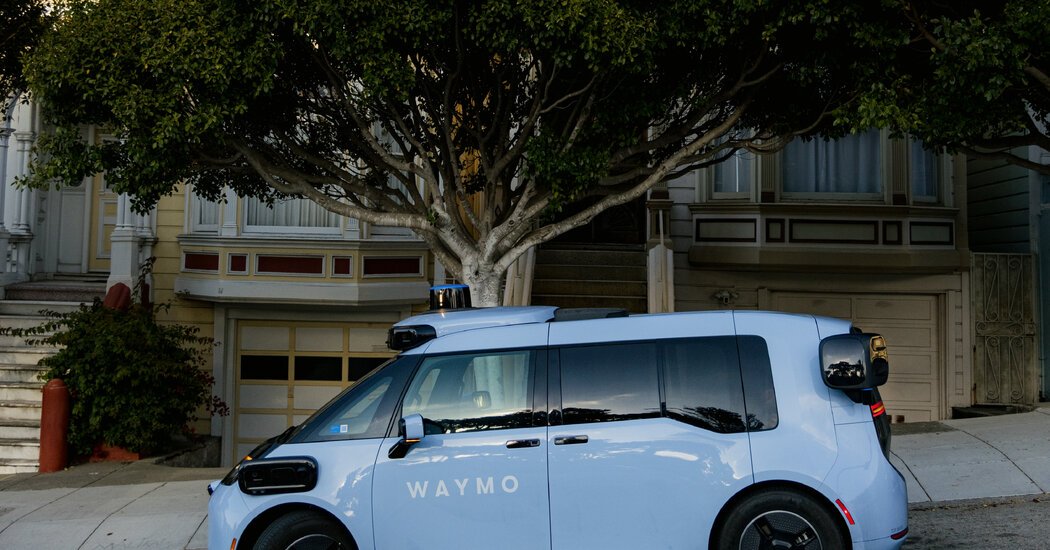
On July 4, more than 100,000 people packed San Francisco’s waterfront for a foggy fireworks show over the Golden Gate Bridge.
When they tried to go home, Waymo got in the way.
With crowds milling around, Waymo’s driverless cars blocked intersections and choked traffic. Some drivers were stuck behind the electric robo-taxis for more than three hours. Several Waymos had to be towed after their batteries died in the gridlock. At least two drove over exploding fireworks, with one catching fire.
Rose Peterson was inside the other. She and her fiancée had ordered a Waymo to return to their hotel. When the car stopped at an intersection, a man ran into the road, set a firework on the street and lit it. The Waymo drove forward, rolling over the firework as it exploded beneath the car.
“We were just in absolute shock,” said Ms. Peterson, 30, who works in insurance in Walnut Creek, Calif. The car smelled like it was on fire, she said, but the Waymo kept going until it stalled at another intersection. She and her fiancée then got out and walked the rest of the way to their hotel, turning what was supposed to be a five-minute drive into an hourlong journey.
What Ms. Peterson experienced is what the driverless car industry calls an “edge case,” which are the unscripted situations that no one trained the robo-taxis to handle. The problem is that edge cases appear to be piling up as Waymo, the leading autonomous car service, rapidly expands.
Owned by Google’s parent Alphabet, Waymo has more than quintupled the number of autonomous cars it has on the road to nearly 4,000 today, up from about 700 early last year. Its vehicles are now in 15 metro areas, having gone fully driverless in Denver, Las Vegas, San Diego and Tampa in the past month alone. Each week, passengers pay for about half a million trips.
Amid that growth, Waymo has issued three federal recalls since December for software problems — including one where the cars drove into flooded roadways — compared with three recalls in the previous 22 months. Some edge cases have drawn headlines, including a December power outage in San Francisco that left nearly 1,600 Waymos frozen for at least two minutes.
More cars in more cities means more chances to meet something the technology has never seen. That’s hard to fix because the cars often do not recognize they are in trouble and so do not request help, said Philip Koopman, a Carnegie Mellon University emeritus professor who specializes in autonomous vehicles.
“This technology struggles to know when it’s in a novel situation,” Dr. Koopman said. “And when it’s in a novel situation, it’s prone to overconfidence and spectacularly stupid failure.” Waymo’s answer has not been to solve the underlying problems, he said, but to hand control of the car to a remote human operator.
Sandy Karp, a Waymo spokeswoman, said the recent recalls were proactive moves and the rate of edge cases was decreasing as the company expands, adding “the ones that do occur inform ongoing improvements.”
The pace of driverless car rollouts has quickened, acknowledged Franklin Trujillo, who leads Waymo’s team that orchestrates expansion into new cities. The company can move faster into cities because the software it developed in one place increasingly works for the next one without having to be retrained for each locale, he said.
Waymo’s goal is for its technology to handle edge cases “regardless if we’ve seen them before,” Mr. Trujillo said. He pointed to the company’s safety record that showed 94 percent fewer serious-injury crashes than human drivers, adding, “we’re constantly learning, constantly improving our product.”
For now, Waymo’s incidents have put the company in the cross hairs of officials and regulators.
Bilal Mahmood, a member of the San Francisco Board of Supervisors who walked an hour to get home after the July 4 fireworks, demanded last month that the city’s emergency management, fire and transportation departments explain what went wrong at the event. Mayor Daniel Lurie also wrote to California’s transportation secretary asking the state to set operational standards for driverless cars during major events and emergencies, saying “regulating for typical conditions is no longer enough.”
On July 28, Mr. Lurie backed federal legislation that would require driverless car companies to staff a hotline for emergency responders and direct regulators to write a minimum standard for how emergency medical workers can move a robo-taxi.
Jonathan Morrison, the administrator of the National Highway Traffic Safety Administration, also wrote in a July 8 letter that the agency had identified “a clear pattern” of autonomous vehicles interfering with police, firefighters and paramedics. “Emergency scenes are not rare or extreme ‘edge cases,’” he wrote.
Mr. Morrison has summoned driverless car companies to meetings to present fixes. His agency has started developing federal safety standards for driverless cars. Sean Rushton, a NHTSA spokesman, said the agency had already met with several driverless car developers.
Waymo’s failures were foreseeable, said Matthew Raifman, who leads research on policy and autonomous vehicles at the University of California, Berkeley. Tens of thousands of people converging at a marathon or a festival is just another normal weekend in a big city, he said.
“Some of the things that we’re calling edge cases are edge cases for autonomous vehicles, but not necessarily edge cases for transportation,” he said.
Elliot Slade, 31, a San Francisco resident, was recently involved in such a case. He and his fiancée were riding in a Waymo back to the city from an event in nearby San Mateo, Calif., in May when the car entered a construction zone that had closed the right lane of the highway.
The car began driving like a “frightened animal,” Mr. Slade said, swerving through traffic cones and accelerating to highway speed in the closed lane. It then wove past a truck and workers as California Highway Patrol officers hit their sirens and shouted, “Stop, Waymo!”
“We were freaking out,” Mr. Slade said, adding that he placed his arm across his fiancée’s chest “just in case we crashed.” He said he pressed a button in the car to call for support but no one answered until the vehicle exited the highway on its own. The couple got out of the Waymo and then took an Uber the rest of the way home.
Weeks later, Waymo recalled the software on some cars for entering freeway construction zones and pulled its vehicles off highways while creating a fix. The company resumed freeway routes late last month in Los Angeles, Miami, Phoenix and the San Francisco Bay Area.
For San Francisco’s July 4 fireworks, Waymo had appeared prepared. The company sent an employee to the city’s Emergency Operations Center that evening and agreed to restrict where riders could hail its cars. Waymo also had a team that could take manual control of stuck vehicles, said Dean Crispen, San Francisco’s fire chief.
Yet more than two hours before the 9:30 p.m. fireworks show began, reports of stalled Waymos reached the center. Several of those cars ran out of battery power, but tow trucks were unable to reach them because of the traffic. The Waymos were not cleared for two hours, according to a letter from San Francisco’s emergency management department.
Waymo’s Ms. Karp said the July 4 traffic snafus “were caused by a number of factors” and that Waymos “contributed to congestion” in the Presidio neighborhood of San Francisco, adding that the company’s roadside assistance team worked with local authorities to clear the vehicles.
Waymo’s next major test in San Francisco is in October, when the U.S. Navy’s Blue Angels take over the sky for the annual Fleet Week air show, which is expected to again draw crowds to the waterfront.
Stephen Sherrill, a member of the city’s Board of Supervisors, has called for a Sept. 3 hearing to better coordinate city agencies to preemptively address potential Waymo failures.
“Waymo is terrible at addressing traffic congestion under abnormal driving conditions during these large scale events,” he said in a statement.
Waymo’s Ms. Karp said the company “will be in close contact and coordination” with city officials about Fleet Week.