I spent the first Saturday in August in Clacton-on-Sea, a fading seaside town on the east coast of England and the seat of Nigel Farage, the polarizing leader of the far-right Reform U.K., who was elected to Parliament in 2024, on his eighth attempt.
Children screamed with pleasure at the funfair while parents wilted in the heat. A few weeks before, in the middle of an investigation into whether Mr. Farage had broken parliamentary rules over an undisclosed gift, he announced he would resign and immediately run for re-election. The people of Clacton, he said, would be the judge of his actions.
Faded grandeur is everywhere in Clacton. It is a constant reminder of the town’s past as a destination for Victorian day trippers — not least the pier, built around 1870, when Britain was the world’s superpower. Such a visible sense of the past brings the more mundane present into sharp relief and in some ways explains Reform better than any focus group.
When the present and future are frightening — and they are — people often look backward for comfort. They find it in the idea that we were great once, and that ought to mean something. Mr. Farage can eloquently voice that feeling, but he has no real solutions. In their hearts I think voters know it. We are in the weeds of culture war: It is a time of distraction.
Until recently, Reform had seemed unstoppable. It consistently polled level with or higher than the governing Labour Party — which last month, after disastrous results in local elections in which Reform made major gains — felled its leader, Keir Starmer, and replaced him with Andy Burnham as the prime minister.
Like all insurgent parties, Reform has benefited from the major parties’ apparent inertia in the face of stagnating wages, faltering public services and scarce and expensive housing. Mr. Farage’s party blames immigration — particularly the highly visible, desperate people who cross the English Channel on small boats. (He has frequently been photographed on the Kent coast, keeping a lookout.) He was an early advocate of leaving the European Union. And though wealthy and well connected — he still dresses like the 1980s commodities trader he was — he succeeded in situating himself, like his friend President Trump, as an ally of the people against the dark forces of the global elite.
But this year something has shifted. In April, The Guardian published an investigation that described how Mr. Farage accepted a gift of about $6.7 million from Christopher Harborne, a cryptocurrency billionaire who lives in Thailand, in 2024, a couple of months before he returned as the leader of Reform. An official watchdog started an investigation the following month. The Met police is also investigating donations to the party.
Mr. Farage tried to frame these investigations as a case of the establishment versus the maverick, but this time he and the party began to slip in polls. The by-election might be understood as an attempt to take back control.
All the major parties have dismissed the election as a stunt and have declined to post candidates. Even so, there are 34 candidates on the longest and perhaps strangest ballot paper in British electoral history. There are three from the Monster Raving Loony Party, Britain’s most established novelty party: Howling Laud Hope, Nick the Incredible Flying Brick and Baron Von Thunderclap. The actor Laurence Fox, who played Hunter Biden in the 2022 movie “My Son Hunter,” is standing for his far-right party, Reclaim.
Count Binface, who says he is a 5,900-year-old intergalactic space warrior and whose policies include making arcade grabber games fairer, building at least one affordable home and promising not to accept gifts from cryptobillionaires (on Earth), is also running. The count — real name Jonathan Harvey, a comedian who studied classics at Oxford University — polled at 20 percent in late July, according to Survation.
Mr. Farage’s leading opponent is a man with a trash can on his head. Britain these days is not short of metaphor.
This is the 10th British by-election I have covered in seven years, and the song is always the same: alienation, ennui, despair. I met Maddie Stevens, a Clacton resident, outside a cafe near the train station. The town has “gone to rack and ruin,” she told me. “It used to be pretty and thriving,” she said. “It’s a dirty, filthy place now.”
Around lunchtime, activists for the lobby group Stand Up to Racism appeared and started handing out fliers that said “Stop Reform U.K.” and “Don’t vote Farage.” A small fight started. Pro-Farage teenagers took the “Don’t vote Farage” fliers, tore off the “don’t” and stuck the repurposed fliers untidily to a tree.
This is Count Binface’s seventh political campaign, and at moments he can evoke more conventional politicians. In a campaign video, he dances by the Clacton pier and sings, “You want somebody new / Who will stand up for you / And choose hope, not fear.” He is fun, but he is a symptom of our political malaise rather than a cure.
Nick Pelas, a theater director who also works in an apartment building for older people and is a local independent candidate, agreed. “All of a sudden, this bin man appears, and then there’s a kind of mass hysteria about him putting Clacton on the map,” he told me in a coffee shop on the town’s main street.
The way supporters of Mr. Farage were often mocked reminded Mr. Pelas of how supporters of Mr. Trump were mocked in 2016. “And people have not learned that lesson,” Mr. Pelas said. “And, God help us, what will follow?”
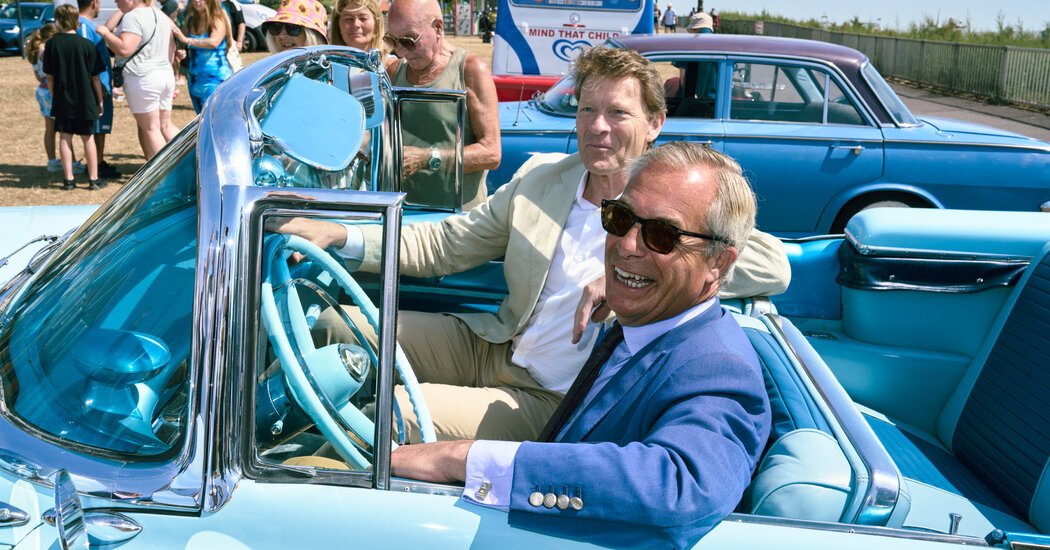
I watched for Mr. Farage all of that hot Saturday but didn’t see him. I left early that evening to catch a train home to Cornwall. The following day Harry Mitchell, the photographer I’d been working with, bumped into Mr. Farage at an event for veterans. He was wearing a suit and sunglasses and was surrounded by bodyguards.
This is how elections are so often fought now. Politicians slink into a constituency to meet fans, make content for their social media and melt away. It’s an unserious politics for a time of decadence. And it’s not about Clacton. The election there is a proxy contest, fought with competing dreams.
Most likely, Mr. Farage will win easily on Thursday: The Survation poll had him at 73 percent. (He won 46 percent in 2024.) Then he will again face the Parliamentary Standards Commission. There could be yet another by-election in Clacton. He could run again.
But Mr. Farage will not heal Clacton — or Britain. Like the man with the trash can on his head, Mr. Farage is a symptom of our fragile, febrile times. He is here to make the most of his time in the too-hot sun.