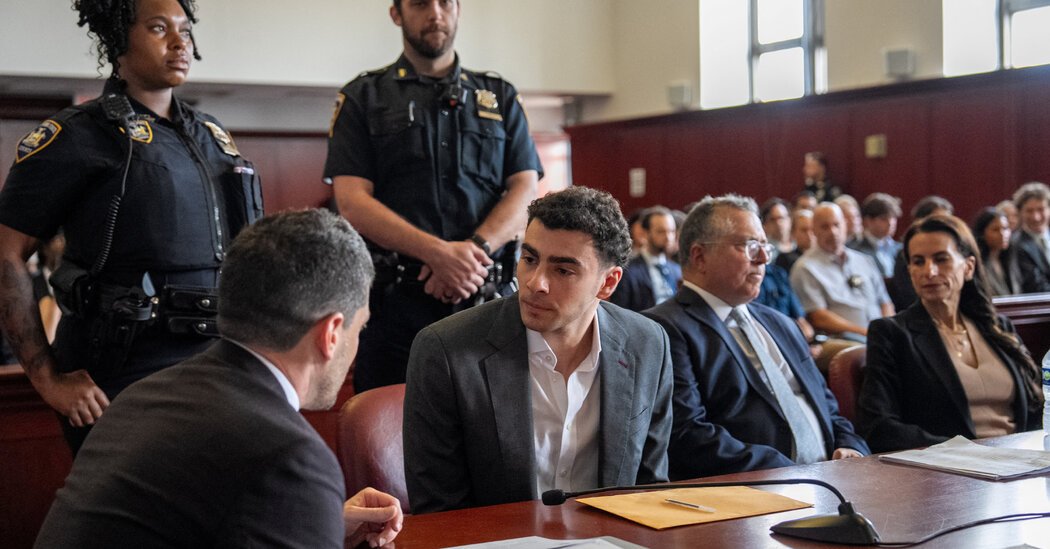
Luigi Mangione is expected to plead guilty on Friday in Manhattan federal court, where he faces charges of stalking resulting in the death of a health insurance executive in 2024, according to two people with knowledge of the matter.
Mr. Mangione was set to go on trial in federal court in January for the stalking charges in connection with the killing of Brian Thompson, the chief executive of UnitedHealthcare, charges that carry a potential life sentence. Mr. Mangione is not charged with murder in the federal case. The two people spoke on the condition of anonymity because of the sensitive nature of the ongoing talks, which could fall apart before or even during a scheduled hearing in federal court on Friday.
The potential plea in the federal case comes less than a month before Mr. Mangione, 28, is scheduled to go on trial on a state murder charge on Sept. 8 for Mr. Thompson’s killing.
Mr. Mangione’s legal team did not respond to a request for comment. When asked at an unrelated news conference on Wednesday about a potential plea, Jamie McDonald, the top federal prosecutor in Manhattan, said there was a court conference scheduled for Friday, adding, “That’s all we can say at this time.”
Mr. Mangione has pleaded not guilty to all charges against him, in both federal and state court.
Mr. Thompson’s killing on one of the most congested patches of America — Midtown Manhattan — and the five-day manhunt that followed riveted the country, leaving many people horrified, but others rallying to support a gunman who some saw as protesting the nation’s health insurance industry.
It was unclear what charges Mr. Mangione would plead guilty to on Friday, and he could reverse his decision at the last minute, even during the court hearing itself.
The impact of a federal plea on Mr. Mangione’s state murder case also remains in question. His lawyers could seek dismissal of the state charges on double jeopardy grounds, which bars someone from being tried twice for the same offense — arguments the Manhattan district attorney’s office is likely to vigorously oppose.
Both the federal and state cases have narrowed over time. In January, the federal judge, Margaret Garnett, dismissed two other charges in Mr. Mangione’s federal case, including one that carried a potential death penalty if he was convicted.
Last year the judge overseeing the state case, Gregory Carro, dismissed a state terrorism count, saying the evidence behind it was “legally insufficient.” The remaining state charges include second-degree murder, which could lead to a possible sentence of 25 years to life.
The dueling cases have led to disquiet between President Trump’s Justice Department and the office of the district attorney, Alvin L. Bragg, the only prosecutor to win a conviction against Mr. Trump.
When Mr. Mangione was first charged in federal court during the last weeks of President Joseph R. Biden Jr.’s term, the U.S. attorney’s office said it expected Mr. Bragg’s office to try the state case first. But shortly after Mr. Trump took office, his Justice Department signaled it would accelerate the pace, announcing quickly it would seek the death penalty for Mr. Mangione, a decision that usually takes many months to make.
Since then, the state and federal prosecutors have seemingly been jockeying to try Mr. Mangione first.
If the federal plea happens on Friday, legal experts say, Mr. Bragg’s office could argue that it can still prosecute Mr. Mangione because the state charges addresses a different harm — murder — than the federal stalking case.
Mr. Bragg’s office raised the double jeopardy issue last month after news reports surfaced about the possibility of a federal guilty plea.
A state prosecutor, Joel Seidemann, suggested in a July 2 letter to Justice Carro that Mr. Bragg’s office would object if a proposed federal guilty plea “would operate to defeat a just outcome in the state prosecution.”
Mr. Seidemann said the district attorney’s office would want Judge Garnett, to “consider that fact in deciding whether to accept that plea.” He said the office had advised Mr. Mangione’s federal prosecutors and his defense team of its position.
“Any guilty pleas in these matters must account for the seriousness of defendant’s offenses, the loss of an innocent life, the impact of those crimes on the victim’s family,” Mr. Seidemann wrote in the letter.
Mr. Mangione’s defense team, led by Karen Friedman Agnifilo, argued from almost the moment he was charged by state and federal authorities in December 2024 that the dual prosecutions violated his rights.
In a motion filed in Manhattan State Supreme Court, the defense called the parallel prosecutions “so constitutionally fraught that we are hard-pressed to find precedent for such an unprecedented situation.”
“The state and federal prosecutions relate to identical facts,” the lawyers wrote, adding that the offices were “trying to get two bites at the apple to convict Mr. Mangione.”