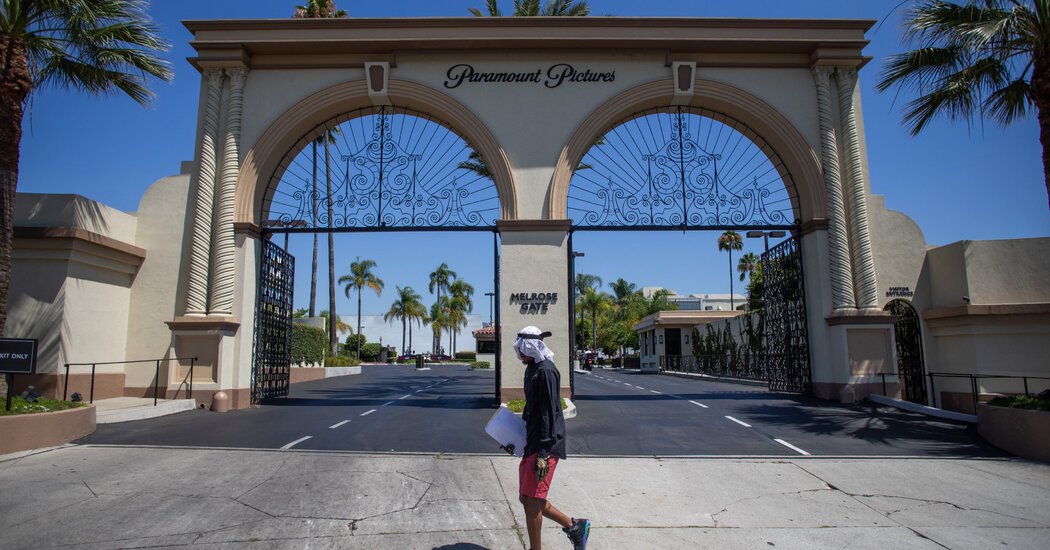
Paramount asked a federal judge on Monday to force the opponents of its acquisition of Warner Bros. Discovery to cover the costs of the delay created by their lawsuit seeking to block the deal.
The Hollywood studio is seeking a $1.88 billion bond from 12 states, led by California, along with the Writers Guild of America, which have sued to stop the company’s deal to acquire Warner Bros., citing antitrust concerns. Paramount proposes that it would collect the proceeds from the bond if the states lost their case.
Paramount’s merger with Warner Bros. would create a media powerhouse combining two major movie studios, multiple streaming services and the news networks CNN and CBS News.
Twelve state attorneys general sued last month to block the deal, arguing that the company would have outsize market power.
In July, Judge Araceli Martínez-Olguín of the U.S. District Court for the Northern District of California temporarily halted the merger to consider the lawsuit. She later scheduled a trial for March, a delay that could put Paramount on the hook to pay Warner Bros. shareholders hundreds of millions of dollars.
As part of its deal with Warner Bros., Paramount must pay $650 million every quarter if the transaction has not closed by Oct. 1. Paramount proposed the fee in an effort to win the support from shareholders, who were also considering a rival bid from Netflix at the time.
Because Paramount offered that fee, Judge Martínez-Olguín is unlikely to grant the company’s request, said Bill Kovacic, a former Republican chairman of the Federal Trade Commission.
“Maybe they thought that a lawsuit by the states was a one-in-100-years event and thus was exceedingly unlikely — about the odds of getting struck by lightning,” Mr. Kovacic said. “But they knew that it was possible.”
Paramount has argued that the deal would create necessary scale to compete against large technology companies, like Netflix, that have moved into the traditional media industry. The deal has already secured clearance from the Justice Department and dozens of countries and regions globally.
“Every month of delay carries substantial and quantifiable financial consequences,” Paramount said in a statement.
“By virtue of what will be at least an eight-month delay in closing, there will be no integration and no ramped-up investment in content, production and creative talent by the combined company,” the statement said. It added that the uncertainties caused by the delay harmed employees of both companies.
Paramount may also be trying to lay the groundwork for a swift appeal on the bond request, Mr. Kovacic said, adding that a ruling on the matter could ultimately reflect on the underlying credibility of the states’ case. In addition, if Paramount needs to appeal the trial verdict next year, the company could argue that it was denied an important measure of relief by the lower court.
David Ellison, Paramount’s chief executive, has also told his senior executives that he would begin moving the company out of California on Oct. 1 if there was no progress toward resolving the lawsuit.
Seamus Hughes contributed research.