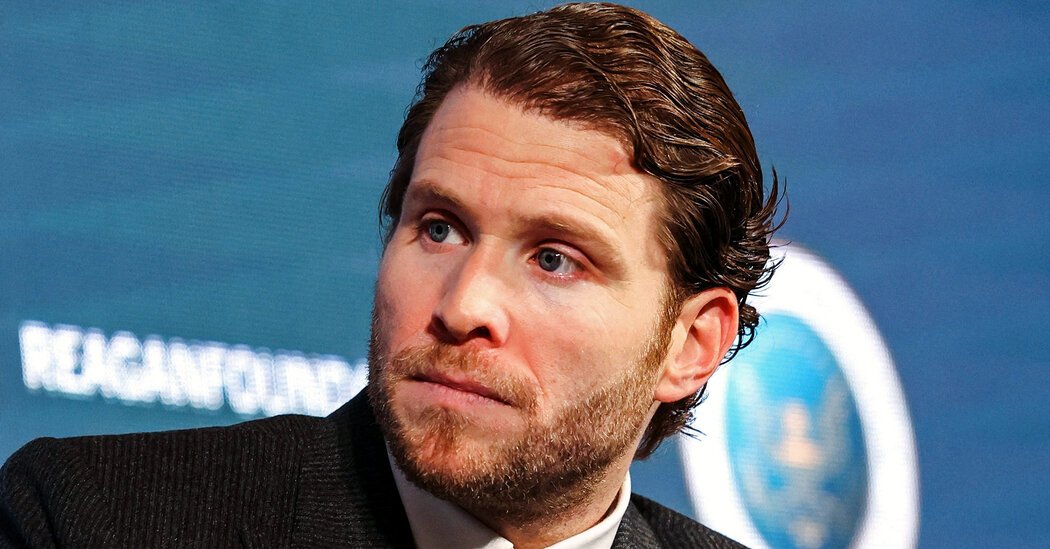
A team from the Cicero Institute, an upstart think tank, flew to Indiana this year to help make it a crime for homeless people to sleep on the street.
It was their third attempt. Even in the conservative state, previous efforts to ban street camping had failed. Catholic leaders said the measure would hurt the poor, and sheriffs had warned that arrests would crowd the jails. “We’re Hoosiers — we’re better than that,” a Republican state senator, Ron Alting, said last year, urging a more caring approach.
But much had changed since the group, founded by Joe Lonsdale, a billionaire ally of President Trump’s, had made its initial efforts. Mr. Trump had issued an executive order on homelessness that so fully reflected Cicero’s agenda it was hard to tell where the group stopped and White House policy began. The sponsor of the Indiana law was fresh from a Cicero conference, Cicero lobbyists worked the bill, and three Cicero analysts testified that the threat of arrests would push homeless people into treatment for mental illness or addiction.
The ban passed just before the legislature adjourned.
With homelessness near record levels, Republicans have embraced tough measures to clear the streets, and no group has led the way more than the Cicero Institute. Mr. Lonsdale formed the institute eight years ago with vague goals — to promote “liberty, accountability, and transparency” — and no mention of homelessness. Now it has commandeered Republican homelessness policy, upending debate over an intractable problem with life-and-death stakes and showing how rich donors can shape the safety net.
Twenty-one states have considered camping bans or other Cicero-backed homelessness laws in recent years, and 16 have passed them. But the group’s sway goes further: It is working with the Trump administration to transform federal homelessness aid away from housing subsidies and toward the forced treatment of substance abuse or mental disorders.
Echoing Cicero’s thoughts and at times its very words, the administration says federal policy, called Housing First, neglects the root causes of homelessness by providing rental subsidies but leaving treatment optional. Opponents of Mr. Trump’s plan, which is blocked in court, say that forced treatment fails and housing aid gets people off the street.
Substantial evidence shows that Housing First succeeds in getting the chronically homeless housed, at least in the short term. But it is expensive, and the evidence also shows it has not consistently improved mental or physical health or lowered death rates. The treatment-first approach that Cicero favors has not been rigorously studied.
For many years, Housing First enjoyed bipartisan consensus; the first Trump administration took office embracing it. Cicero has helped make it a conservative epithet. “Obviously, our work has been one of the main influences” in shaping administration views, Mr. Lonsdale said in an interview.
The White House and the Department of Housing and Urban Development declined to comment on Cicero’s influence.
A co-founder of Palantir, the data-mining firm, Mr. Lonsdale, 43, is an unlikely force in homelessness policy. He brings to it vast wealth but no experience with homeless services and a distrust of conventional expertise. He argues that his outsider’s perspective gives him and the young generalists he hires a fresh view.
A pugnacious presence on social media — he recently called for public hangings of repeat violent offenders — Mr. Lonsdale said he is fighting in part to defend “capitalist society.” He argues that a corrupt “homelessness industrial complex” dominated by liberal social service groups wants to increase homelessness to discredit society.
“Some of them are cynical Marxists who clearly want mayhem and want to show that our civilization is broken,” he said.
Many on the left return the scorn, calling Mr. Lonsdale an emblem of the inequality that creates homelessness — a billionaire fighting a reverse class war to preserve an unjust order.
“He’s using the homelessness crisis to deflect attention from the broken economic system that both causes homelessness and enables people like him to become billionaires in the first place,” said Jesse Rabinowitz of the National Homelessness Law Center, a progressive advocacy group.
As Mr. Lonsdale taps his fortune to shape views, it is easy to see a story of money and politics. But it is also a story of public fatigue. With unsheltered homelessness up more than half in a decade to about 266,000 people, Cicero succeeded in part by putting the status quo on trial.
A signature Cicero line is that there is “nothing compassionate” about leaving people on the street. Echoed by Mr. Trump, it may send an army of marginalized people down an untested path.
Banning Public Sleeping, State by State
Asked why he focused on homelessness, Mr. Lonsdale often begins by saying that a homeless person harassed his wife as she pushed their child in a stroller in San Francisco. “She just got screamed at, multiple times, and threatened by someone who has clearly lost their mind,” he said in an interview.
But Mr. Lonsdale’s conservatism took root much earlier. He cites Ayn Rand and Austrian free-market economists as teenage influences and used his perch as editor of The Stanford Review, a conservative publication, to assail “political correctness.” He blasted a student movement to raise custodians’ pay, warning it “destroys incentive for them to improve themselves.”
The magazine’s alumni include Peter Thiel, the libertarian investor who helped start PayPal, where Mr. Lonsdale landed an internship and found a mentor. They helped start Palantir in 2003 when Mr. Lonsdale was 21. He left after six years and became a tech investor. Forbes now estimates his fortune at $3.5 billion.
The subject of homelessness never arose in 2019 when Mr. Lonsdale hired Cicero’s first analyst, Judge Glock, who tackled technocratic topics like zoning laws and published into a vacuum.
Then Mr. Glock turned to encampments and interest surged. “The one thing that took off was homelessness,” he said.
Mr. Lonsdale left San Francisco for Austin in 2020, but encountered another homelessness crisis. The City Council had lifted a camping ban, encampments were growing, and Mr. Lonsdale gave $40,000 to a ballot measure drive to bring the ban back. Even in liberal Austin, the measure passed easily.
With few rival groups working on homelessness, the institute had its lane. After Texas passed a statewide camping ban in 2021, Cicero made it into a model bill to take to other states.
Cicero was too small to matter in Washington, but about two dozen states had Republican control of the legislature and governorship. For harried legislators frustrated by encampments, Cicero’s bill offered a stance. And with no housing or services included, it required no spending.
“In most states, state legislators don’t even have policy staff,” explained Jared Meyer, an early Cicero recruit, on Mr. Lonsdale’s podcast. “The best thing you can do is be an outsourced staff.”
Cicero first found success in Missouri, where a measure to create a camping ban succeeded as part of an unrelated bill the governor signed.
“We did it,” Mr. Lonsdale wrote.
A win in one state — any state — built momentum. By the time Missouri’s supreme court reversed the law on procedural grounds the following year, Cicero was on its way. Florida, Idaho, Kentucky, Louisiana, Mississippi, Oklahoma and Utah were among the states where camping bans followed.
Success flowed in part from Mr. Lonsdale’s wealth. Together with a nonprofit lobbying arm, Cicero Action, the institute hired lobbyists, commissioned polls, made political donations and invited lawmakers to study tours. Mr. Lonsdale’s personal company gave $1 million in 2024 to a PAC that supported Mr. Trump.
Declining to say how much he spends on Cicero, Mr. Lonsdale called it “well less” than $15 million a year and called the sum “very small” for the clout it brings.
But Cicero’s influence also grew because the problem got worse. In Kentucky, where Republicans passed a Cicero bill in 2024 over a Democratic governor’s veto, unsheltered homelessness had more than doubled in five years.
The head of the group’s homelessness work, Devon Kurtz, is a 28-year-old Quaker with a background in prison ministry and often appears as earnest as Mr. Lonsdale can be caustic. His claim that camping bans save lives by encouraging treatment has drawn retorts from many in the field, who say that there is no evidence to support it and that treatment is in short supply.
“It’s frankly absurd,” said Dr. Margot Kushel, a physician who directs the Benioff Homelessness and Housing Initiative at the University of California, San Francisco. “People are desperate for treatment and can’t get it.”
Since Mr. Trump cut Medicaid, which helps finance treatment, “it’s hard not to see the cynicism in this,” she added.
But Mr. Kurtz says many homeless people need the push that the threat of fines or arrest can provide. “They need that accountability; they need that supervision,” he said.
Finding Sway in Trump’s Washington
Though Cicero rose by focusing on states, Mr. Trump’s re-election expanded opportunity: Most homelessness policy and money come from Washington.
By congressional design, most of the $4 billion a year that the government spends goes to Housing First — long-term rental aid with voluntary treatment. Cicero wanted the opposite, temporary “transitional housing” (capped at two years) with treatment mandates.
During the campaign, Mr. Trump had released a seething video that pitted “dangerously deranged” people who “squat and do drugs” against “hard-working, law-abiding citizens.” Still, new policy was slow to emerge. Scott Centorino, who worked on homelessness issues at the White House Domestic Policy Council, later offered an explanation: The council wanted guidance from groups “in the trenches” like Cicero.
“We didn’t know what to do about it from a federal level,” he said at a closed-door Cicero conference in June, which an attendee taped. “We didn’t have somebody in our team, and I’ll include myself in this, who had a really strong grasp of what the federal authorities were in this space.”
In helping draft the executive order, he consulted with Cicero “to kind of bring you a sense of what the solutions might be.”
Asked about the comment, Mr. Centorino — who is now a Cicero Institute fellow — said in an email he also consulted with federal homelessness officials and other outside groups.
If there was doubt of Cicero’s influence, Mr. Trump’s order dispelled it. Cicero rejected Housing First. The order pledged to end it. Cicero wanted camping bans. The order vowed to enforce them. Cicero wanted more civil commitments of people with mental illnesses. The order endorsed the idea seven times. A few years earlier, Mr. Lonsdale expressed regret that people hesitated to call the homeless “vagrants and bums.” Mr. Trump directed his order at “fighting vagrancy.”
Ann Oliva, the chief executive of the National Alliance to End Homelessness, an advocacy group, called the order “the most harmful policy proposal on homelessness in my career.”
A few months after the executive order, HUD issued an annual document called a Notice of Funding Opportunity. It had long been the lifeblood of Housing First, directing about 90 percent of homelessness aid to long-term housing. Following the principles in Mr. Trump’s order, HUD sought to move two-thirds of the money to time-limited programs with work rules or treatment mandates.
Mr. Lonsdale exulted.
“A lot of the permanent bureaucracy is in the hard left,” he said in an interview soon after. “We’re stopping them from doing it their way and forcing them to do it a different way.”
Opponents sued, arguing that only Congress could alter the program so profoundly and warning that as many as 170,000 formerly homeless people could lose housing. A federal judge blocked the initial plan and a revised version (which cited Cicero four times), both times on procedural grounds. HUD is appealing. In the meantime, the money has been dispensed under pre-Trump rules.
“Housing First has fueled a self-serving homeless industrial complex,” and “enabled dangerous encampments and addiction,” Scott Turner, the HUD secretary, said in a statement.
Dennis Culhane, a homelessness scholar at the University of Pennsylvania, contends the opposite, saying the problem is a shortage of Housing First funds.
Examining a year of national shelter data, he found that only 13 percent of the chronically homeless got housing aid. By contrast, 48 percent of veterans got housing, due to a veterans program with much greater funding that operates on Housing First principles. Veterans homelessness has dropped by more than half since 2010.
“If Housing First didn’t work, we wouldn’t have seen that success,” Professor Culhane said. “But outside of veterans, we’re greatly underfunded.”
Mr. Kurtz sees little need for rental subsidies, arguing “most people can pay their bills.” Professor Culhane said the idea that homeless people do not need housing aid was “a radical assertion that runs contrary to experience and common sense.”
Holdouts Give Way
When Mr. Kurtz returned to Indiana in January for a third effort to ban sleeping in public, the arguments were the same, but the politics had changed: Mr. Trump’s order had labeled the issue a presidential priority. The governor, Mike Braun, backed the ban. Resistance would be noticed.
The Senate sponsor, Cyndi Carrasco, had recently returned from a Cicero conference and presented the bill in Cicero terms. “It is not compassionate to allow our neighbors to die on the street,” she said. (She declined an interview request.) Mr. Centorino, now with Cicero Action, told lawmakers the bill was a “compassionate step.”
Still, the bill would not have cleared the Senate if a handful of Republicans had not changed their minds.
The most surprising was Mr. Alting, the senator who had told colleagues the previous year that a camping ban would pass “over my dead body” and that “Indiana was better than that.”
Mr. Alting declined interview requests. In the Senate, he said that the governor had pledged funding if mental health needs grew in jails. Mr. Alting called the promise a “game changer.”
Mr. Kurtz found the victory especially satisfying. Not long ago, he noted, Republicans had little to say about homelessness policy. Now they had detailed plans, an effective message, and an ally in Mr. Trump.
He credited his boss, the founder of the Cicero Institute.
“If we were to think about the conservative position on homelessness even in the first Trump administration, it’s quite unclear,” Mr. Kurtz said. “Joe Lonsdale articulated the conservative position on homelessness.”
Georgia Gee and Ryan Mac contributed reporting.