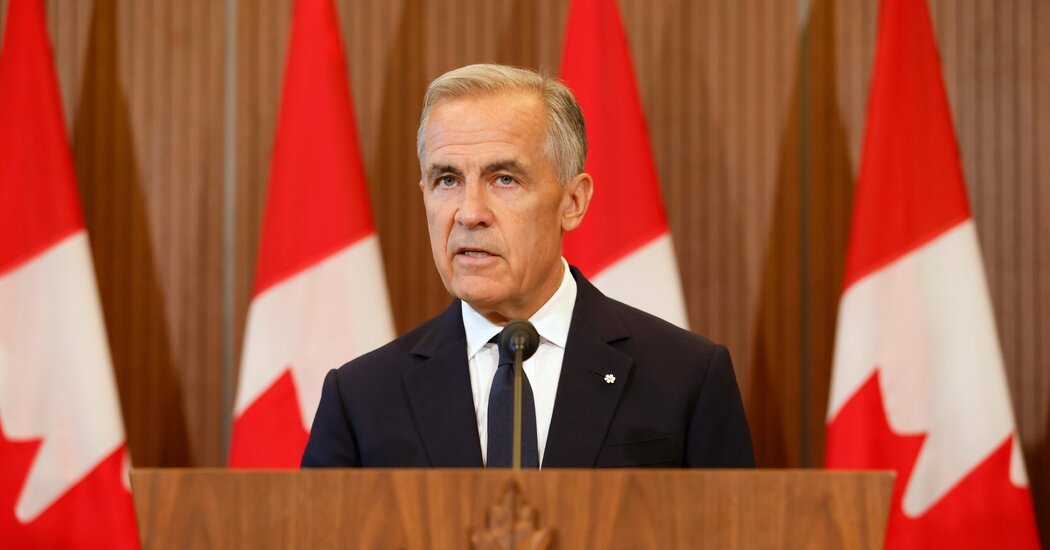
The morning after he pulled negotiators from trade talks in Washington and set off a new round of American tariffs, Prime Minister Mark Carney called the U.S. proposal “a bad deal” and said Canada was “at war” with the United States.
“We’ve recognized from the start that America has changed,” he said in an address to Canadians on Saturday. “We recognize that sometimes, its signature is written in pencil.”
“We cannot accept what they offered and we will not give what they asked,” he added. “We were not prepared to compromise Canada’s sovereignty or undermine our key industries.”
In a muscular, 22-minute speech that let Canadians — and Americans — know exactly where he stands, Mr. Carney said that Canada was under attack by President Trump’s punishing tariffs.
“You’re at war when you’re attacked, and we got attacked,” Mr. Carney said.
But unlike his electrifying speech at Davos that spoke of a rupture in the world order, Mr. Carney explicitly named the United States as an aggressor and a threat to Canada and the global economy.
The latest U.S. tariffs, he said, “are designed to hurt and divide us. They are a miscalculation because Canadians will always take care of each other. We know we’re stronger together.”
On Friday night Mr. Carney blamed unspecified last-minute demands for the collapse of negotiations, saying that they were “unfair, uneconomic and called into question the reliability of any deal.” Minutes later, the United States went ahead with previous plans and introduced 50 percent tariffs on $20 billion worth of Canadian exports.
Mr. Carney immediately promised that Canada will retaliate “dollar for dollar.”
On Saturday, he said that American negotiators “asked too much and offered too little.”
“We were close to reaching a comprehensive agreement with the U.S., but they made changes, including threats on French language and culture and Canadian culture that would never be acceptable for that reason,” Mr. Carney said in French. “That marked the end of that stage of negotiations.”
Mr. Carney added that the United States wanted Canada to align its trade policies toward other countries with American tariffs, something he called “a power play” and “a question of sovereignty. ”
During negotiations, Mr. Carney said, the U.S. side also refused to budge on including Canadian as well as American parts when calculating tariff payments on Canadian autos, and refused to reduce the rate for heavy trucks. It also offered little for companies that make products the United States deems to be primarily aluminum or steel — a category that ranges from antennas to snowmobiles. Those products currently face 25 percent tariffs.
The prime minister’s decision to stand up to President Trump and walk away from negotiations is the latest fracture in the once-close ties between the countries. The relationship has drastically deteriorated since Mr. Trump returned to office, where he has targeted Canada with tariffs, insulted its leaders and repeatedly proposed that it be annexed as the 51st state.
Mr. Trump’s trade actions and slights have prompted widespread anger and fear among Canadians.
The trade negotiations began in late July, in a bid to ward off new tariffs and to reverse or at least reduce U.S. tariffs of up to 50 percent on the key auto, steel and aluminum sectors that were introduced last year.
As he did on Friday night, Mr. Carney suggested on Saturday that Canada would now double down on its strategy of disengaging from the U.S. economy, expanding trade with other countries and diversifying Canada’s economy.
“Last spring, I warned that America is trying to break us so that they can own us and I promised: ‘That will never, ever happen,’” Mr. Carney said. “We are keeping that promise. Canada is becoming stronger and less dependent on America.”
Unlike the previous tariffs, the new U.S. measures affect a more varied array of business sectors, although they disproportionately target building materials like plywood as well as tissue used for toilet paper, which are significant exports for the forestry industry. Canadian alcohol is also singled out.
The new American tariffs only cover a small portion of the $382 billion worth of products the United States imported from Canada last year, in part because they conspicuously avoid oil, gas and electricity imports. They also avoid potash, a key fertilizer not mined in large quantities in the United States.
But many of the items hit with tariffs, like men’s suits and honey, are often made by small to midsize companies that will likely be unable to withstand any significant loss of business.
Trevor Tombe, a trade economist at the University of Calgary in Alberta, estimates that the new tariffs could cost upward of 90,000 jobs in Canada.
Mr. Carney promised 25 billion Canadian dollars in financial assistance to affected companies.
Exactly how Canada could retaliate without creating further headaches for Canadian businesses was not clear. Many manufacturers in Canada rely on supplies and materials which generally cannot be readily or economically purchased elsewhere. Canada’s much smaller economic footprint also limits its ability to inflict significant economic pain on the United States.
Mr. Carney said that Canada was moving ahead on retaliation “reluctantly, because we recognize that it will raise costs and reduce choice for Canadians. Reluctantly, because we recognize that some U.S. companies and states are innocent bystanders in a dispute they did not want.”
He added: “We take this step confident that it is in the best interests of Canada and that by rejecting a bad deal, by standing up for Canada and by focusing on what we can control, we will build Canada strong for all.”
Mr. Carney said that Canada’s retaliatory tariffs will come into effect on Sept. 8 and will be focused on “steel, dairy, appliances, agricultural equipment, pulp and paper, electronics.”
Jamieson Greer, the U.S. trade representative, said on Fox News on Saturday morning that the Trump administration was “moving forward with measures that respond to Canadian retaliation.”
Doug Ford, the premier of Ontario, the most populous province, urged Mr. Carney to look at using oil, gas and electricity as trade weapons in a letter this week. Mr. Carney previously downplayed that idea, saying it would jeopardize Canada’s reputation for reliability.
But polls show widespread support for export taxes on energy. On Saturday, after outlining the United States’ energy dependence on Canada, Mr. Carney added: “I don’t think they want us to stop sending it.”
Mr. Ford also spoke in defiant terms. “We never started this fight but I assure we’re going to win this fight,” he told reporters on Saturday, saying he was happy that Mr. Carney refused to sign a deal that could hurt his province’s automobile and steel sectors.
“We have to make sure that as Donald Trump is trying to inflict pain on every Canadian that we inflict pain right back, until he realizes that we are his number one customer in the world,” the Ontario premier said. “We have to make sure we look at every single asset we have, if it’s critical minerals, steel or nickel, everything is on the table.”
Mr. Carney said that the free trade agreement between Canada, the United States and Mexico was “being violated day in, day out” by the Trump administration. On July 1, the United States declined to renew the pact for another 16 years, putting it on a year-by-year basis.
Asked on Saturday what the American actions mean for the renewal of the agreement, Mr. Carney said, in French: “It certainly isn’t good news.”