Just hours after Prime Minister Andy Burnham of Britain arrived in Kyiv Monday for his first foreign trip since taking office, Russia issued yet another darkly-worded statement.
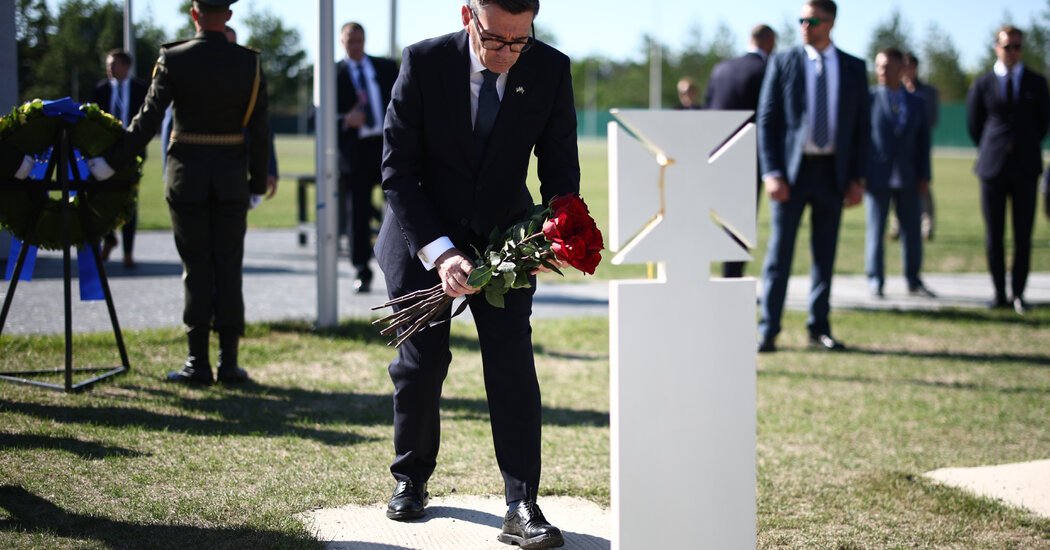
Britain has been “hell bent on pouring oil on a fire and plotting to prevent any kind of peace process,” Dmitri S. Peskov, the Kremlin spokesman, said, as Mr. Burnham affirmed his support for Ukraine in a speech and placed red roses at a military cemetery.
Mr. Burnham, 35 days into his tenure as prime minister, appeared unfazed. He announced the delivery of technical blueprints that will allow Ukraine to assemble long-range missiles. Asked to respond to Mr. Peskov’s comments, he shot back: “Who started the fire? That’s the question, isn’t it?”
Mr. Peskov’s comments were the latest in an escalating series of rebukes and threats from Russia aimed at the British government and its new prime minister, Mr. Burnham. Last week, Moscow warned Britain that the use of British-made drones in attacks on Russia would lead to “consequences for which it will have to answer.”
Last month, Russia pulled its long time ambassador out of its embassy in London, leaving the diplomatic post in the hands of a career official, saying that relations with Britain had “deteriorated to an unprecedentedly low level.”
Political officials and military experts say there is little risk that the heated rhetoric will lead to a direct, military clash. But the intensity of the Russian commentary has prompted deep concern about the likelihood that President Vladimir V. Putin of Russia will order new episodes of sabotage, cyberattacks, maritime harassment and intelligence operations.
“We’ve bypassed every Russian red line there is,” said Al Carns, a Labour Party member of Parliament who served until recently as Britain’s armed forces minister and is an ex-Royal Marine officer.
“We need to continue to stand up for what is right,” he told The New York Times on Monday. “What is right is continuing to defend Ukraine’s sovereignty with everything we have.”
David Cattler, a former senior official in the U.S. intelligence community and NATO assistant secretary general for intelligence and security, warned that Russian operations that target Britain’s infrastructure could cause an escalation that neither side wants.
“Russia doesn’t need to decide to go to war with the U.K. to take actions that increase the risk of one,” he said.
Relations between Britain and Russia have been tense for years, dating back to the poisoning of Sergei and Yulia Skripal in the English town of Salisbury, not far from Stonehenge. In 2018, Mr. Skripal, a double agent for British intelligence, and his daughter were nearly killed with a nerve agent called Novichok, in a brazen attack that rattled many people in the country.
A British woman died from exposure to the military-grade poison after the botched assassination attempt.
In the wake of the attack, Britain expelled 23 Russian diplomats and has since denied scores of diplomatic visa applications.
More recently, the Kremlin has waged a campaign of violent sabotage across Europe that British intelligence officials have denounced in speeches. The navies of Russia and Britain have had several tense standoffs in the English Channel and the North Sea.
Last year, a cyber attack against Jaguar Land Rover, a crown jewel of British manufacturing, cost the country’s economy $2.5 billion. A group of Russian hackers was responsible, five people familiar with an investigation into the attack told The New York Times.
“Russia’s relationship with Britain is shaped by a long history of hostile intelligence activity, sabotage, targeted assassinations, and other forms of gray-zone confrontation,” said Natia Seskuria, a senior fellow at the Royal United Services Institute, a defense research group in London. “By issuing threats, the Kremlin reinforces the narrative that Russia is fighting an existential struggle against the West.”
During the last four years, Britain has repeatedly pushed for a cease-fire in the war, which began when Russia invaded Ukraine in 2022. But those efforts have faltered as the United States seized control of the peace process and then appeared to disengage from it.
On Monday, the British prime minister stood next to President Volodymyr Zelensky of Ukraine in a plaza beside an Orthodox cathedral. Mr. Burnham and other European leaders were there to celebrate Ukraine’s fifth Independence Day since Russia invaded, a vivid measure of Ukraine’s determination to withstand an assault that many had expected Moscow to win within days.
”This is the moment to keep up the pressure on Russia,” Mr. Burnham said in a speech from Sofiivska Square.
As a demonstration of that resolve, Mr. Burnham announced that Britain had agreed to a request from Mr. Zelensky to provide classified details that would allow production of a long-range missile at factories inside Ukraine.
The missile, jointly built with France, is known as the Storm Shadow in Britain. Officials said that giving the technical plans for the missile’s British-made components to Kyiv would let Ukraine and France build the French version, known as SCALP, on assembly lines near the front.
Mr. Burnham personally presided on Monday over a meeting, partly virtual, of the “coalition of the willing,” a group of leaders who have pledged support for Ukraine.
The new arrangement follows another effort called Project BrakeStop, in which Britain is developing low-cost weapons capable of deploying a powerful warhead against Russian targets as far away as about 300 miles.
In remarks released by video on Monday, Mr. Zelensky underlined that Ukraine and its allies needed to do “more,” a word that appeared a dozen times in his remarks. Ukraine, he said, needed to field more drones, in the air, on the ground and at sea. It needed to sink more Russian ships and strike more oil refineries to pressure Moscow to end the war.
Douglas Barrie, a senior fellow for military aerospace with the International Institute for Strategic Studies, said Ukraine’s ability to produce the new missiles within its borders was a notable change in its capabilities.
“Any impact, however,” he said, “will in part depend on how quickly Ukrainian-assembled SCALP cruise missiles can be introduced into service.”
Ukraine is in dire need of defenses amid a shortage of Patriot missile interceptors. But President Trump has backed away from an earlier promise to provide the technology to make them.
The European Union’s executive arm said on Monday that it would earmark 6.1 billion euros for air and missile defense systems, missiles, ammunition and radar. The money comes as part of a 90 billion euro loan that the bloc is rolling out this year and next.
Ursula von der Leyen, president of the E.U. executive arm, said on social media that Europe would stand with Ukraine “for as long as it takes.”
Katarina Mathernova, the European Union’s ambassador to Ukraine, told reporters on Sunday night as she traveled for the coalition meeting that the mood in Ukraine had “darkened” this summer amid targeted Russian attacks on civilians.
She noted that the war seemed to be moving into a new phase in which both sides tried to inflict serious economic damage on the other. Russia is choking off Ukraine’s grain exports through the Black Sea, and Ukraine is targeting economic actors, such as Wildberries, a company that is Russia’s equivalent to Amazon.
Constant Méheut contributed reporting from Kyiv.