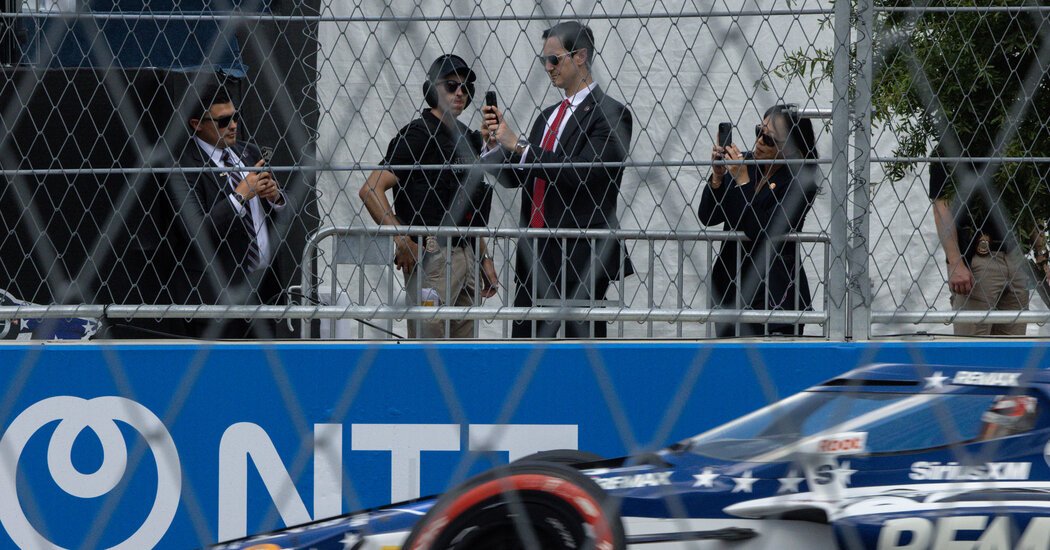
Two weeks ago, the State Department invited foreign ambassadors to what looked like one of the premier diplomatic events of the Washington summer: a V.I.P. zone at President Trump’s IndyCar race last Sunday.
The dignitaries would be brought by bus to the “Freedom 250” track set up in downtown Washington, according to emails that two diplomats shared with The New York Times. The invitation promised free food and drinks and “shaded seating areas with misting fans.” The dress code was “summer chic/golf attire.”
Then on Saturday evening, some embassies received another email. “Due to changes by the event organizers,” it said, the V.I.P. invitation was off.
The State Department apologized to the embassies and offered them general admission tickets instead. And several senior diplomats from countries including Germany and Monaco still got V.I.P. treatment. But to some of the disinvited foreign officials, all of whom spoke on condition of anonymity for fear of offending their host government, the episode was the latest sign of the Trump administration’s lack of interest in traditional diplomacy.
One senior diplomat said they had cut short a vacation to be in Washington for the race, seeing attendance as “part of my duty.” Another described the last-minute change as particularly frustrating because embassies had been told on Friday — a day before the cancellation email — that ambassadors could bring plus-ones. And another said they had missed the Saturday evening email and arrived at State Department headquarters at 9 a.m. on Sunday, only to be told, along with several other diplomats gathered in the Harry S. Truman Building lobby, that they were no longer invited as V.I.P. guests.
Jeremy Shapiro, a former State Department official who is the research director of the European Council on Foreign Relations, said the incident fits into a pattern of signals that the Trump administration “just doesn’t really care very much” about what “not just diplomats, but other countries, think of them.”
“If it was isolated, it wouldn’t mean anything,” said Mr. Shapiro, who had not heard of the IndyCar episode before it was described to him by a reporter. “But because it’s part of a much larger pattern that goes much higher and reaches into much more consequential areas, I’m sure it will, in its own small way, reinforce that.”
Ambassador Maguy Maccario Doyle of Monaco, who did get to attend, called the race a “remarkable showcase for Washington.” She said in a phone interview that she was surprised to hear that some other diplomats were disinvited because “there was space left” in the suite.
“We were not on top of each other at all,” she said, estimating that about 20 diplomats attended.
It was unclear how the decision was made on who made the cut, or how many diplomats were disinvited. Several who were disinvited asked that their countries not be identified to avoid antagonizing the White House. Those officials received an email Saturday evening with the subject line “Important event update” in all capitals.
“Due to changes by the event organizers, we are no longer able to provide expediated entry into the racetrack or provide access to a hospitality zone,” the email said, with a typo. “Chiefs of Mission should make their own transportation arrangements to and from the racetrack.”
It said that ambassadors could instead use the Ticketmaster smartphone app to receive two free general admission tickets to the race, adding: “We sincerely apologize for the last-minute changes to the event.” At least one said he took up the offer, setting aside the blazer he had planned to wear to comply with the “summer chic” dress code.
A State Department official said in a written statement that the last-minute switch for those diplomats who had to settle for general-admission tickets was “due to a change imposed by private event organizers.” The official also said that “foreign ambassadors have benefited from extraordinary access through official and private engagements” during the Trump administration, “including a full slate of events and celebrations related to America’s 250th.”
Sunday’s race was put on by Penske Corp., the owner of the IndyCar racing series. While the race was privately funded, it had the imprimatur of Mr. Trump, who signed an executive order in January directing it to take place and took a lap around the course in his limousine before it began.
Penske recouped some of the cost by selling 78 V.I.P. suites at the race that could offer access to administration officials, seat 30 to 40 people and cost $200,000 each, according to The Athletic. The race organizers announced on Aug. 14 that the luxury suites surrounding the 1.7-mile race circuit around downtown Washington would feature “premium food and beverage options” as well as “executive restrooms located on all three floors.”
It was the day before that announcement, on Aug. 13, that several embassies received their invitations to watch the race from “a climate-controlled hospitality suite.” It included a gold U.S. seal and the Freedom 250 Grand Prix’s marketing tagline, “Let freedom rev.”
A spokesman for IndyCar did not provide details to explain the back-and-forth. He said in an email that the company “did not downgrade anyone’s invitation and was pleased to host several Ambassadors at the event.”
Monica Crowley, the State Department’s chief of diplomatic protocol, played a prominent role in the event, which she promoted as a historic display of American excellence.
Ms. Crowley later posted images of herself donning a black-and-blue race suit and riding as a racecar passenger for what she called “a 180mph spin.”
The Trump administration has signaled in a variety of ways that it places less emphasis than many of its predecessors — let alone other governments — on diplomatic tradition. A year and a half into Mr. Trump’s term, 98 ambassador posts around the world remain unfilled. Roughly 3,500 Foreign Service officers have left the diplomatic corps, according to an estimate from the American Foreign Service Association, with only about 1,000 new officers taking their place. The department also laid off more than 1,000 civil servants last year.
Last month, a senior health official with the State Department displayed a map of Africa at an international AIDS conference that incorrectly identified several African countries. The State Department called the incident “an unfortunate error.”
Wolfgang Ischinger, a German ambassador to Washington during the George W. Bush presidency, said he could not recall a mix-up similar to the IndyCar episode during his tenure. He said an administration’s treatment of foreign diplomats came down to building trust with other countries, and that the Trump administration has already lost trust in episodes like its efforts to take over Greenland and the current trade war with Canada. Mr. Ischinger is now chairman of a marquee diplomatic gathering, the Munich Security Conference.
“I can just see how at embassy dinners this week, next week, people will keep talking about this,” Mr. Ischinger said. “Is it a sign of their unimportance, that they were not being taken seriously?”
Michael Crowley contributed reporting.