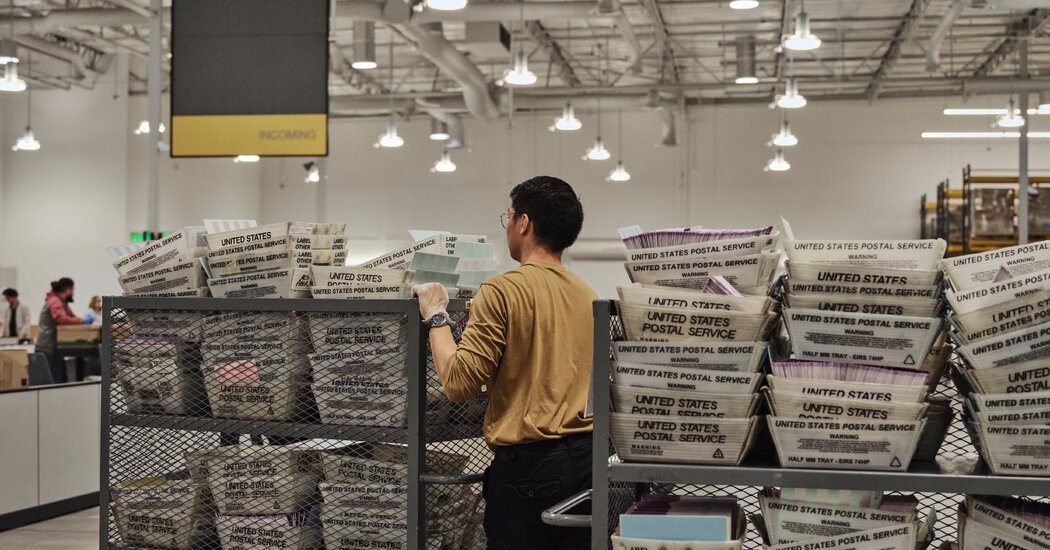
The Postal Service can for now move ahead with plans to restrict mail-in voting ahead of the midterm elections in November, after a federal judge on Wednesday lifted an order that had blocked it from carrying out Trump administration efforts.
However, the judge left open the possibility that the Postal Service rule could be blocked again soon as legal challenges unfold, a process that is already underway.
The judge, Indira Talwani of the Federal District Court in Massachusetts, wrote that she felt compelled to act in response to a ruling from the Supreme Court on Monday that action by the courts was premature.
She indicated that she may reconsider the issue after groups challenging the policy updated their legal arguments to reflect that the agency has now taken concrete steps to carry out an executive order from President Trump dealing with the issue.
And she predicted that those groups could offer “substantial arguments that might persuade the Supreme Court to reach a different result.”
Those updated arguments arrived on Wednesday, as a coalition of Democratic-led states filed a new lawsuit challenging the Trump administration’s mail-in ballot efforts. They argued that steps the Postal Service took on Friday to finalize its plans will harm them and their voters, making the issue now ripe for court action.
The Supreme Court said on Monday that it was effectively too early for states and other litigants to challenge the administration, as none had — so far — been hurt by the federal government or faced illegal incursions into their balloting. But the court had not taken account of the recent Postal Service action in its decision.
Under its new plan, the Postal Service would not deliver mail ballots in states that do not share voter data with the agency and would deliver only ballots that meet certain criteria.
In the new lawsuit, the states argued that the plan would result in the federal government tying the delivery of mail-in ballots to states’ willingness to help the government scrutinize their voter rolls, meaning they have now been harmed. Under the law, states and Congress set election rules, not the executive branch, they argued.
“Congress has not afforded U.S.P.S. any authority whatsoever to set rules for federal elections or mail voting, even though Americans have cast ballots by mail for generations,” the lawsuit said.
In the suit, the states described the new Postal Service policy as “part of a broader effort by the president and his administration to rewrite federal election law and usurp the authority of the states and Congress.”
Mirroring the move by the states, a voting rights organization challenging the same restrictions updated its lawsuit hours later on Wednesday, giving Judge Talwani another opportunity to consider their legality. Like the states, the group wrote that there was no longer any doubt about the Postal Service’s intentions.
“That uncertainty is gone,” lawyers for the group wrote.
An executive order Mr. Trump signed in March sought to restrict mail ballots and to create state-by-state lists of citizens to help determine voting eligibility.
It instructed the Department of Homeland Security to compile the lists and then send them to each state.
Under the plan finalized on Friday, the Postal Service would also review every envelope for compliance with the new standards before accepting ballots into its system. This review would include checking that the recipient was enrolled with the Postal Service to receive a mail ballot and that the ballot envelope met certain specifications.
Numerous voting advocacy groups have warned that the lists of eligible voters compiled by the federal government were likely to contain errors based on obsolete data and could conflict with more up-to-date voter registries compiled by the states. In court, the Justice Department also acknowledged that mismatches in the data could lead to certain voters being flagged as noncitizens and having their ballots rejected by the Postal Service.
A coalition of more than 20 state attorneys general and Gov. Josh Shapiro, Democrat of Pennsylvania, first challenged the order in Federal District Court in Boston in April, resulting in the Supreme Court’s finding on Monday.
The same group filed the new lawsuit on Wednesday, also in Boston, where another suit challenging the restrictions is also pending. In that case, brought by the League of Women Voters and other nonprofits, Judge Talwani on Tuesday ruled she had previously blocked the Postal Service from making any rule changes as part of Mr. Trump’s order that could affect the midterm elections in November. She described the new rule as a violation of her previous order.
Either of the two suits could now move quickly through the courts and potentially result in more action by the Supreme Court in the coming weeks, as states gear up to administer elections that are just over two months away.
Mr. Trump has worked for years to discredit mail-in voting as vulnerable to voter fraud and to reduce its availability. Critics have said they believe his larger goal is to sow confusion and doubt in the vote.
A variety of groups, including the Democratic state attorneys general, the League of Women Voters and the Democratic Senatorial Campaign Committee, have sued to block the executive order and the new restrictions, arguing they would dampen turnout and create chaos ahead of a critical election.
“Across the country, states are already deep into preparations for the 2026 elections,” said Letitia James, the New York attorney general. “Now, at the last moment, the federal government is attempting to meddle in those preparations and potentially threaten countless Americans’ right to vote.”
Abbie VanSickle contributed reporting.