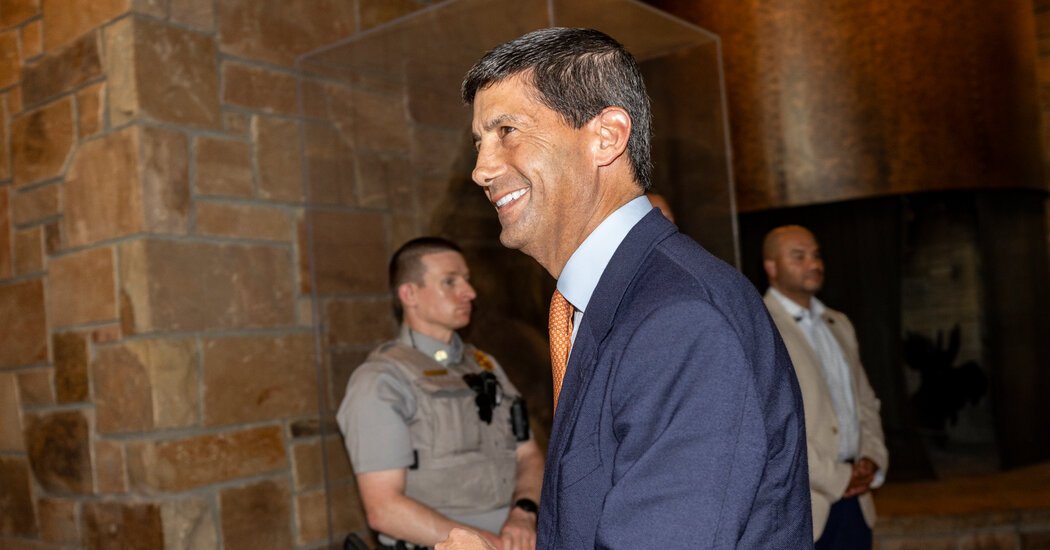
Kevin M. Warsh, the chairman of the Federal Reserve, sought to alleviate concerns about his commitment to taming elevated inflation, suggesting in a closely-watched speech that the central bank will have “work to do” if price pressures do not ease in a timely fashion.
Mr. Warsh, delivering his first address to the world’s leading economic policymakers at the Fed’s annual conference in Jackson, Wyo., affirmed that the central bank is chiefly focusing on getting inflation down after half a decade of it overshooting the Fed’s 2 percent target.
The Fed would not waver on that goal, Mr. Warsh said, although he stopped short of saying whether the current moment required higher interest rates.
“The responsibility for 65 months of sustained, elevated inflation sits squarely with the central bank — and that is where it belongs,” he said in prepared remarks.
“Here is my standard: We must be confident that underlying inflation is moving to our objective, clearly and at sufficient speed,” Mr. Warsh added. “Otherwise, we have work to do.”
Mr. Warsh made clear that adjustments to the Fed’s overnight rate, which currently stands at 3.5 percent to 3.75 percent, was the “predominant tool” to achieve both low, stable prices and a healthy labor market.
“Price stability is not self-executing,” Mr. Warsh said.
The comments are Mr. Warsh’s most extensive to date about the economy since taking over the Fed’s top job in May and confronting a confluence of risks. They range from a protracted Iran war that has worsened the trajectory of inflation to rising U.S. government bond yields that has prompted surprise interventions recently from Treasury Secretary Scott Bessent.
Mr. Warsh struck an upbeat tone about the prospects of “substantially higher growth,” saying its potential was “on the rise.” He cited the “ever-expanding pools of capital” that are being deployed to expand artificial intelligence abilities.
Mr. Warsh also noted pockets of weakness, in sectors like housing and agriculture, but concluded that he would be “hard pressed to describe broad financial conditions as restrictive.”
Perhaps most importantly, he seemed to downplay recent progress in inflation, after two months that showed slightly less acute price pressures. “They do not tell me that underlying trends have meaningfully improved,” he said of inflation data this summer. Moreover, he suggested that with the labor market “quite stable” and inflation running above target, “the Fed’s predominant focus right now should be on prices.”
In his first months at the helm, Mr. Warsh has made it a priority to emphasize the Fed’s intolerance for inflation. But up until this point, he has not given a clear steer on how he views the drivers of the inflation he wants to root out and what it might take from a policy standpoint to do so.
That obscurity is by design. It reflects Mr. Warsh’s strategy to recast how the Fed communicates. Unfettered transparency from past leaders, he has argued, has muddied an important signal officials would otherwise have gleaned from financial markets. It has also made officials too bogged down by near-term rate decisions that Mr. Warsh believes are less relevant than the overall arc of policy form the central bank.
Investors say this framing misses the fact that expectations about what the Fed will do factor heavily into how markets behave. In fact, a significant portion of the recent move in Treasury bond yields reflects the fact that the central bank, once thought to be lowering rates this year, appears more inclined to raise them.
Mr. Warsh on Friday did not endorse a specific policy move at either the Fed’s next meeting in mid-September or beyond that point. He defended his decision to keep his preferences on the path forward for rates close to his chest.
“Oversharing policy deliberations and overcommitting to future decisions can lead markets, businesses and households astray,” he said. “And I believe when policymakers make quasi-commitments on interest rates through the cycle, we inhibit our own freedom to make the right calls when it’s time to decide.”
Investors, he added, will always try to anticipate what the Fed will do next. “But we should not indulge a regime in which market participants are looking primarily to the Fed for their next trade.”
Mr. Warsh’s colleagues have more readily embraced the possibility of higher rates. In fact, a growing group of policymakers have argued that the central bank should have already raised borrowing costs to hasten progress on getting inflation down. They maintain that rates at the current range of 3.5 percent to 3.75 percent are doing little to hold back economic activity and in turn counteract inflationary pressures, which are now emanating from a variety of sources.
The war with Iran is no closer to a resolution, keeping energy prices high. Computer chips and semiconductors, among other items, have become expensive amid a splurge of A.I.-related spending. And President Trump has waded into new trade wars; the latest target is Canada.
A failure to act now, these policymakers warn, could mean the Fed has to eventually raise rates more aggressively than otherwise would have been the case, imperiling a labor market that remains on slightly shakier footing.
However, this cohort has yet to convince a majority of officials, who are still holding out hope that their forecasts for inflation to ease in the second half of the year will bear out, thereby obviating the need to raise rates. If that progress does not materialize, these officials have said they will support higher rates.
On Wednesday, new data from the Commerce Department indicated the Fed’s preferred gauge — the Personal Consumption Expenditures Price index — showed little improvement in July.
Core prices, a measure that strips out the volatile food and energy categories, were up 3.3 percent from a year earlier, unchanged from June, after a 0.2 percent monthly increase. The Fed pays closest attention to the core measure because it seen as a reliable indication of the trajectory of inflation in the months ahead.
How the Fed measures and models inflation is the focal point of one of Mr. Warsh’s five task forces he convened earlier this year to look at issues core to the central bank. The other groups — all of which are being led by a slate of external advisers spanning former policymakers, academics and business leaders — include how the Fed communicates, its $6.7 trillion portfolio of government debt and mortgage-backed securities, the data sources it prioritizes and productivity trends and jobs.
Mr. Warsh set up the task forces, whose work is set to be completed by the end of the year, to be unconstrained in their scope and scale. But Mr. Warsh has in the past indicated his preferences.
For example, he has long championed a smaller Fed balance sheet, arguing that past interventions not only stoked inflation, but also distorted financial markets and eroded the central bank’s independence by veering into fiscal policy. He has also maintained that the proliferation of A.I. will lead to significant productivity gains that over time will support stronger growth without stoking inflationary pressures.
On Friday, Mr. Warsh said that the recommendations of the task forces would have “no bearing on decisions we make in the current policy conjuncture.”
“But I believe that for future policy challenges, this intellectual investment today will leave us far better prepared,” he added.