➡️ Did someone forward you this email? If you would like to receive this information directly, every morning before the markets open in New York, sign up here.
ONE BIG THING
Venezuela oil pact ‘looks like an insider deal’ for those close to Delcy and Trump, expert says
President Trump’s plan for the U.S. to own majority control of Venezuelan oilfields harks back to a century-old era of colonialism and backroom dealmaking with Venezuelan oilmen and politicians, energy and geopolitical analysts told Fortune’s Jordan Blum.
“If the U.S. scheme in Venezuela sounds colonial, that’s because it is,” said Gregory Brew, senior analyst with the Eurasia Group. “This is the Trump administration trying to increase U.S. revenue from Venezuelan oil production. It’s extremely unusual. It’s probably unprecedented in the history of the international oil industry.”
Under the deal, the U.S. would control more than 65 billion barrels of proven oil reserves in Venezuela.
The agreement would give the U.S. Department of Defense a 55% stake in the private Venezuelan oil producer North American Blue Energy Partners. NABEP is controlled by the Venezuelan businessman Alejandro Betancourt López and his family. López has fostered close relationships with both the Trump and Rodríguez administrations.
“From a certain angle, this looks like an insider deal to profit businessmen who are close to Delcy and who are also close to Trump and his inner circle,” Brew told Fortune.
THE WAR
Iran again offers to accept Trump’s deal but the President wants to ‘hit them hard’ instead
The conflict between the U.S. and Iran has entered a surreal new phase in which Iran is offering to accept the deal based on the “memorandum of understanding” first offered by the White House in June, but President Trump shows no signs of wanting to take the deal.
Iran’s President Masoud Pezeshkian said Iran was prepared to reciprocate if the U.S. honored its commitments under the MOU, according to Al Jazeera. Iran made a similar offer—to accept the MOU—on August 26.
The MOU technically expired on August 17. The MOU proposes an end to all hostilities, an end to sanctions, and $300 billion in reparations. It also requires Iran to “not procure or develop nuclear weapons” but it allows for “enrichment and other mutually agreed matters related to the Islamic Republic of Iran’s nuclear needs.”
Trump is considering a further set of relatively limited strikes on Iran to degrade its ability to hit ships on the Strait of Hormuz, Axios reported. “The President retains all options at his disposal. The Iranians want to make a deal, but they are always a day late and a dollar short,” a source told the site. “We are going to hit them hard,” Trump told Fox News yesterday, in response to Iran’s previous strikes on U.S. sites in the Gulf, which were in turn triggered by U.S. strikes on Iranian missile launchers near the Strait.
Both sides continue to be engaged in skirmishes in the Strait. Two supertankers were hit by unknown projectiles in the last 24 hours, according to Bloomberg.
The U.S. has made progress in terms of removing Iran’s ability to damage ships in the Strait, the WSJ reported. However, Iran has developed the ability to launch mines into the sea by firing them from rockets—a tactic that is confounding the U.S. blockade. As the WSJ put it:
- “At the heart of the fight is a fundamental imbalance of mine warfare. Iran doesn’t necessarily need to sink ships. It only needs to persuade shipowners, captains and insurers that the risk of encountering a mine while transiting the strait is too high to make the trip.”
- “For the U.S., however, which wants to ensure safe passage, the mission is harder. It needs to disable or remove every mine.”
THE MARKETS
Bond market revolt has traders selling out of stocks worldwide
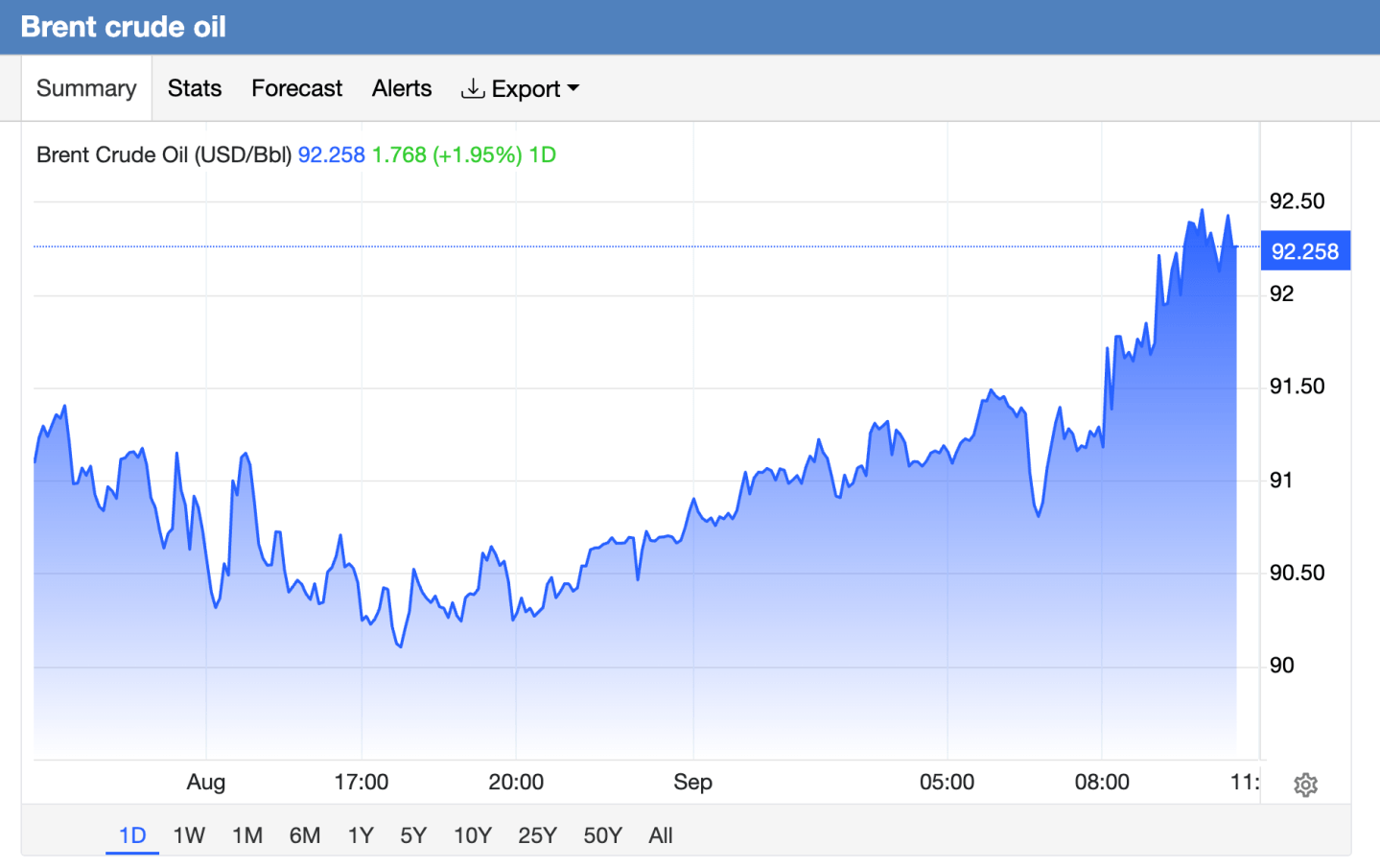
Stock markets are selling off this morning in reaction to the price of Brent crude going up to $92 per barrel and—perhaps more importantly—a global selloff in bonds as investors express their frustration with government debt levels.
The U.S. 30-year Treasury rose to 5.278%, and appears to be heading back over 5.3%. That was the level that forced Treasury Secretary Scott Bessent to deploy a bond buyback scheme a week or so ago. (As the price of bonds declines, the interest yield traders demand for holding them goes up.)
The U.K. 30-year gilt hit 5.8906%, a level it has not seen since 1998. And the Japan 10-year bond hit 2.992%, its highest since 1996.
With no end to the U.S.-Iran conflict in sight, it’s not surprising that U.S. futures were down after markets in both Europe and Asia took losses.
- S&P 500 futures were down 0.53% this morning. The index fell 0.33% yesterday.
- In Europe, the Stoxx 600 was up 0.74% in early trading and the U.K.’s FTSE 100 was down 1.18% before lunch.
- Asia: South Korea’s KOSPI was up 0.23%. Japan’s Nikkei 225 was down 0.15%. India’s Nifty 50 was down 0.46%. China’s CSI 300 was down 0.3%.
- Brent crude rose to $92 per barrel this morning.
- Bitcoin was $77,821.
Useless 60:40 strategy is even more useless than previously thought, top analyst says
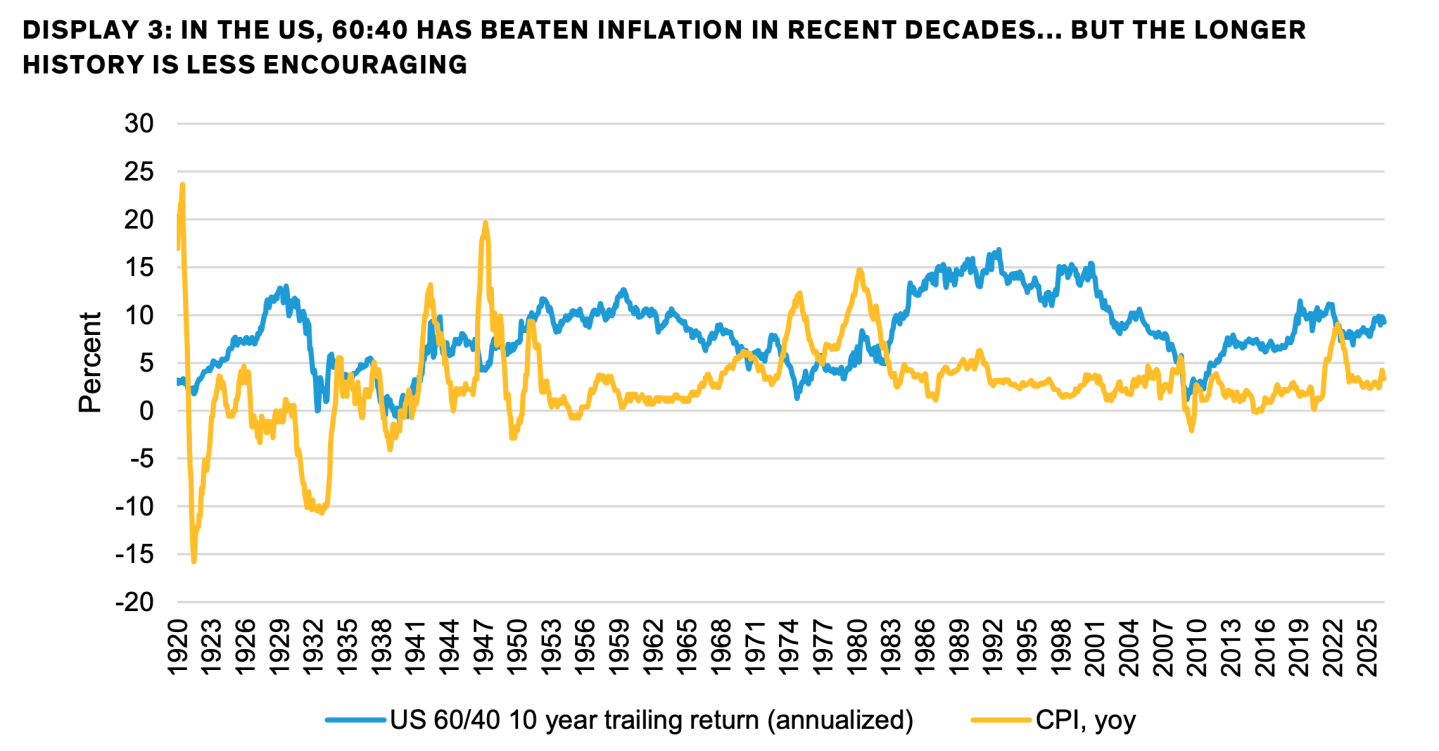
We’ve noted repeatedly that the 60:40 stocks-to-bonds strategy for investing stopped working years ago, but some analysts believe this dead horse needs to be flogged just a little bit more. AllianceBernstein’s Inigo Fraser Jenkins, in a discussion of what you’d need to create a portfolio robust enough to survive 100 years, discovered that the 60:40 strategy isn’t even a good hedge against inflation.
“This strategy has beaten inflation in recent decades, but the longer history is less encouraging,” he said in a recent note. “Once the horizon is long enough, it is essentially a coin flip if a 60:40 outperforms inflation or not.” He also notes that “there are periods like the 1940s and 1970s when inflation can wipe out years of returns.”
MORE FROM FORTUNE
The End of Privacy? Flock Safety Explained | Fortune Daily
Starbucks is discontinuing a blending powder for drinks after particles went ‘airborne’ and left baristas coughing and falling ill – Sasha Rogelberg
Meet the CEO whose century-old company never laid off employees through the Great Depression, the recession, or Covid – Mia Osmonbekov
Asia’s aging population will redefine retirement, care—and independence – Steve Finch
THE DOLE
What does Warsh watch? Unemployment claims.
In his Jackson Hole speech last Friday, Fed Chair Kevin Warsh in particular highlighted unemployment claims: “Labor markets are quite stable. The jobless rate, at 4.1 percent, remains low by historical standards and has not changed much for a couple of years. Unemployment claims, on a four-week average—an empirically robust real-time indicator—are near their lowest level in decades,” he said.
That was significant, according to Nancy Lazar, chief global economist at Piper Sandler, especially because he called out unemployment claims as “an empirically robust real-time indicator.”
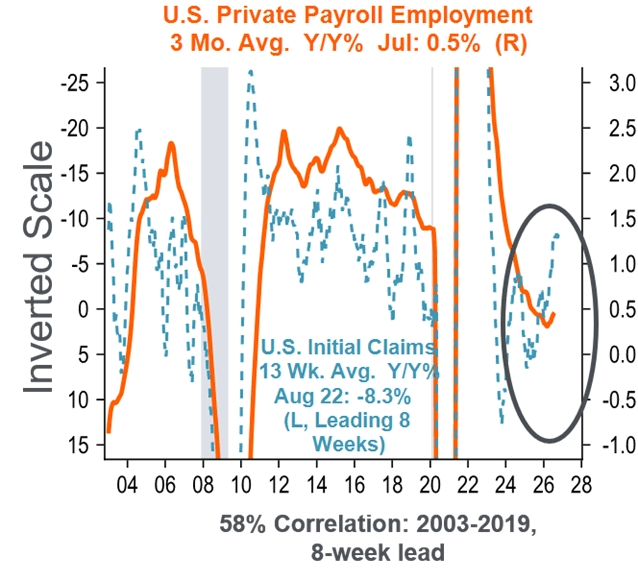
“We’ve been pounding the table on this for years, saying claims (a hard count that’s rarely meaningfully revised) are a great (and very timely) labor indicator,” Lazar told clients in a note seen by Fortune. The 13-week moving average of unemployment claims predicts the private payrolls number eight weeks in advance, Lazar says, as illustrated by this chart (below). “Today, they suggest private employment growth will accelerate toward 1% y/y as we move into 4Q – another tailwind for 2027 growth,” she told clients.
QUOTE OF THE DAY
“In this world nothing is certain, except death, taxes, and quantitative easing.”
—Michael Hartnett, chief investment strategist, Bank of America Global Research.
CHART OF THE DAY
Don’t worry about quantum computers cracking encryption—progress may be slower than you think
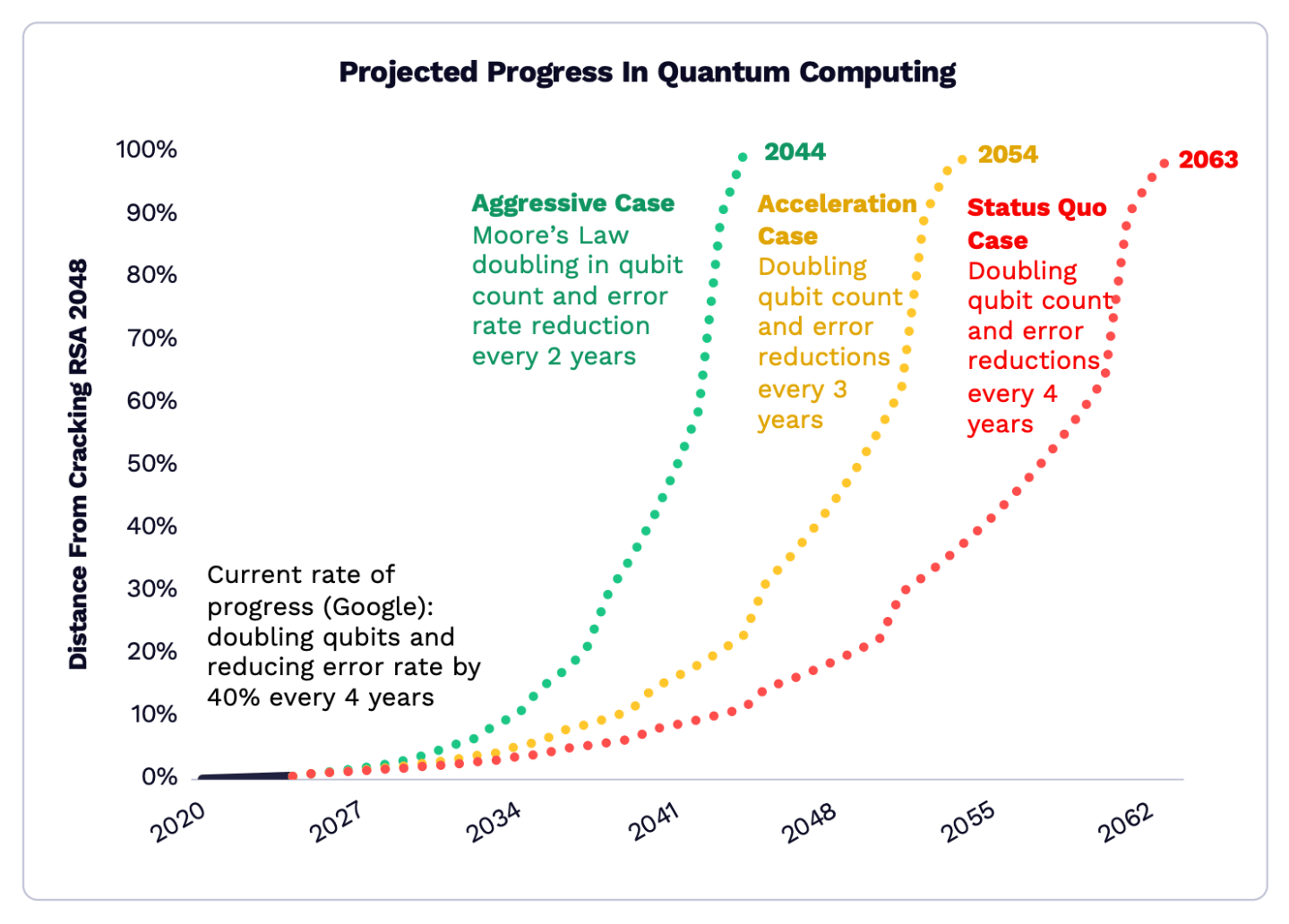
The earliest year in which quantum computing will be able to unlock standard encryption is 2044, according to ARK Invest.
“Quantum computing’s performance improvement curve has been slow. Despite spending billions in research and development, Google doubled qubits only once in more than four years. Even if its performance and costs were to improve markedly, achieving Moore’s Law’s pace, quantum computing would not be useful for cryptographic decryption until the 2040s,” Cathie Wood’s team believes.
THE FRONT PAGES TODAY
Global bond sell-off deepens amid inflation fears – FT
Supreme Court allows Trump’s ballroom construction to proceed – Axios
Anthropic signs $35 billion cloud deal backed by Nvidia – WSJ
Apple’s 2,275% gain under Tim Cook is a tough act for John Ternus to follow – Bloomberg
F.T.C. and 22 states claim in lawsuit that Amazon secretly inflated ad prices – NYT
ONE MORE THING
The sardine index: How global warming is putting up the price of tinned fish
The global tinned fish market was worth roughly $10.24 billion in 2024, and is projected to reach $17.97 billion by 2034. But the supply behind that growing appetite is shrinking fast. Morocco, the world’s top sardine supplier, saw its fish landings fall nearly 46% between 2022 and 2024, and the reasons are feeding into each other. Because sardines are unusually sensitive to temperature, warming water as a result of climate change is pushing the fish into new territories further away from fishermen, Fortune’s Catherina Gioino reports.
The war in Iran, coupled with the effective shutdown of the Strait of Hormuz (through which one-fifth of the world’s oil supply normally passes), is driving up fuel costs. Fishermen now need to go farther to catch the fish, just as it’s costing them that much more to travel longer distances, and they’re bringing back almost half the quantity as before.