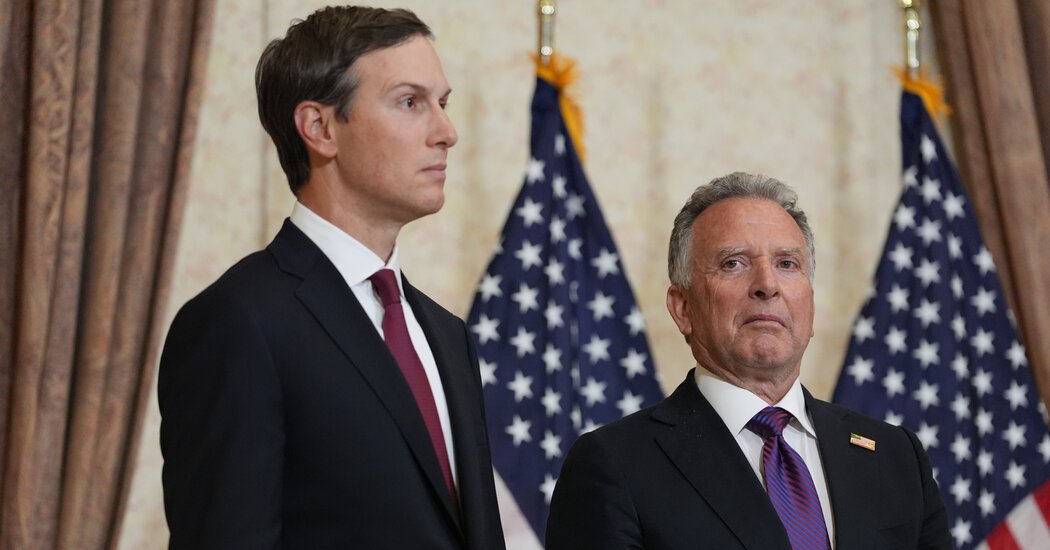
Two of President Trump’s top envoys, Steve Witkoff and Jared Kushner, are traveling to Moscow and Kyiv this weekend, in an effort to revive discussions of a peace agreement to end the four-and-a-half-year war in Ukraine, according to officials familiar with the diplomatic effort.
Mr. Witkoff, the president’s special envoy, and Mr. Kushner, his son-in-law and frequent key negotiator, are expected to see President Vladimir V. Putin of Russia on Saturday. Then they will travel to Kyiv, a first for the two envoys, to see President Volodymyr Zelensky.
Negotiations over the trip have gone on for weeks, the officials say, with the United States insisting that the Ukrainians temporarily cease their drone attacks on Moscow and the country’s energy facilities while the two men are in Russia, and that the Russians similarly stop their missile attacks on Kyiv. The officials spoke on condition of anonymity to discuss a trip that had not been formally announced.
It is unclear whether the Americans are bringing new proposals to the two presidents, or are pushing them to close the gap on the remaining issues, which include who will ultimately control the Donbas, Ukrainian territory that is partly occupied by Russia.
While Mr. Witkoff and Mr. Kushner have traveled to Moscow several times, they have not been to Kyiv, despite multiple official invitations. Two weeks ago the C.I.A. director, John Ratcliffe, traveled to Moscow, staying only a few hours to meet with his Russian counterpart. Mr. Witkoff has seen Mr. Putin more than a half-dozen times.
The meeting comes at a precarious moment in the conflict. For most of the year, Ukraine’s attacks on oil refineries and other energy targets have had a devastating effect, leaving Russians lining up for hours to get gasoline, if they can find it at all. But the Ukrainians have run out of interceptors to stop Russian missiles that have been raining down on Ukraine, leaving Kyiv and some other cities almost defenseless.
President Trump has been eager to bring Russia back into the fold: He and Treasury Secretary Scott Bessent invited Russia to participated in a Group of 20 finance ministers meeting last week in North Carolina, over the objections of European allies. Russia has been excluded from many diplomatic meetings since its 2022 invasion of Ukraine.
The session comes more than a year after Mr. Trump met Mr. Putin in a summit meeting in Alaska, the administration’s highest-level effort to end the war. Ever since that session, Russian and American officials have disputed what, exactly, the two men said about the outlines of a possible agreement. And the Ukrainians were somewhat relieved at that deadlock: Desperate as they were to end the death and destruction, their deepest fear was that Mr. Trump would give in to the Russian president’s territorial demands, and force Mr. Zelensky into a painful choice between giving up more than 20 percent of his country or rejecting a peace accord that he fears is a poison chalice.
The dynamic has changed since. But it is far from clear that Mr. Putin, despite the pressure on Russian energy and the economy, is prepared to give ground on his territorial demands. Some Ukrainian officials say they doubt the conditions will be ripe for a peace agreement until next spring because they expect the Russians will want to use the winter months to try to destroy more of their energy facilities in hopes of making the Ukrainians more malleable.