U.S. envoys Steve Witkoff and Jared Kushner held more than three hours of talks with Vladimir Putin in Moscow on Sept. 5, marking their first visit to the city since January.
In recent months, the war in Ukraine has received less attention as Washington has focused U.S. foreign policy and military resources on the conflict with Iran. The Moscow visit was intended to revive negotiations that had been stalled for nearly eight months.
The Kremlin meeting concluded without an immediate announcement about its outcome. Putin’s adviser Yuri Ushakov described the talks as “constructive and extremely frank.” He said the two sides discussed resolving the war, economic issues, and potential “mutually beneficial Russian-American projects.”
Ushakov told Russian reporters that “note was made of the Russian army’s tangible advances in the combat zone.” The passive, unattributed phrasing is typical of Kremlin readouts of closed-door diplomatic sessions. Moscow was placing its military progress on the record with the Americans, likely to project strength and shape its negotiating position.
Ushakov added that the talks needed to address the “root causes” of the conflict. “Root causes” is longstanding Kremlin language, used since before the 2022 invasion, for Russia’s underlying justifications for the war.
These include Ukraine’s NATO aspirations and broader Western military alignment; Ukraine’s governance and political orientation, which Russia has at times framed around “denazification” and the protection of Russian speakers; and the post-Cold War security architecture in Europe, which Russia argues expanded NATO into its sphere.
In this framing, Russia’s demands go beyond retaining the territory it currently occupies. They also include Ukraine renouncing NATO membership and reducing the size of its armed forces. Moscow separately said it remains confident that it can achieve its military objective of seizing the remainder of eastern Ukraine.
A Russian official said the talks were “making progress,” while a White House official said the three discussed “plans for next steps” to be announced in the coming weeks.
Kushner said the U.S. team reviewed ideas that had not worked and tried to identify what was needed for a “durable peace.” He added that Putin “asked a lot of questions.” Witkoff said the envoys met with Putin before traveling to Kyiv because they “needed to hear” where he stood.
Ukrainian officials disputed Russia’s battlefield account. They claimed that Ukraine gained more territory than it lost in August and that Russia suffered 42,000 casualties, dead or wounded, during that period.
Russia still controls about one-fifth of Ukrainian territory, land it seized in 2022. Russian ground forces have made slow advances throughout most of the conflict, inflicting losses on Ukraine while incurring heavy casualties. Putin has signaled that his territorial demands remain unchanged. Kyiv has not accepted those terms.
Witkoff and Kushner traveled from Moscow to Kyiv by train rather than by air because of the risk of Russian drone activity. They arrived on Sunday, Sept. 6.
The visit was their first trip to Ukraine despite months of negotiations with both sides and multiple previous trips to Russia. It also marked the highest-level visit by U.S. officials to Ukraine since Trump began his second term. Zelensky greeted the envoys at Kyiv’s St. Sophia Cathedral, near the headquarters of the Security Service of Ukraine, which was struck by a Russian drone on Friday, Sept. 4.
Ahead of the meeting, Zelensky wrote on X: “Peace is needed. Security guarantees are needed. A dignified character of the postwar peace is needed. Our proposals are ready.”
He also said: “We have been waiting for Steve Witkoff and Jared Kushner for a long time. We thank President Trump for allowing them to come — for us, this is important.”
Putin and Zelensky agreed to halt strikes on each other’s capitals for three days while the envoys conducted the trip. Zelensky thanked them for the visit, saying the pause had given Kyiv residents a brief respite.
Despite the agreement, Russia struck multiple targets across Ukraine early on Sept. 6, sparking fires in Kyiv Oblast. Drones were also reported targeting the nearby city of Boryspil.
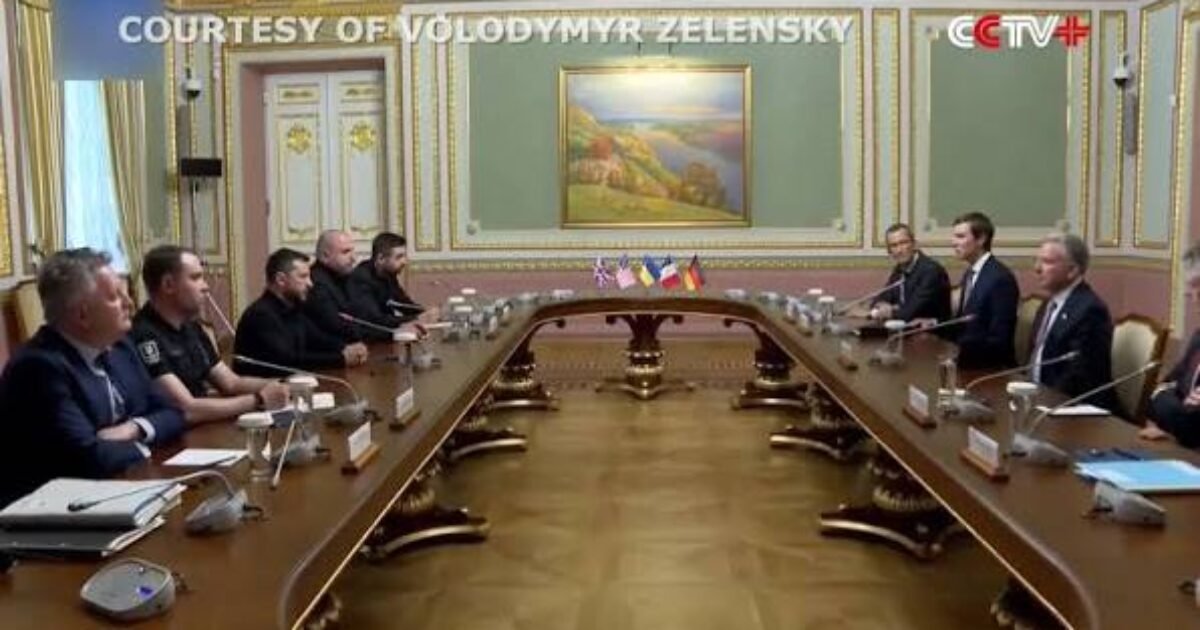
Witkoff and Kushner met twice with Zelensky and his senior advisers. A third meeting included national security advisers from the U.K., France, and Germany, including U.K. National Security Adviser Jonathan Powell.
Zelensky wrote on Telegram: “Three rounds of talks today. All of them were very substantive.”
At a joint press conference, Zelensky said “several new ideas” had been discussed but did not elaborate. He said: “We want to prevent loss of life, we want this war to end fairly for all of us, and we want it to end in such a way that Russia’s aggression against Ukraine is never repeated.”
Zelensky’s press secretary, Serhiy Nykyforov, said the president had prepared T-shirts reading “Kyiv regime” as gifts for attendees. The phrase refers to language used by Russian and some U.S. officials to describe his government.
Witkoff said negotiators had made significant progress in Moscow. He added that the Ukrainians he met showed resiliency that he described as “pronounced.”
Kushner told Zelensky that Trump “wanted us to convey” that he considers the conflict a difficult and complex but worthwhile problem to solve.
Kushner said the envoys’ task was “creating a peace package,” with officials across the U.S. government, including Secretary of State Marco Rubio, working on it.
Kushner said he and Witkoff wanted to return to the trilateral U.S.-Russia-Ukraine format last used roughly six months ago. Zelensky separately called for the resumption of negotiations that included Russia.
Zelensky said Ukraine would require “strong and clear” security guarantees, including a strong army. He gave no indication that he was willing to cede territory in the eastern Donbas region, an issue he described as “difficult.”
Zelensky said he expects the war to continue into winter, stating that this is “what it looks like” for now. He said Ukraine would need air defense and energy support if that occurred, along with an additional U.S. support package.
Ukraine has relied on American-made Patriot interceptors against Russian ballistic missiles, but the U.S. has used much of its stockpile during its war with Iran. Russia has targeted Ukraine’s energy infrastructure during previous winters.
Zelensky said Ukraine needs to develop its own anti-ballistic missile system, adding that American production is expected to increase next year.
Some diplomats have referenced a possible “window of opportunity” for a settlement next spring. Others expressed less optimism.
Fighting continued during the diplomatic visits. A Russian drone struck the headquarters of the Security Service of Ukraine in Kyiv on Friday, Sept. 4.
Overnight into Sunday, Ukrainian forces struck an oil refinery, an airfield, and two air defense systems inside Russia. Ukraine’s Air Force reported that Russia attacked Ukraine overnight with 108 long-range drones and small cruise missiles. Ukrainian air defenses downed 82 drones and six missiles. Eleven locations were hit, and debris fell at seven additional sites.
The current round follows more than a year of intermittent negotiations. Trilateral talks among Ukraine, the U.S., and Russia were held in the UAE in January 2026. They were described as the first meeting of delegations from all three nations since the 2022 invasion.
Zelensky said in February that the U.S. was seeking a peace agreement by June, a target that was not met. A further round was held in Florida in March, but Russia declined to attend.
A 28-point plan brokered by Witkoff and Russian envoy Kirill Dmitriev was viewed by Kyiv as favoring Moscow. It was revised in Geneva and Florida into a 19-point proposal. A 32-hour ceasefire was also observed around Orthodox Easter in April 2026, one of several short-term pauses attempted since 2022.
As of Sept. 7, no ceasefire framework or written agreement has been announced. The dispute over Ukrainian territory remains the primary obstacle, as it has throughout the previous rounds of negotiations.
Ad block users: Some site features may not work correctly while an ad blocker is enabled, because they break scripts and content this website depends on. If you can’t see comments below, for example, please disable your ad blocker.