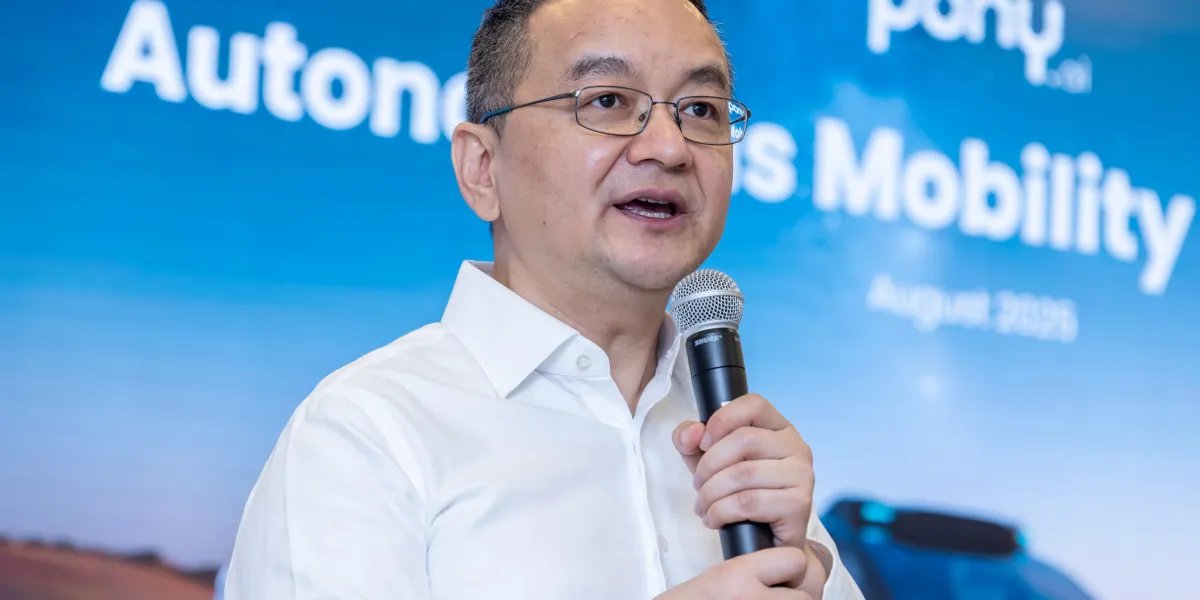
Robotaxis will be a common sight on the world’s streets within five years, predicted James Peng, founder and CEO of the Chinese autonomous driving firm Pony.ai. “I think the technology problem is pretty much already solved,” he said at the Fortune Leaders Forum in Macau on Sept. 8. “You’ll be able to hail a robotaxi just like a normal taxi.”
While Waymo dominates the robotaxi conversation in the U.S., Chinese robotaxi firms like Pony.ai are gaining ground almost everywhere else. Pony.ai, founded in 2016, runs commercial robotaxi services across Beijing, Guangzhou, Shenzhen and Shanghai. The company now averages about 25 rides per day per vehicle.
“Our riders are very diverse across different age groups, different professions,” Peng said. “It’s definitely not something unique, just for the tech-savvy people to try.”
The company is also pushing abroad. In August, Pony.ai announced an expanded partnership with Uber to deploy more than 2,000 robotaxis across Europe, building on their launch in Zagreb, Croatia, and agreed to bring 200 robotaxis to South Korea by 2028. It also has partnerships in the Middle East and Singapore.

LUCAS SCHIFRES for Fortune
When deciding where to expand, Peng said he looks for cities with a relatively expensive taxi market and a favorable regulatory environment. Partnerships with companies like Uber can help foster trust in a community and convince governments and policymakers to embrace a driverless future.
Other robotaxi providers, like WeRide and Baidu, are also pushing abroad with new ventures in Southeast Asia and Europe.
Peng credited China’s “supportive” regulatory environment for the country’s strength in autonomous driving. “The key challenge is it’s such a complex system,” he said. “It requires hardware, software, talents… China provides a good system to support this kind of innovation.”
More widespread robotaxis could reshape how cities work. “Most private cars are used for two hours a day,” Peng said. “If robotaxis are more ubiquitous, we’ll save on parking spaces.”
“The implications will be profound,” he added. “It will change the whole urban planning and change the way of our life.”
Pony.ai generated robotaxi revenue of $12.1 million in the second quarter of the year, a jump of almost 700% from a year earlier. Still, the company also reported an operating loss of $65.7 million.
In a March interview with Fortune, Peng noted some ways that robotaxis were changing user behavior. Passengers, for example, sometimes forget to close the car door when leaving; without a human driver, Pony.ai ends up asking nearby delivery gig workers to close the door for them.
At the Fortune Leaders Forum, Peng shared another observation: The share of female riders trends upwards during evening hours. “They feel a lot safer because there are no drivers,” Peng said. “It’s safe, private, and, also, it’s consistent.”