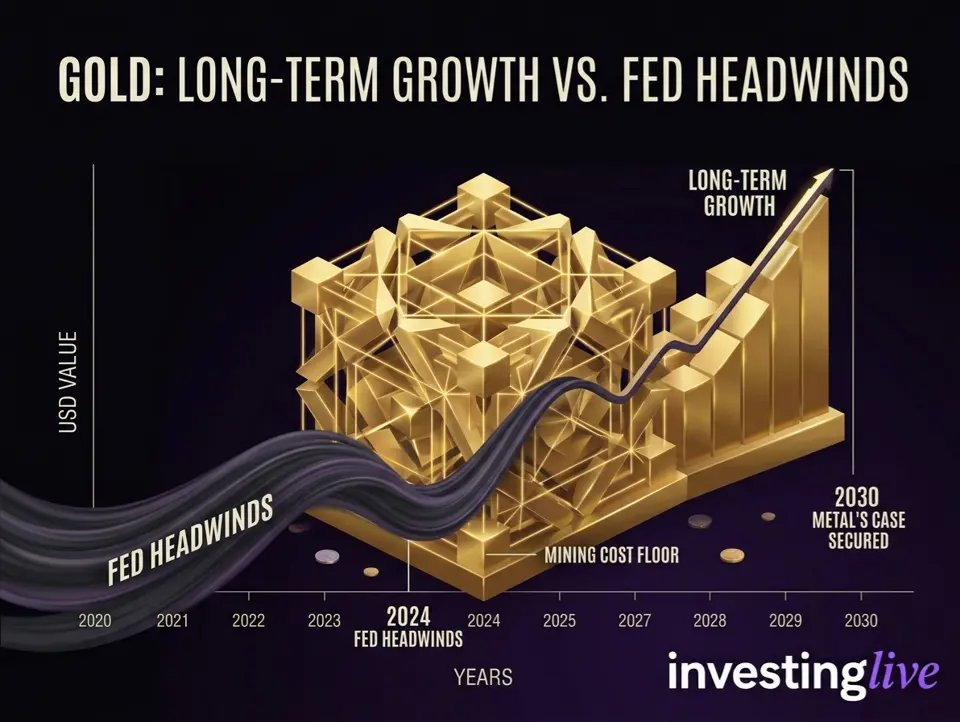
UBS’s core message for positioning is a separation between near-term price action and long-term allocation, arguing the current pullback reflects a shift in Fed rate expectations rather than any deterioration in gold’s structural case. That framing matters for how traders read further weakness: if UBS’s view holds, dips driven by yields or dollar strength would be treated as entry points by strategic allocators rather than signals to reduce exposure. UBS’s revised call for a 50 basis point Fed hike this year, if it plays out, would likely keep real yields and the dollar as headwinds in the near term, meaning any tactical bounce in gold may need a shift in that rate outlook rather than a geopolitical trigger alone.
—
Earlier:
—
UBS is telling clients gold’s pullback is a rates story, not a reason to abandon the metal’s long-term diversification case.
Summary:
- Gold has fallen 5.5% over the past two weeks, giving back part of a 15% gain from the first three weeks of August, as US Treasury yields rose alongside hawkish comments from Fed Chair Kevin Warsh and stronger-than-expected payroll data
- UBS now expects the Fed to raise rates by 50 basis points this year, and sees the resulting pressure from higher real yields and a stronger dollar as a near-term headwind for gold
- UBS argues the near-term Fed outlook does not undermine gold’s medium-term strategic case, drawing a parallel to its unchanged bullish view on equities despite the same rate backdrop
- China’s central bank bought 650,000 ounces of gold in August, up from 640,000 ounces in July and its largest monthly addition since October 2023, extending a buying streak to 22 consecutive months
- A World Gold Council survey cited by UBS found nearly 90% of central banks expect global official gold reserves to rise over the next year, with 45% expecting their own holdings to increase
- UBS continues to forecast annual central bank gold purchases of 750 to 1,000 metric tons and says underallocated investors could use current weakness to build strategic exposure
UBS is telling clients that gold’s recent pullback is a function of shifting Fed expectations rather than a break in the metal’s longer-term investment case, arguing dips driven by rates should be treated as opportunities rather than a signal to step back from the trade.
Gold has fallen 5.5% over the past two weeks, giving back part of a 15% rally recorded in the first three weeks of August, as US Treasury yields climbed alongside hawkish remarks from Federal Reserve Chair Kevin Warsh and a run of stronger-than-expected payroll data. UBS has revised its own rate call in response, now expecting the Fed to deliver a 50 basis point increase this year, and it says the resulting lift to real yields and the US dollar is likely to remain a near-term headwind for the precious metal.
UBS’s framing draws a direct comparison with how it treats near-term Fed risk for equities: just as it does not see near-term Fed decisions as undermining its medium-term bullish view on global stocks, supported in its analysis by AI-related spending, resilient economic activity and broad earnings growth, it argues the same near-term rate pressure does not diminish gold’s strategic role in a diversified portfolio.
Central bank demand is central to UBS’s longer-term case. It points to China’s central bank buying 650,000 ounces of gold in August, up from 640,000 ounces in July and the largest single monthly addition since October 2023, extending Beijing’s buying streak to 22 consecutive months. UBS also cites a recent World Gold Council survey showing nearly 90% of central banks expect global official gold reserves to increase over the next 12 months, with 45% expecting their own holdings to rise, and it continues to forecast annual central bank purchases in the range of 750 to 1,000 metric tons, which it describes as a structural source of support for the metal.
Fiscal dynamics feature as a second pillar of UBS’s long-term thesis. It argues that while higher US rates and resilient growth currently support a stronger dollar, ongoing concerns over fiscal sustainability and elevated government debt could cap the currency’s appreciation over a longer horizon, reinforcing a gradual shift away from concentrated dollar exposure that it expects to benefit gold as an alternative store of value. A weaker dollar over the medium to long term would, in UBS’s view, further support demand for the metal.
The note also frames gold’s traditional roles, as an inflation hedge and a buffer against geopolitical uncertainty, as reasons institutional investors continue citing it for portfolio diversification, pointing to gold’s historical crisis performance and to data from the Global Investment Returns Yearbook showing real returns on gold and commodities have been positively correlated with inflation since 1900.
UBS’s overall conclusion treats gold primarily as a structural hedge and diversifier rather than a tactical bet on the next Fed meeting, and it suggests investors who remain underallocated to gold could use the current period of weakness to build out strategic exposure within a broader portfolio.