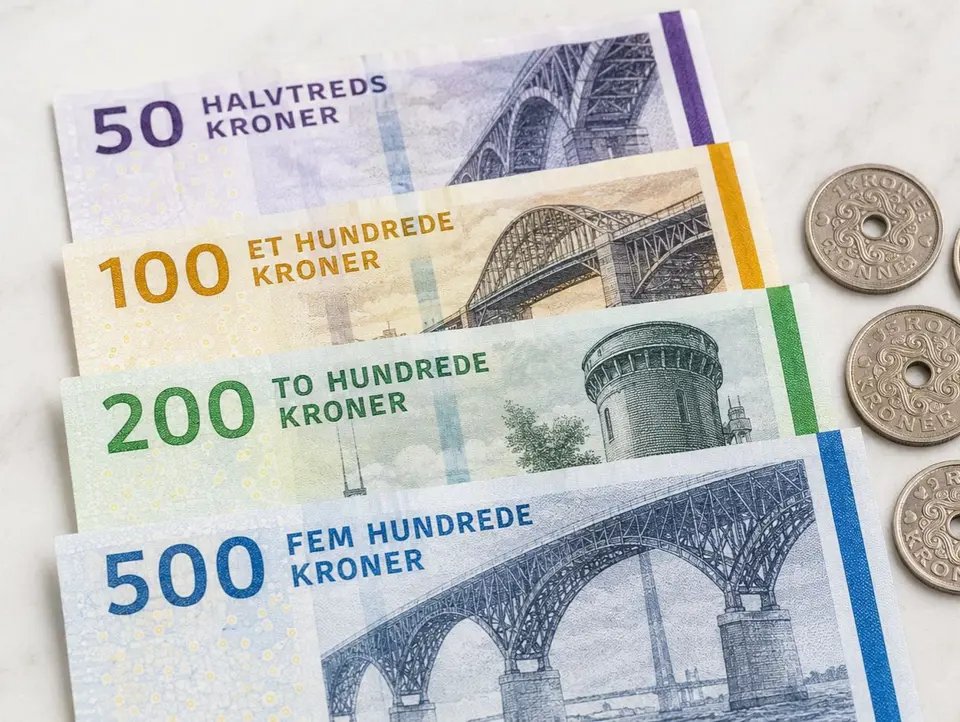
The Danish krone holds a distinct
position among European currencies. Instead of floating freely, it is anchored
tightly to the euro through a formal fixed-exchange-rate policy. As of August
19, 2026, the European Central Bank quoted EUR/DKK at 7.4759, extremely close
to the central parity of 7.46038. Against the US dollar, the picture shifts
entirely: the DKK
to USD exchange rate moves freely, driven by EUR/USD fluctuations rather
than domestic monetary decisions. On the same date, USD/DKK traded at 6.4025,
with the krone gaining 2.25% against the dollar over the prior month. This
setup ensures stability for European trade while leaving dollar crosses exposed
to global market forces.
Current
DKK Exchange Rates to EUR and USD and Historical Data
The table below compares live valuations with recent historical
performance. EUR/DKK shows a 52-week range of 0.1333–0.1347 (inverse) and a
1-year change of just -0.16%, reflecting the stability imposed by the peg,
while USD and GBP pairs vary more as free-floating crosses. Data comes from the
ECB euro reference rates and Danmarks Nationalbank publications.
Live and Historical Danish Krone (DKK) Exchange Rates (2026)
|
Currency Pair |
Live Rate (Aug 19, 2026) |
1M Change (%) |
1Y Change (%) |
5Y High / Low |
|
EUR/DKK |
7.4759 |
-0.04% |
-0.16% |
7.477 / 7.454 |
|
USD/DKK |
6.4025 |
-2.25% |
-0.06% |
Data not available |
|
GBP/DKK |
Cross-rate derived |
Cross-rate derived |
Cross-rate derived |
Data not available |
DKK to EUR
EUR/DKK trades in an
exceptionally narrow band around the central rate of 7.46038. The formal
agreement with the ECB permits fluctuation of ±2.25%, giving hard limits of
7.29252 on the strong side and 7.62824 on the weak side. In practice, the
currency rarely approaches either boundary: in August 2026, the pair averaged
7.4709, just 0.2% above parity.
DKK to USD
The DKK/USD cross has no
independent policy target. Because the krone is pegged to the euro, any
movement in EUR/USD transmits directly into the dollar rate. On August 19,
2026, EUR/USD stood at 1.16747 while USD/DKK hit 6.4025, consistent with the
implied cross. Dollar strength or weakness against the euro feeds straight
through, with no domestic policy buffer.
DKK to GBP
The DKK/GBP pair combines the
krone’s near-fixed euro position with the pound’s independent float. Denmark
and the UK maintain substantial trade: £18.6 billion in the four quarters to Q2
2025, including £9.1 billion in UK exports and £9.5 billion in imports. The
rate remains unmanaged, and sterling volatility, driven by UK inflation data
and political events, determines most of its movement.
Danish
Krone Euro Peg: The ERM II Mechanism
Denmark’s fixed-exchange-rate policy operates through the European
Exchange Rate Mechanism II (ERM II). The krone’s central parity is 746.038 per
100 euro. Instead of the standard ±15% band, Denmark negotiated a much tighter
±2.25% corridor, with limits at 762.824 on the weak side and 729.252 on the
strong side.
A fixed valuation eliminates currency uncertainty for companies
trading with the Eurozone, Denmark’s dominant trade partner. It anchors
imported prices and keeps inflation low without a separate inflation target.
The system has functioned since 1982, first tracking the D-mark and later the
euro, and the central parity has remained unchanged since January 1987.
Denmark is the only non-euro EU member state in the mechanism
without a goal of adopting the single currency, as the ECB Convergence Report
of June 2026 confirms.
Diagram of the ERM II mechanism showing the Danish krone’s central
parity rate and the narrow ±2.25% fluctuation band against the Euro.
Official Documentation & Research:
·
European Central Bank
Convergence Report June 2026
·
IMF Denmark 2025 Article IV
Consultation
Danish
Monetary Policy and Its Impact on DKK
Most central banks set interest rates to hit an inflation target.
Danmarks Nationalbank, founded in 1818, takes a different path: its monetary
policy objective is keeping the krone stable against the euro, and interest
rates serve exclusively that goal. Price stability follows as a consequence of
the peg.
As a general rule, the central bank follows ECB rate decisions. The
key instrument is the “monetary policy yield spread” — the difference
between domestic and euro-area rates. In early 2026, it stood at -40 basis
points, a deliberately negative value meant to counteract capital inflows and
prevent the krone from strengthening too far above parity. On June 12, 2026,
the bank raised rates by 0.25 points following an ECB adjustment, leaving the
spread intact.
Danmarks
Nationalbank Interventions
When
market pressure pushes the rate outside its comfort zone, the central bank uses
two direct tools: foreign exchange intervention, the faster lever, and
adjustments to the yield spread.
By
the end of February 2026, the bank had not intervened since December 2022, more
than three years of uninterrupted stability. That changed in June 2026, when
the krone came under market pressure and the bank intervened in the FX market
for a net 0.7 billion kroner. When the krone weakens, the bank buys kroner and
sells foreign reserves, pushing the rate back toward parity; when it
strengthens too much, it does the reverse.
Impact of
Interest Rates and Inflation on DKK
Interest
rates in Denmark serve the peg, not the domestic economy directly. The critical
concept is the spread between ECB and Nationalbanken rates. When capital flows
in and the krone strengthens toward the upper boundary, the bank lowers its
rates relative to the ECB, making domestic assets less attractive. During
periods of weakness, the opposite applies.
Inflation
enters the picture indirectly. Because the euro rate is fixed, Eurozone price
changes pass through with minimal distortion, and the peg itself provides the
framework for stable prices. In 2026, the -40 basis point spread remained in
place amid broadly neutral conditions.
Danish
Krone Exchange Rate Volatility Chart
Against the euro, the krone is essentially a flat line; against the
dollar, it moves significantly. EUR/DKK barely deviates from 7.46038, while
USD/DKK tracks the global EUR/USD cycle. Severe stress episodes — the 2008
financial crisis, the 2015 Swiss franc shock and COVID-related capital flight
in early 2020 — tested the mechanism but failed to break it.
DKK
Forecast and 2026 Market Outlook
The peg looks broadly stable entering the second half of 2026, with
the krone near 7.475 per euro in August and monetary conditions described as
neutral. Within such a narrow band, point forecasts for EUR/DKK are essentially
meaningless.
External pressures remain real. The Eurozone entered 2026 facing
energy price shocks, slowing growth and tariff uncertainty, with inflation
hitting 2.9% in July 2026. Bloomberg Economics projected 2026 euro-area GDP
growth at 0.9%. Weaker euro-area growth reduces Danish export demand, while
elevated global yields can push the krone away from parity, as happened in June
2026.
The main risks are sudden risk-off moves in global markets, a large
EUR/USD shift or unusual capital-flow stress, none of which looks imminent.
Still, the June 2026 intervention is a reminder that even a long-stable system
needs active defense when external conditions shift. The framework has survived
every major financial shock since 1987 without a realignment, the strongest
evidence of its credibility.
Macroeconomic Projections:
·
Bloomberg Economics Eurozone
Outlook 2026
·
Reuters Global Yield Analysis
Practical
Guide: Exchanging Currency in Denmark
Denmark ranks among the most cashless societies globally. Visa and
Mastercard are accepted in virtually every shop, restaurant and public
transport system, so most visitors need little cash.
For travelers and expats, pay by card wherever possible: the applied
rate typically matches the interbank rate. When you need cash, most local ATMs
accept international debit cards. Always choose to be charged in Danish kroner
rather than your home currency, since the latter triggers Dynamic Currency
Conversion at a worse rate.
Avoid airport exchange kiosks, which typically add 5 to 10% above
the market rate, a markup the convenience rarely justifies. Local banks charge
8 kroner at competitor ATMs, while global out-of-network ATM fees average $4.86
per withdrawal. Frequent travelers can use platforms like BankPro for
multi-currency accounts and FX tools that remove this friction.
Frequently Asked
Questions (FAQ)
Why does Denmark pursue a fixed exchange rate policy?
Denmark adopted the peg in 1982 to ensure stable inflation and
predictable trade with the Eurozone, its largest trading partner, and to anchor
domestic price expectations.
Since when has Denmark pursued a fixed exchange rate policy?
Since 1982. The krone was initially pegged to the German D-mark and
switched to the euro when the single currency launched in 1999.
Will Denmark ever adopt the Euro?
Danish voters rejected the euro in a 2000 referendum over concerns
about surrendering monetary sovereignty. As of 2026, the formal opt-out remains
in place and no new referendum is scheduled.