There’s an idea about how political power is supposed to work in the U.S. To guard against anything resembling monarchy, the founders vested Congress, not the president, with the power of the purse. The premise was simple: kings tax and spend at will. American presidents aren’t supposed to. Of course, it’s well known that this boundary is being stress-tested by President Donald Trump. What isn’t is that it’s related to his solution to the crisis at airports, with TSA agents going unpaid due to the partial government shutdown related to Trump’s controversial immigration regime.
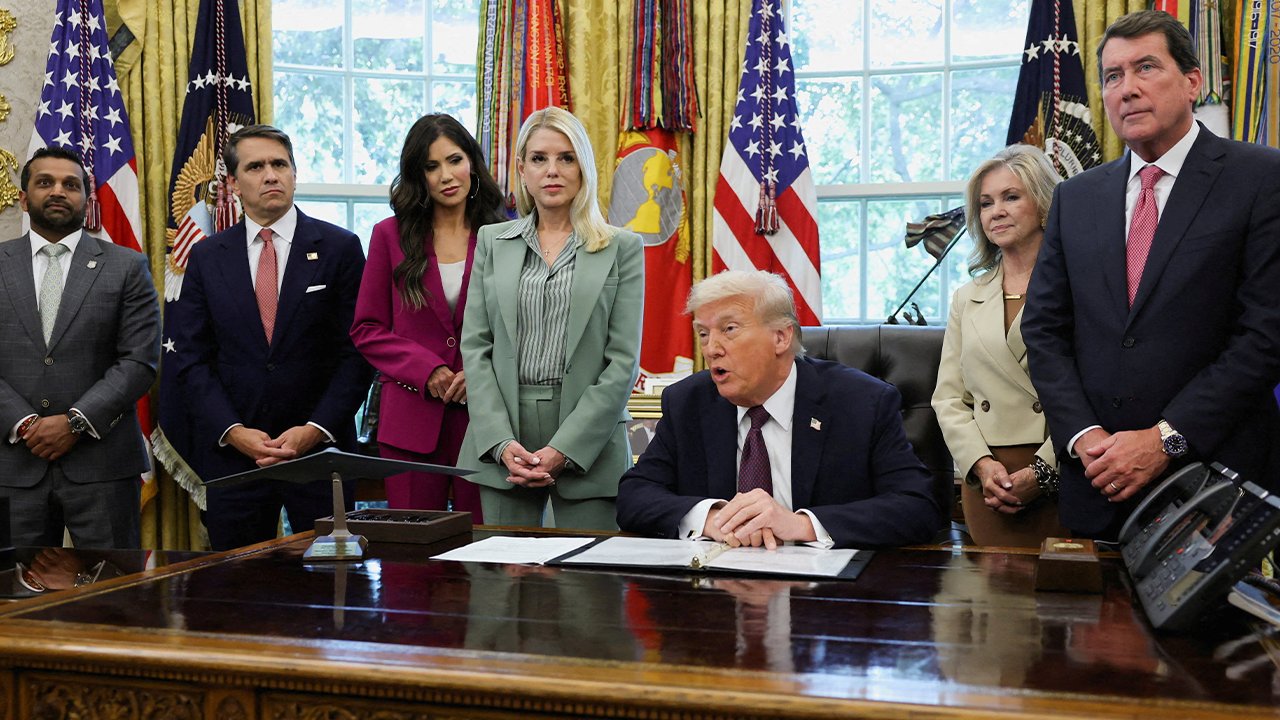
Trump signed an executive order last week to pay TSA agents. The order directs the Secretary of Homeland Security “to use funds that have a reasonable and logical nexus to TSA operations to provide TSA employees with the compensation and benefits that would have accrued to them if not for the Democrat-led DHS shutdown.”
Some policy and legal experts say Trump’s order relies on funding from legally questionable sources. The White House hasn’t exactly specified where within the tax and spending bill the money is coming from. But Bobby Kogan, senior director of federal budget policy at the Center for American Progress, said in an interview with CNBC, there’s just one section deep in the more than 300 pages of the One Big Beautiful Bill Act where the money can be coming from.
“They do have a pot of money,” he said. “It is a giant slush fund. But you couldn’t use it for [just] anything.” The specific text Kogan is referring to comes from a portion of the bill that reserves funding for the Department of Homeland Security (DHS), reserved for “reimbursement of costs incurred in undertaking activities in support of the Department of Homeland Security’s mission to safeguard the borders of the United States.”
The TSA funding comes weeks after Trump tapped Immigration and Customs Enforcement (ICE) agents to support the TSA as agents went without pay. ICE agents secured what the libertarian think tank Cato Institute called “shutdown proof” funding, meaning they were able to continue operating with pay during the partial government shutdown by shifting funding for immigration enforcement outside of normal appropriations. But the TSA funding move is the latest in a series of what budget experts deem illegal actions the president has taken to ensure certain aspects of the government are funded during shutdowns.
“No one has standing,” Kogan told CNBC. “No one can stop this. Similarly, no one had standing to stop Trump from illegally paying the military last time.” He added, “It’s just going to be one of his bajillion illegal budgetary actions.” Kogan penned an essay titled “How Trump Violated the Law to Pay the Military” in Lawfare last October outlining the methods the president used to fund the military while the government remained shut down.
A pattern that has people in the streets
Trump on Friday revealed he is asking Congress for the largest military budget in American history—a staggering $1.5 trillion—to boost defense spending amid the Iran war, military action the president for which the president hasn’t received Congress’s approval. That comes after the president floated on Wednesday the idea that states should fund welfare programs rather than the federal government. Moreover, the funding risks adding nearly $7 trillion to the already sky-high $39 trillion debt, according to the Committee for a Responsible Budget.
“It’s not possible for us to take care of day care, Medicaid, Medicare — all these individual things,” he said at a private White House event Wednesday, as reported by the Associated Press. “They can do it on a state basis. You can’t do it on a federal.”
The defense spending proposal, along with the TSA agent funding, are just two developments among a string of actions that have Trump’s opponents likening him to a king. The “No Kings” movement has staged three rounds of nationwide protests against the Trump administration. Part of that concern is the president’s growing willingness to sidestep Congress, eroding the check on the executive branch the Constitution was designed to enforce.
Why legal experts say the TSA pay move breaks the law
While Trump has moved to pay agents, legal experts find the use of this specific funding for the TSA to be legally dubious, pointing to the fact that Congress has the power of the purse and the “purpose statute,” which requires using appropriations only for the specific use for which they were originally made. Zachary Price, a law professor at University of California Law in San Francisco and the author of a recent academic article about the president’s growing power during government shutdowns, argues that the administration is interpreting this statute too loosely.
“The object is border security, not everything DHS does,” Price told Fortune. “By paying TSA, they’re basically treating it as just a four-year appropriation for DHS’s overall mission, but I think the language is more specific than that.”
Kogan estimated TSA costs at roughly $140 million per week, meaning the administration could fund the agency for close to a year before exhausting the $10 billion pot. Though it’s still unclear how long TSA will actually continue to be paid via that fund depending on Congress’s ability to reach a deal. The House on Thursday took no action on a Senate-passed funding plan for DHS that would end the partial government shutdown.
However, Price argued that regardless of the funding’s function, it sets a questionable precedent for the power of the executive branch.
“The thing to worry about in situations like this is the President degrading that check and claiming more and more flexibility about how they use money Congress has provided,” he said.