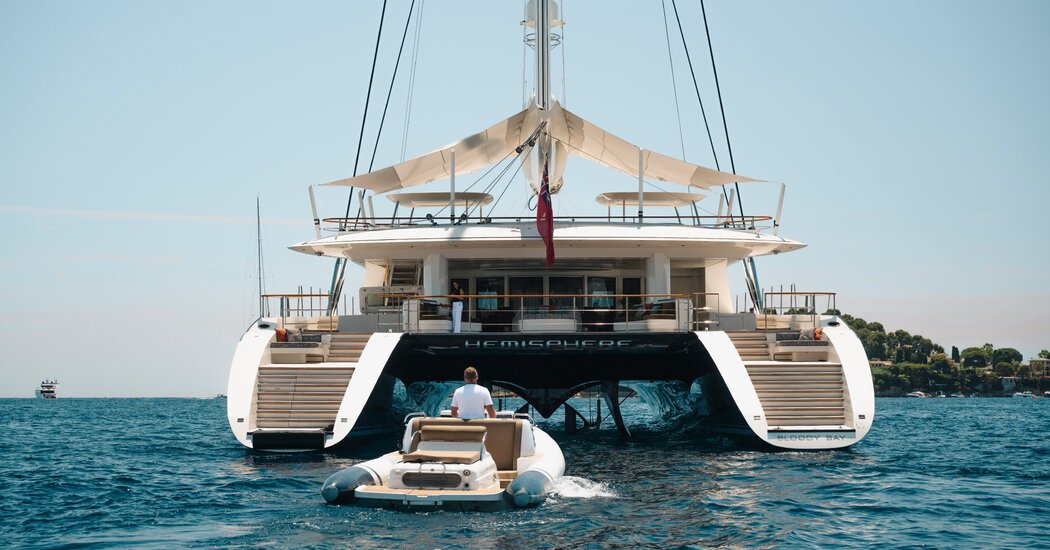
For 38.5 million euros, the prospective boat buyer would expect perfection, and Capt. Gavin Bladen was pretty sure that what he had to offer — a five-cabin luxury catamaran anchored in a Mediterranean cove on the French Riviera on a nearly cloudless day in June — was as close as it gets.
Mr. Bladen, 54, dressed for work in a white polo, charcoal shorts and bare feet, was at the ready when his visitor, a yacht broker from Monaco, stepped onto the teak deck. He clasped his guest’s hand, offered him an espresso and eased into a soft sell of the boat, Hemisphere, as it rocked ever so gently in the bright blue water. Its owner, a wealthy 83-year-old American named Anthony Marlon, was selling it, leaving Mr. Bladen with the unwelcome task of finding a buyer for what had been his home for 15 years — and a dreamy home at that.
The tour was a delicately orchestrated exercise in showcasing Hemisphere’s quiet but undeniable luxury. Was there anything like the ridged texture of this ostrich-leather wall covering? Notice the undulating finish of the African walnut main cabin flooring? See how the outdoor dining area has overhead air-conditioning, so that even on the hottest days, one needn’t unwillingly perspire?
The yacht broker, Simon Ting, touring Hemisphere on behalf of “a specific client that loves doing adventurous stuff,” seemed underwhelmed. Newer boats have cabins with floor-to-ceiling windows that dip below the waterline, a feature so immersive that “the dolphins wink at you,” Mr. Ting said.
Mr. Bladen couldn’t compete with winking dolphins. And he was aware there were superyachts that dwarfed Hemisphere and had helicopters, jet skis and infinity pools, along with aquarium-style windows.
But a sailing catamaran is not like most superyachts, which are powerboats. Hemisphere is instead a two-hulled sailboat (though it has a powerful motor, too), so, with a 55-foot beam, it is roughly double the width of a typical power boat of similar length, delivering a roomy, stable ride. It has circumnavigated the globe three times, reaching some of the most secluded diving destinations on Earth. The 145-foot vessel was the largest sailing catamaran in the world until the 2024 launch of the Artexplorer, at 152 feet. “By gross tonnage, we’re still the largest,” Mr. Bladen noted.
Mr. Bladen oversaw the design and construction of Hemisphere and has lived aboard it since it first set sail in 2011 from Falmouth, England. Just about his whole life is on the boat. For the past decade, his girlfriend, Fatima Llaban, 44, has sailed with him, working on board as the head of housekeeping. The main cabin centerpiece is a 2-foot-by-3-foot wooden octopus that Mr. Bladen bought in Palau, where he met Ms. Llaban. The 30-year-old bonsai trees on the rear deck? He bought them, too, and makes sure they’re properly pruned, protected and nurtured.
Even Dr. Marlon, the boat’s owner, sees Hemisphere as Mr. Bladen’s home. “There’s no question,” he said in a telephone interview. Dr. Marlon and his family use the boat about one month a year, always with Mr. Bladen at the helm. Mr. Bladen cares for the vessel, overseeing a crew of nine, operating charters for a fee of €255,000 a week, plus 30 percent for incidentals and tips for the staff.
Now, Mr. Bladen was facing the possibility that the seafaring paradise he created might soon be lost.
A new owner might not want to charter the boat or sail the globe, choosing instead to stick to the predictable seasonal route from the Caribbean to the Mediterranean. That trip is known among captains as the milk run, and while it might sound interesting if you spend most of your time on land, Mr. Bladen finds it numbing. The next owner might run a more corporate operation than Dr. Marlon does, dictating whom Mr. Bladen hires and how the charters are managed. Or they might already have a captain on staff, leaving Mr. Bladen without a job.
“It’s 100 percent the end of a chapter,” Mr. Bladen said after Mr. Ting departed, offering vague overtures about checking in with his client. “I could find the person who fires me.”
Mr. Bladen met Dr. Marlon in 2001, when he was the captain of Double Feature, a 57-foot catamaran in the British Virgin Islands. Dr. Marlon, a cardiologist who started a health insurance company that he later sold for $2.6 billion to UnitedHealth Group, had chartered the boat for a week of diving with his wife, Renee, and other family members. He immediately took to Mr. Bladen, impressed by the way he coolly shepherded Ms. Marlon through the process of getting her diving certification, staying by her side as her confidence and skill grew.
The couple returned later for another vacation, and this time, Mr. Bladen said, Dr. Marlon “gave me the nod and wink to look for a big cat” to buy. But there was nothing on the market that seemed worth the money. “That should have been the end of it,” Mr. Bladen said.
But it wasn’t, because Mr. Bladen then suggested that Dr. Marlon build a boat of his own. Soon Mr. Bladen found himself interviewing the world’s top yacht designers. At one point, they found a 130-foot catamaran under construction, but it burned down in the shipyard before Dr. Marlon could make an offer. The two pressed on, and with each interview, the definition of a “big cat” grew. “You get a drawing of an 85-footer and it’s like, ‘That is lovely! Look at that one.’ And then a 90-footer, 95-footer, 100-footer,” Mr. Bladen recalled.
Mr. Bladen hired a yacht designer, an interior designer and a builder, and managed the sprawling project across two continents. It was nearly derailed when the original shipyard went bankrupt, turning what was supposed to be a four-year project into a seven-year slog and doubling the cost from $27 million to $57 million.
Mr. Bladen grew up in Yorkshire, England, the son of a regional bank manager. Never much of a student, he left for Australia at 20 to travel. “My dad didn’t speak to me for a week,” he said. He took diving lessons in the Great Barrier Reef, became an instructor and eventually captained dive boats like the Double Feature.
So he was surprised, in 2004, to be sitting in a yacht designer’s Paris office, poring over plans for what had ballooned into a 145-foot vessel. He obsessed over details, constantly looking for ways to elevate the design. “I’d look at their drawings and go, He could do that differently; he could do this differently.”
He moved to Connecticut to oversee the build and, in the wake of the bankruptcy, eventually loaded the 180-ton vessel onto a ship and, as a passenger, crossed the Atlantic Ocean with it. Two years later, in 2011, the Marlon family gathered for the maiden voyage on a windy afternoon, hovering around Mr. Bladen as he steered Hemisphere out to sea and off toward the Mediterranean. Residents from town gathered for the event, celebrated with a fireworks display.
So began an epic voyage that would take Mr. Bladen to 75 countries — diving in Micronesia, India, French Polynesia, Egypt and the Galápagos Islands — sometimes with the Marlons, sometimes with charters, sometimes with only the crew. He dove alongside a humpback whale and her calf (she was not pleased). He swam with orcas. A cattle egret, blown out to sea from a storm in Puerto Rico, landed aboard in 2018, exhausted and weak. Mr. Bladen named the orphan Rodeo and fed him bits of fish. Rodeo hung around for two weeks until they reached Tahiti, then took flight.
In 2016, Mr. Bladen met Ms. Llaban at a bar where she worked in Palau, earning about $1.50 an hour, and persuaded her to join him aboard the boat as a seafaring stewardess. Her wages soared, and she did not have to pay for rent, food or any household items, allowing her to send two-thirds of her income home to the Philippines and eventually put her son through medical school.
“It’s changed her whole family’s life,” Mr. Bladen said.
After the yacht broker finished his visit to Hemisphere, Mr. Bladen had 36 hours before he would depart the south of France for Dubrovnik, Croatia, a five-day passage, to pick up a family that had chartered the boat for two weeks.
But before the crew began working round the clock, four hours on, eight hours off, with no alcohol allowed — one crew member called this “sea-tox” — they wanted a night out in nearby Nice to celebrate the 22nd birthday of one of the stewardesses.
While the crew got ready to party, Mr. Bladen was thinking about the case of €500-a-bottle wine he needed to pick up from the wine dealer for Hemisphere’s next charter. “I orchestrate everything,” he said. “So tonight when they’re drinking, going, ‘Hey, happy birthday, don’t need to do anything,’ I’m still working. My mind’s still ticking. It never stops.”
At sunset, Mr. Bladen and the crew rode a tender, beers in hand, to the Whale’s Tail, a pickup point at the nearby dock. They piled into Ubers and shared a dinner of wine, beef cheeks, carpaccio and sea bream. As Mr. Bladen signed the check, most of the crew scrambled to make plans to stay ashore for the night.
The next morning, Mr. Bladen and Ms. Llaban visited Èze, a medieval village perched in the cliffs above the Mediterranean, for lunch. From the mountains high above the sea, while tourists admired the view, Mr. Bladen spotted Hemisphere anchored among the other superyachts. “I can’t see if they put the tender away,” he groused to Ms. Llaban.
Luxury lies in the details, and Mr. Bladen is a details guy. The boat’s cabins are infused with a citrus and basil aroma. Towels, draped on a warming rack, are never cold. Lunch, perhaps a spread of grilled branzino, Sardinian fregola and heritage tomatoes, awaits as you re-embark after a morning spent diving. Fresh laundry is returned to your cabin pressed and folded after an evening spent spotting the whales breach. In February, in St. Thomas, after returning from shore, Mr. Bladen spotted a tiny, quarter-inch ding in the teak on the upper floor deck and was furious. “Teak costs like €300,000,” he said. “No one admitted to it when I got back, and I see a ding in the teak, and I think, Who did that?”
The next day, the mystery was solved: A bullet was found in the boom. Mr. Bladen assumed someone had fired a gun from the dock and the bullet had landed on deck, a plausible explanation that exonerated his crew.
As the live-aboard captain, Mr. Bladen enjoys many of the luxuries he provides to his guests. He gets warm towels and doesn’t launder his own clothes. He doesn’t cook his meals, either; the chef does that.
Providing all this luxury is not cheap. Hemisphere has two engines, three generators and four air-conditioning compressors. When anchored, it churns through 114 gallons of fuel a day. During a passage, it can burn as much as 635. It makes its own fresh water, which is stored in tanks that hold 2,230 gallons, using reverse osmosis. With docking fees, passage fees and maintenance costs, it all adds up to $3 million a year in maintenance. Charters defray about half the cost.
Dr. Marlon is done carrying the financial load. “How old am I? 83?” he said. “I do not want to leave my wife with that boat.”
Mr. Bladen tries not to think too far ahead. He has been working with a yacht designer to potentially build a new catamaran, which, at 230 feet, would overshadow Hemisphere. Perhaps an adventurous patron will buy it and hire him as captain. But whatever happens, he will miss the Marlons. “I won’t have anybody as good as the family I’ve worked with,” he said.
When it was time to leave the French Riviera, a deck hand pulled up the anchor — 330 feet of metal chain, grinding up from the sea floor and coiling under the deck. Mr. Bladen, at the helm, steered into open water. “France is behind me now,” he said. By early evening, the last vestiges of land had faded from view. With the air still, there was no reason to raise the sails. It was just as well; they were old, stained with mold and ready to be replaced. Dr. Marlon had no plans to spend €500,000 on new sails. That would fall to the next owner.
To Mr. Bladen, the moldy sails were another gnawing reminder that while nothing had changed, everything already had. He would make no more trips to the South Pacific; the boat needed to stay close to the Mediterranean for showings. Even charters would be scarce because charter agents are reluctant to book a boat that’s on the market. So Mr. Bladen and his crew were already relegated to the tedious milk run, a path that could leave a crew restless and open to jobs on more active boats.
Daylight brought with it a view of land. Southern Corsica was in Mr. Bladen’s sights. He inhaled the earthy, salty morning air. Terra firma “smells like problems — paperwork, rules,” he said. “That’s what’s cool about being here. There’s no rules. There’s no paperwork. No problems.”
His destination was far beyond the horizon, and he was safe at home.