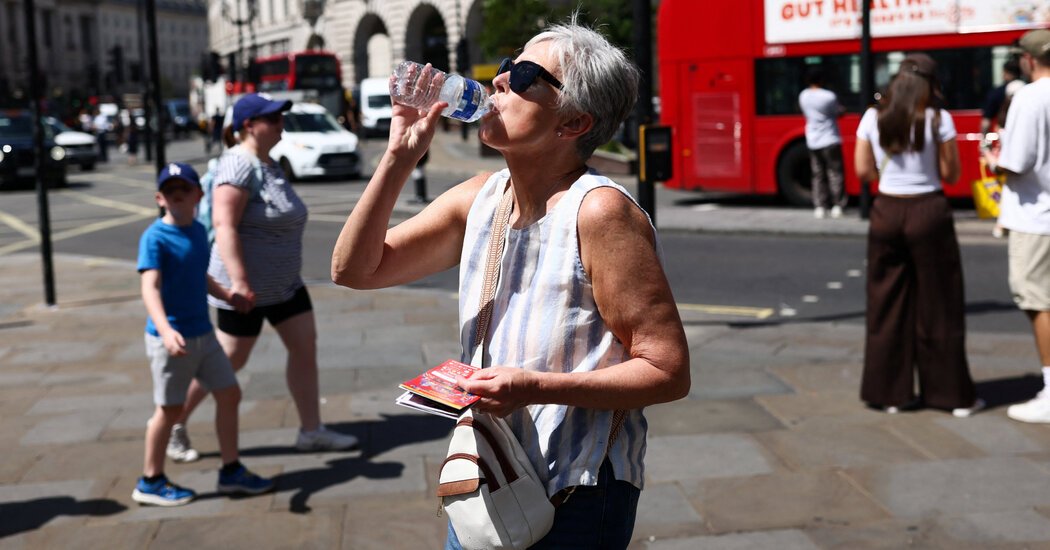
Lines of Londoners outside public pools and ponds. Water mists dousing tennis spectators at the French Open. Commuters packed in stifling public transportation.
And summer hasn’t even started.
Several countries in Western Europe baked under record-breaking heat this week, far earlier than normal, prompting governments to warn about health risks. Heat waves in Europe have become more frequent and more severe in recent years, and scientists have repeatedly attributed that to a rise in global temperatures, driven mainly by the burning of coal, oil and gas.
One study by climate scientists on Tuesday concluded that the extraordinary temperature spikes “are primarily attributed to human driven climate change.”
In France, seven people died in circumstances linked to the heat wave since Saturday, officials said. In Britain, three teenagers drowned in separate incidents, the police said. The unseasonable temperatures came after an abnormally hot 2025 in Europe.
Britain
Temperatures recorded on Monday at Kew Gardens in Greater London climbed to 34.8 degrees Celsius, or nearly 95 degrees Fahrenheit, provisionally setting a record for the highest May temperature and the highest temperature ever recorded during meteorological springtime, which covers March to May.
The new record didn’t last long. On Tuesday, temperatures climbed to 35.1 degrees Celsius, or 95.2 degrees Fahrenheit.
“Too hot for me,” is how Sam Worth, 34, described it as he joined a long line of people seeking respite at a public pool in London.
Britain’s official weather service described the latest heat as “unprecedented for the time of year.” The previous record of 32.8 degrees Celsius, just over 91 degrees Fahrenheit, stood for decades after being recorded in 1922 and 1944.
By Tuesday, the majority of England and Wales were officially in what Britain defines as a heat wave.
“I’m very glad we’re not teaching this week because the children would be struggling,” Phoebe Thomson, a schoolteacher in London said.
Schools are on a midterm break in Britain this week, but they may have to consider loosening uniform rules and administering exams in air-conditioned rooms if the heat continues, Ms. Thomson said.
Many in Britain live without air conditioning.
The average high temperatures for May in the country hover at around 15 degrees Celsius, or 59 degrees Fahrenheit — meaning the heat wave hit when few would expect it. Extreme heat can lead to heat strokes, and people with chronic conditions like hypertension and kidney disease are especially vulnerable.
The U.K. Health Security Agency issued an amber heat health alert — the second-highest level — warning of significant effects across health and social care services, including a rise in deaths, particularly among seniors.
“Our ability to control temperature is much less efficient,” Lucia Daniels, 72, said after dipping into her local pool. She was careful to stay in the shade on her walk home, where she planned to spend the rest of the day “like a lizard,” with curtains drawn and windows closed.
France
Parts of western France broke heat records for May on Monday, according to the national weather service, which warned that temperatures were expected to remain high through the rest of the week.
Temperatures over the weekend climbed as much as 13 degrees Celsius, or 23.4 degrees Fahrenheit, above seasonal norms, the national weather service said, adding that it was “remarkable” for being so early, intense and prolonged.
Seven people in the country have died directly or indirectly because of the current heat wave, including five drownings, Maud Bregeon, the French government spokeswoman, told the TF1 news channel.
At the French Open in Paris, players endured stifling heat on the court and spectators tried to cool off with water misters.
Celine Yahiaoui, 49, a clerk at a Paris court, said she had to commute on a stuffy train with inconsistent cooling and wished she could work from home.
“It’s suffocating,” she said. “We don’t sleep, we struggle to get hydrated.
Spain
Across Spain, a country no stranger to scorching temperatures, an unusually early heat wave has left locals struggling. Temperatures in the southwest are forecast to reach 40°C in the coming days. In the central city of Valladolid, there was a sea of empty outdoor tables —usually a sight reserved for the height of summer — as people avoided the sun. And in Madrid, the capital, residents were bracing for an early summer.
“It looks like we are deep in July,” said Ángeles Ruiz, 60, a nurse sheltering from the broiling heat in the shade of an empty Plaza de Olavide with her two grandchildren.
Ms. Ruiz, 60, said that climate change was upending an old Spanish saying that “you shouldn’t pack away your winter clothes until the ‘40th of May’” — meaning early June.
“Well, that saying makes no sense anymore,” she said.
Elsewhere
Asia has been grappling with record-breaking heat as well. Daytime temperatures were above 45 degrees Celsius, or 113 degrees Fahrenheit, across central and northern India over the past two weeks. In Pakistan, temperatures through Thursday are forecast to be up to six degrees Celsius, or 10.8 degrees Fahrenheit, above seasonal averages.
Ségolène Le Stradic contributed reporting from Paris, Carlos Barragánfrom Madrid and Lauren Leatherby from London.