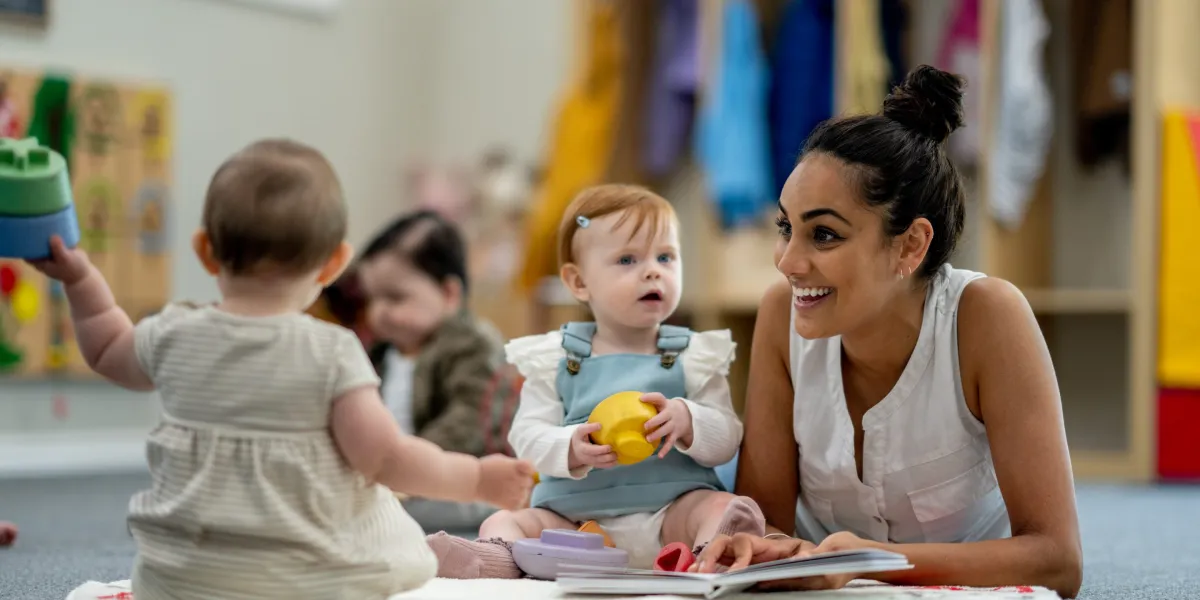

The average American family doesn’t come close to having enough income to comfortably afford childcare, according to a LendingTree study last month.
Federal guidelines say that childcare is affordable if it consumes no more than 7% of household income. Citing data from Child Care Aware of America, LendingTree found that the average annual cost of care for an infant and a 4-year-old is $28,190 nationwide.
That would require household income of $402,708 a year to meet the 7% benchmark. But the average two-child household earns an average of $145,656, meaning the typical family would need a 176.5% pay hike to reach the affordability threshold.
“Most parents could tell you that childcare costs are astronomical these days and can cause a major financial burden, even for high-income families,” said Matt Schulz, LendingTree chief consumer finance analyst and author of Ask Questions, Save Money, Make More: How to Take Control of Your Financial Life.
Looking at individual states, the affordability picture gets even worse. In 20 states, families need at least triple the average income for households with two kids to easily affordable childcare. They include Hawaii, where families need nearly 270% more, followed by Nebraska (263.0%) and Montana (257.8%).
By contrast, South Dakota has the most affordable childcare costs at $16,702. But even then, families would need to earn $238,600, or 95.4% more than the average income in that state.
Racial disparities are also wide. American Indian and Black families need more than 300% in income to hit the affordability benchmark, while white families need 147% and Asian families need nearly 95% more.
“With numbers like these, it’s easy to see why birth rates are falling. Many Americans are saying that having kids doesn’t make financial sense,” Schulz said. “It’s going to require concerted effort on the part of our political and business leaders to change the state of childcare costs here in our country, but that change isn’t coming anytime soon.”
In fact, the U.S. fertility rate dropped to an all-time low in 2024 with less than 1.6 kids per woman, the Centers for Disease Control and Prevention said last summer.
Meanwhile, slightly over 3.6 million births were reported through birth certificates in 2025, or about 24,000 fewer than in 2024, continuing a long-term trend.
To help families cope with childcare expenses, LendingTree suggested maximizing employer benefits, such as dependent care flexible spending accounts, as well as exploring alternative arrangements, like nanny shares, co-ops, mixed informal and licensed care, or part-time preschool.
It also encouraged families to adjust work schedules to reduce the number of paid care hours and to ask providers about sibling discounts, sliding-scale fees, and flexible payment terms.
The findings come as Americans grapple with an affordability crisis that has stretched across a range of basic expenses, including food, electricity, insurance, health care and housing.
Coupled with a sharp slowdown in the labor market, a massive voter revolt is gaining momentum heading into this year’s midterm elections.
To be sure, economic data show cooler inflation, steady income gains, and resilient consumer spending. But according to Michael Green, chief strategist and portfolio manager for Simplify Asset Management, conventional gauges don’t capture how much Americans are struggling with the cost of living, even households earning six figures.
In a viral Substack post in November, he took particular aim at the federal government’s poverty line, which traces back to the early 1960s and was calculated by tripling the cost of a minimum food diet at the time.
The poverty line’s narrow focus on food leaves out how much other expenses are now sucking up incomes and lowballing the minimum amount Americans need to get by.
Green estimated that food comprises just 5% to 7% of household spending, but put housing at 35% to 45%, childcare at 20% to 40%, and health care at 15% to 25%.
“If the crisis threshold—the floor below which families cannot function—is honestly updated to current spending patterns, it lands at $140,000,” he added. “What does that tell you about the $31,200 line we still use? It tells you we are measuring starvation.”