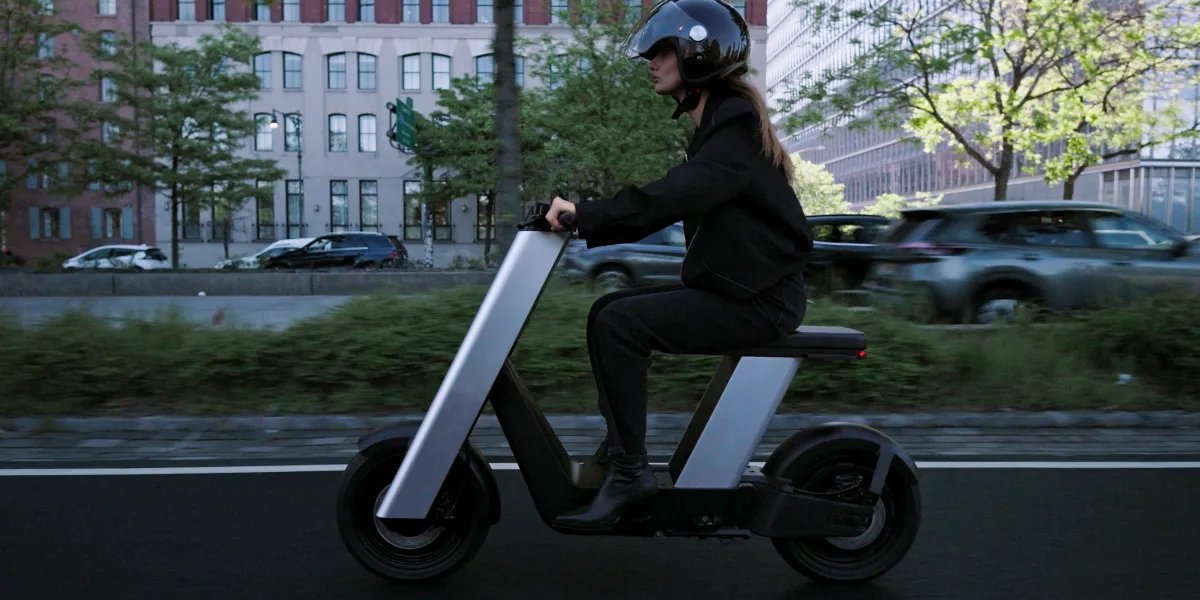
Last week, in Queens, I met up with Infinite Machine CEO Joseph Cohen at his startup’s new vibey office space in Long Island City. After a brief tour, Cohen and I donned motorcycle helmets and went for a ride, spinning through the cobble and paved roads and bike lanes on Infinite Machines’ new e-bike, the Olto. The Olto is quick, fun, and smooth, and it was a blast.
As Cohen and I waited at a traffic light, people on the corner pointed at us, grinning. Olto’s sleek and modern design—like a Cybertruck for the bike lane—tends to grab attention. But is it really a bike?
The Olto follows all the technical parameters of a Class 2 e-bike, where you don’t need a license plate or registration, and it’s allowed in the bike lane. Legally, it’s a bike. In motion, it felt more like I was riding a moped. The Olto is a whopping 176 pounds, has a moped-style seat position, and uses a throttle that gets it up to 20 miles per hour—or more if you’re in a city like New York where higher speeds are allowed.
While there technically are pedals, Cohen advised me not to use them, and said that customers keep the pedals in the locked position—like pegs. Almost as proof of this, the chain on the Olto I rode was really rusty, and a piece of black plastic covered most of it, which I couldn’t help but notice would make the chain impossible to lube or service.
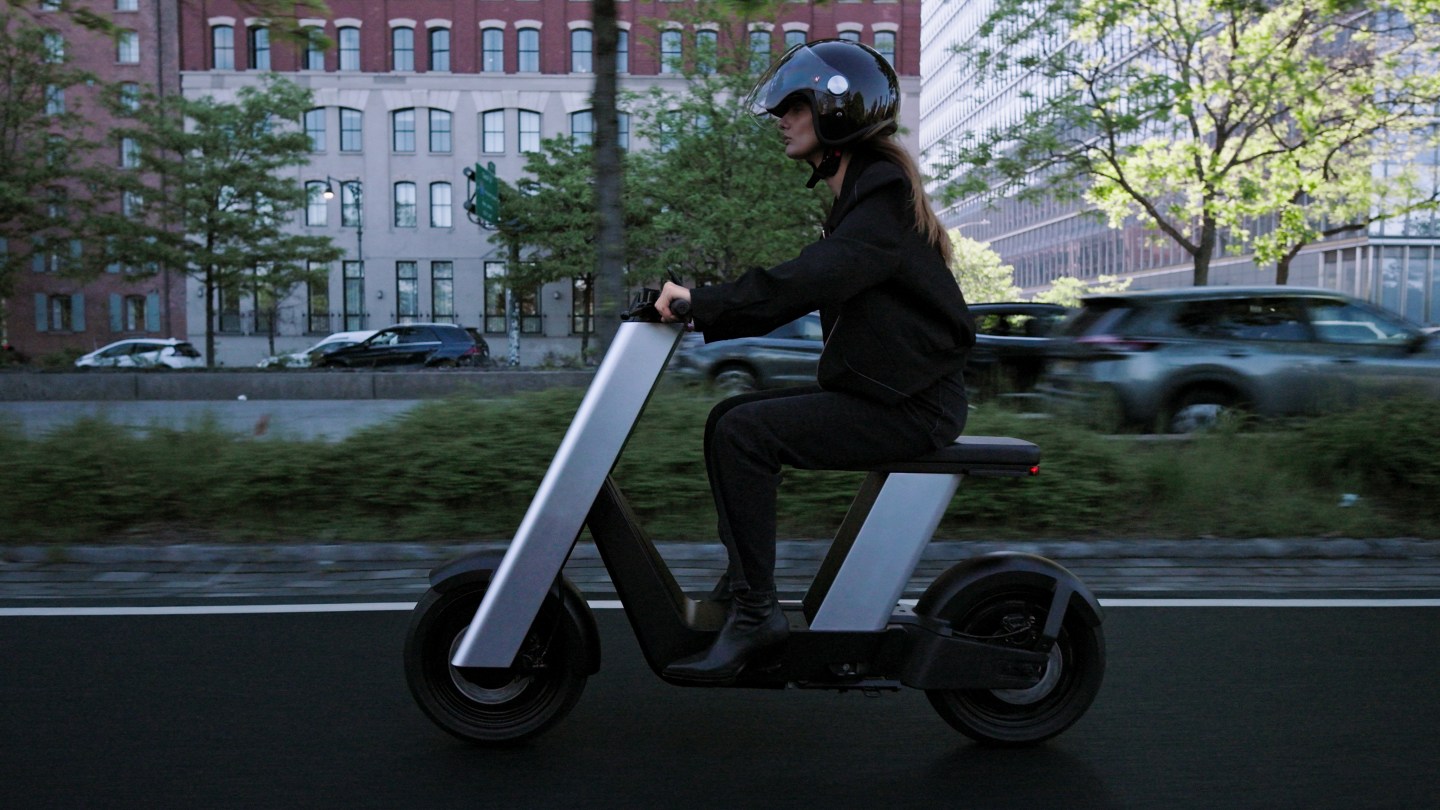
Courtesy of Infinite Machine
For Cohen, these quirks are exactly the point. He and his brother, Eddie, wanted to design a brand new kind of two-wheel transit option designed for both the road and the bike lane. The two spent a lot of time riding their Vespas during Covid, and Cohen says they realized “that two wheels is kind of a hack for New York.” Infinite Machine started manufacturing its first vehicle, an electric moped the P1, and later this e-bike Olto, which they started delivering to customers last year, though he wouldn’t tell me how many had been sold yet
Infinite Machine, which launched a moped motorcycle before the Olto, is already dabbling in what other kinds of vehicles it can build next—and how the startup could (eventually) plug in some sort of autonomy to its e-bikes and scooters. It’s a well-funded venture, with $14.2 million from investors including a16z’s American Dynamism fund (a little funny when you consider that Infinite Machine, like many transit companies, has its scooters and e-bikes assembled in Shenzhen, China). Cohen and his brother, Eddie are energetic and bubbly about their sleek designs and where they see the future of transit going. When you’re talking with them, it’s hard not to get excited right along with them.
At the same time, it’s hard to imagine Infinite Machine won’t run into some trouble as they scale. The e-mobility space is notoriously difficult and full of cautionary tales, but more than that, I wonder what the reaction will be from cyclists like me to have something like Olto passing them in the bike lane. At a speed of 20 or 25 miles per hour, a 176-pound bike carries much more energy than a traditional bicycle, and collisions don’t look the same. E-bike accidents are drawing additional scrutiny from residents in cities, including New York, where some groups are pushing for more parameters for e-bikes and scooters.
After thinking all of that over for a few days, I called up Cohen yesterday and asked about some of those concerns. He said that Infinite Machine is proactive with regulators and has built a “good relationship” with the New York City transportation department, and pointed out that he hadn’t heard of any complaints so far. From his perspective, he wants customers to ride in the bike lanes as a safety precaution from cars and dangerous drivers. “The real threat to safety is from cars and trucks, not from e-bikes,” he said.
Olto isn’t the only vehicle that may redefine the bike lane. Last week, I saw Amazon’s new four-wheel “e-cargo quadricycle” pedaling through the Lower East Side and making last-mile deliveries. It’s a stretch, but the enormous quadricycle technically meets all of the qualifications of a bike, even though it weighs many hundreds of pounds.
It’s hard not to feel that these new modes of transportation may erode the social order of the bike lane—the idea that bike lanes are solely for lower-speed vehicles and the commuters who are most vulnerable on the road. I’m a cyclist with four bikes—I use bike lanes all the time—and can’t help but wonder as some of these new designs get prolific, whether it could start to feel hostile to the people who are actually pedaling.
See you tomorrow,
Jessica Mathews
X: @jessicakmathews
Email: jessica.mathews@fortune.com
Submit a deal for the Term Sheet newsletter here.
Joey Abrams curated the deals section of today’s newsletter. Subscribe here.
VENTURE CAPITAL
– E2, a Menlo Park, Calif.-based developer of medical technology designed for venous thromboembolism, raised $80 million in Series C funding. Gilde Healthcare and Norwest led the round and were joined by existing investors.
– True Footage, an Austin, Texas-based residential appraisal and appraiser services company, raised $40 million in Series C funding from Cox Enterprises, Nava Ventures, Roger Ferguson, Pilot Enterprises, and others.
– Membrane Technology & Research, a Newark, Calif.-based industrial membranes company, raised $27 million in Series B funding. Climate Investment led the round and was joined by Hartree Partners.
– HexemBio, a New York City-based biotech company focused on blood stem cell rejuvenation therapy, raised $10.4 million in seed funding. Draper Associates led the round and was joined by SOSV, Seraphim, and others.
– CONXAI, a Munich, Germany-based agentic AI platform designed to automate construction workflows, raised €5 million in pre-Series A funding. BayBG Venture Capital and Capricorn Partners led the round and were joined by Pi Labs, Earlybird, Noa, Zacua Ventures, and Argonautic Ventures.
– FLORA Fertility, a Calgary, Canada-based fertility insurance platform, raised $5 million in seed funding. ManchesterStory led the round and was joined by Slauson & Co., BDC, Marathon Fund, and Adara Venture Partners.
– Felix, a Prague, Czech Republic-based AI workflow platform designed for legal, finance, and insurance professionals, raised $1.7 million in pre-seed funding. XYZ Venture Capital led the round and was joined by angel investors.
– Prism Layer, a Washington, D.C.-based AI-powered platform for enterprise risk management, raised $1 million in pre-seed funding. Fenway Summer led the round and was joined by Plural VC and others.
PRIVATE EQUITY
– Bay Collective, backed by Sixth Street, agreed to acquire Sunderland AFC Women, a Sunderland, U.K.-based women’s soccer club. Financial terms were not disclosed.
– Caylent, backed by Gryphon Investors, acquired Pronetx, a Columbia, Md.-based customer experience consulting firm. Financial terms were not disclosed.
– First Reserve acquired a majority stake in Lindsey Systems, an Azusa, Calif.-based designer and manufacturer of electric transmission and distribution equipment. Financial terms were not disclosed.
EXITS
– Gamut Capital Management agreed to acquire Acousti Engineering Company, an Orlando, Fla.-based ceiling, drywall, flooring, and specialty interior services provider, from Ardian. Financial terms were not disclosed.
– Triton Partners agreed to acquire Integris, an Amsterdam, The Netherlands-based ballistic protection company, from Agilitas Private Equity. Financial terms were not disclosed.
FUND OF FUNDS
– Eclipse, a Palo Alto, Calif. and New York City-based venture capital firm, raised $1.3 billion across two funds focused on companies in physical industries.
PEOPLE
– 500 Global, a Palo Alto, Calif.-based venture capital firm, hired Nadia Karkar as managing partner. Previously, she was with TPG Rise.
– H.I.G. Capital, a Miami, Fla.-based private equity firm, promoted Brian Schwartz to CEO.
– Rally Ventures, a Menlo Park, Calif.-based venture capital firm, hired Liz Benz as operating partner. Previously, she was Chief Sales Officer at Jamf.