Good morning. AI is moving fast, but many companies still have not decided who should own the job of turning that momentum into measurable business value.
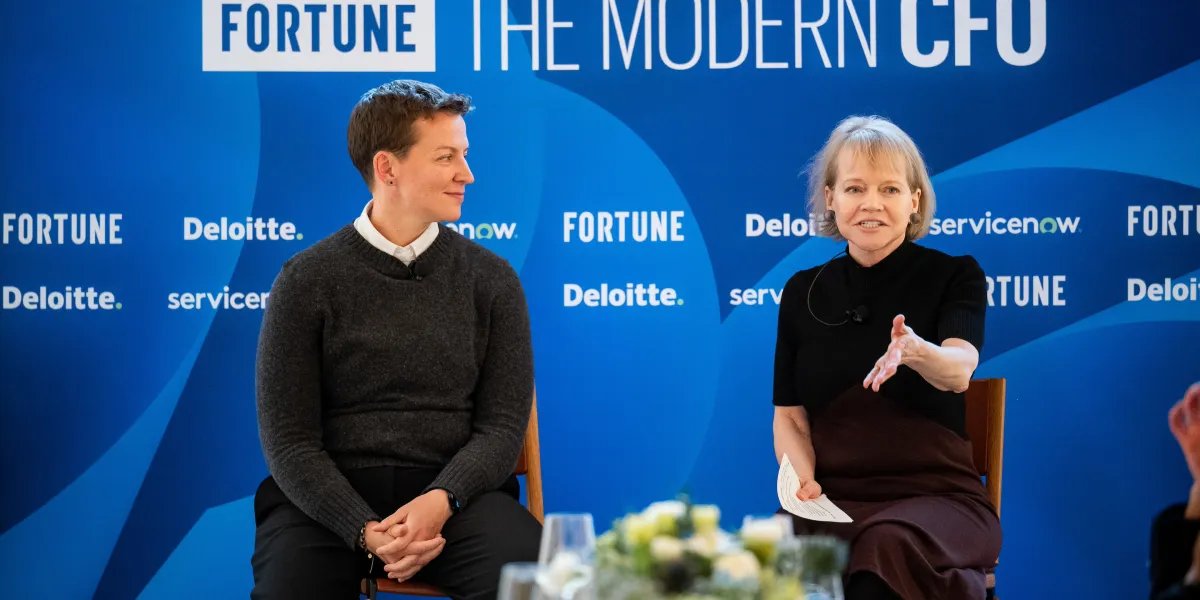
At Fortune’s Modern CFO dinner in San Francisco last Thursday, sponsored by Deloitte and ServiceNow, Melissa Valentine, a senior fellow at Stanford Institute for Human-Centered Artificial Intelligence, delivered a clear message to CFOs: they have a narrowing window to take command of AI value creation.
Valentine pointed to a recent Harvard Business Review article by the founders of the Return on AI Institute, citing survey findings that underscore this opening. Only 2% of the C-suite executives surveyed said CFOs were charged with capturing value from AI. Yet when CFOs were responsible, 76% reported generating substantial value, well ahead of other functions. Laks Srinivasan, coauthor of that report, told me that finance chiefs are uniquely positioned to define, evaluate, fund, and measure AI initiatives, then apply that framework across the company.
Valentine, a tenured associate professor of management science and engineering at Stanford’s School of Engineering, told the room of finance chiefs that CFOs have a strategic opening to lead on AI if they are willing to quantify the value and be accountable for it. She argued that generative AI is moving out of its experimental phase and into something CFOs know well: systematic measurement. Two years ago, she said, rigorous accountability would have been premature. Today, it’s essential.
On the question of guardrails, Valentine pointed to a recent incident in which Anthropic inadvertently exposed internal source code for its Claude coding tool, offering a rare public glimpse into how frontier AI labs protect their models. She called attention to the concept of “harness engineering,” the infrastructure surrounding models to make them usable and safe, including secondary AI systems designed to monitor primary ones. Her advice to CFOs: Study that architecture because leaders must understand whether the system around a model is robust enough to govern, monitor, and trust at enterprise scale.
That example reinforced a broader point in Valentine’s remarks: the requirements for safe, production-grade AI are fundamentally different from those for everyday employee experimentation. She drew a sharp distinction between two very different forms of AI transformation. One begins at the frontline, where employees use tools such as Gemini or NotebookLM and discover practical applications through experimentation. The other is driven from the top, where production-grade use cases demand robust data infrastructure, engineering rigor, and governance. Both matter. Each requires a distinct operating model.
The main takeaway for finance leaders is that AI accountability is becoming a CFO-level competency. As AI moves from novelty to operating imperative, the executives who impose discipline will be the ones best positioned to capture its value.
Sheryl Estrada
sheryl.estrada@fortune.co
Leaderboard
Marcel Teunissen was appointed CFO of Expand Energy Corporation (Nasdaq: EXE), effective April 6. Teunissen most recently served as president of North America for Parkland Corporation. He previously served as Parkland’s CFO where he led the company’s financial strategy, capital markets, and investor engagement. Before Parkland, Teunissen spent more than 20 years with Shell plc in roles, including as VP of finance for Integrated Gas Ventures and EVP of finance for Global Integrated Gas and New Energies.
Steven E. Pfanstiel will step down from his role of EVP, CFO and treasurer of Neuronetics, Inc. (Nasdaq: STIM), a medical technology company. Pfanstiel is pursuing an opportunity outside the company. He will remain through May 1. Neuronetics has launched a search to identify his successor.
Big Deal
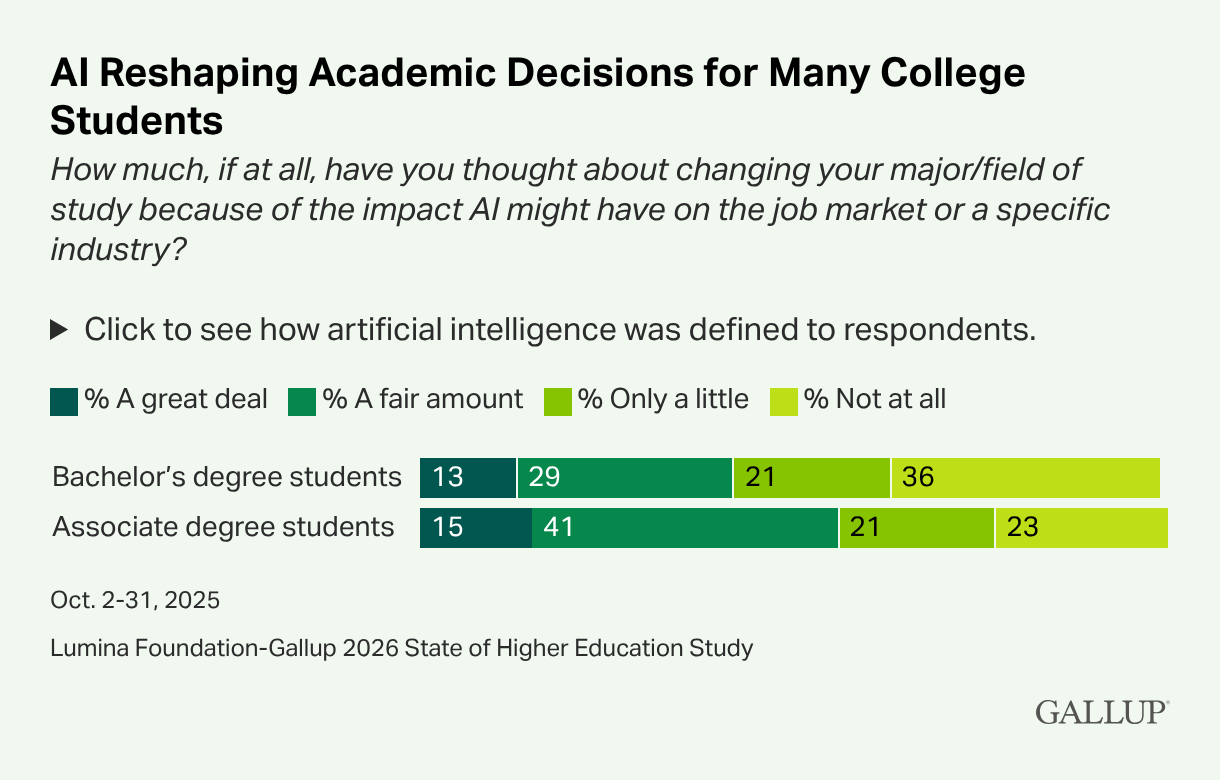
As companies build talent pipelines for the next generation of employees, AI is shaping how college students think about their academic paths, according to the findings of a Lumina Foundation-Gallup 2026 State of Higher Education Study. Forty-two percent of bachelor’s degree students surveyed say AI has led them to consider changing their major, including 13% who have thought about it a great deal. Among associate degree students, that share rises to 56%, with 15% giving it serious consideration.
Another key finding is that while traditional motivations — including gaining skills, higher pay and career fulfillment — remain far more common, about one in seven bachelor’s degree students (14%) and associate degree students (13%) say preparing for AI and other technological advances is an important reason they enrolled.
Going deeper
The State of AI in Manufacturing is a report by Digit, based on an analysis of U.S. Census Bureau Business Trends and Outlook Survey, looking at data from manufacturing firms from July 2022 to February 2026. AI adoption in U.S. manufacturing has grown four times since 2023. Enterprises are also 2.3 times more likely to adopt than small manufacturers.
But that growth is slow and cautious — 87% of manufacturers still haven’t adopted it. Uncertainty around adopting AI has grown from 9.2% to 14.4%. A factor contributing to slow adoption is the lack of clarity about AI’s ROI.
What manufacturers are missing is a clear problem to solve to move from planning to execution, according to the report.
Overheard
“Most organizations trying to deploy AI are discovering that the hardest problems are not technological. Data readiness, security, integrations, workflow redesign, and building human skills remain stubborn bottlenecks for true AI implementation.”
—Omar Abbosh, CEO of Pearson, a global education company, writes in a Fortune opinion piece.