When McPherson Middle School in central Kansas banned cell phones in school four years ago, they didn’t reconsider their school-issued Google Chromebooks that were actively being used in the classroom and at home. It wasn’t until December of last year that it asked its 480 students to give up the laptops as well.
Administrators found that without their phones, students were using school laptops for distracting activities like watching YouTube or playing games, rather than learning. Some were even using their school Gmail accounts to tease other students, the New York Times reported.
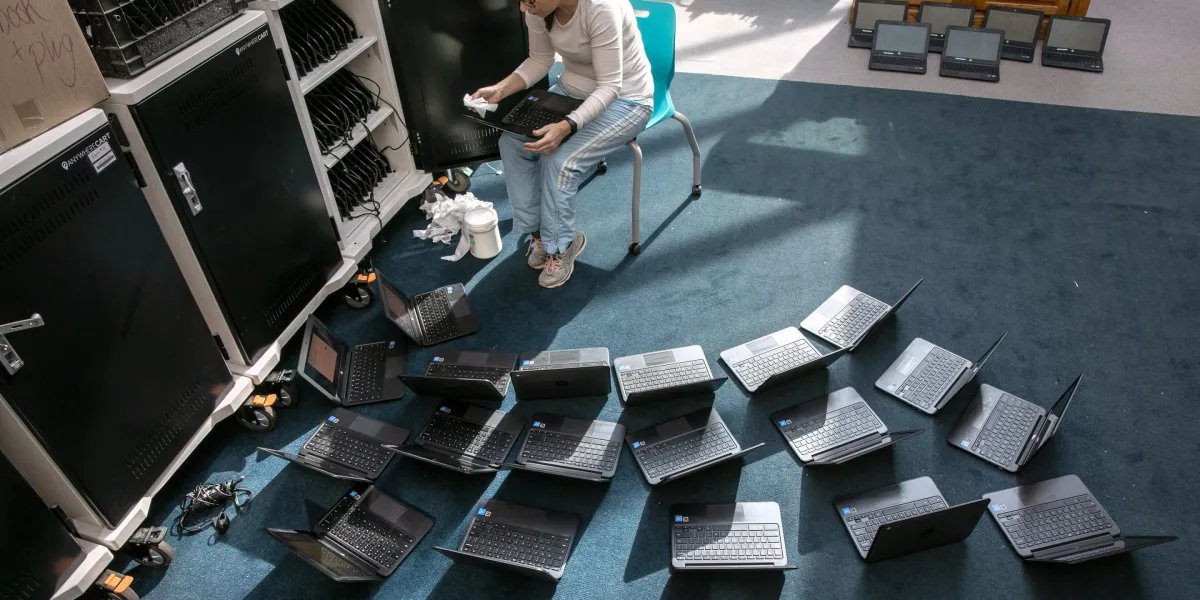
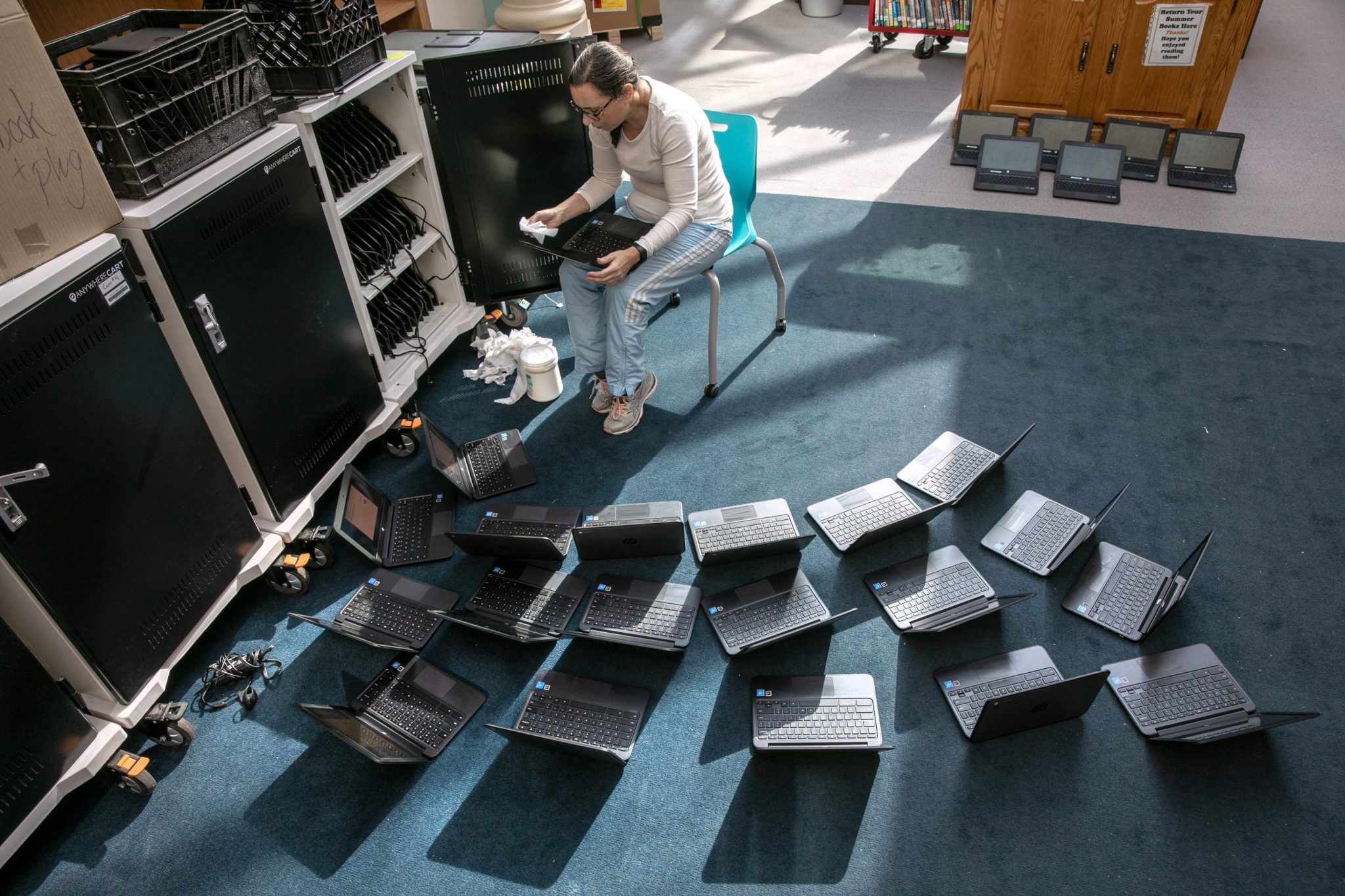
Now, the school has transitioned to using laptops only for specific teacher-assigned activities. Meanwhile, the unused laptops sit in carts in the back of classrooms, and children take notes the old-fashioned way: on pen and paper.
“This technology can be a tool. It is not the answer to education,” said McPherson’s principal Inge Esping, who won Kansas’ middle school “principal of the year” award for 2025.
Students who want to use the laptops for extra work at home can also borrow a Chromebook from the school library, the Times reported.
Increasingly, schools like McPherson in other states such as North Carolina, Virginia, Maryland, and Michigan are rethinking their policies of buying and assigning a laptop to every student and the millions of dollars they spent on them, as studies show implementing technology in schools has reportedly coincided with either decreasing test scores or no progress at all for students.
Maine, which in 2002 was one of the states to first adopt a policy of putting laptops in public school did not improve its test scores after 15 years of its laptop initiative, NPR reported in 2017. Jared Cooney Horvath, a neuroscientist and former teacher, said in written testimony before the U.S. Senate Committee on Commerce, Science, that math and science scores have decreased as technology has been introduced in classrooms. Citing the Trends in International Mathematics and Science Study (TIMSS), Horvath said “frequent in-class computer use correlates with significantly lower math and science performance across both high-income and middle-income countries.” This study showed that fourth graders and eighth graders test scores correlated with whether they were using laptops almost never on the high end versus almost daily on the low end.
Google Chromebook laptops, which are made by PC makers like Lenovo, Acer, and Dell, have a tight grip on America’s schools. The laptops are relatively low cost, averaging between $300 and $400 per device. In schools, Chromebooks also have an advantage by leveraging ChromeOS, which use built-in web apps like Google Docs rather than installed apps like Microsoft office, which can be costly. Similarly, tools such as Google Classroom have become a mainstay of America’s K-12 schools.
Google’s education push has also been lucrative. Education accounts for 60% of global Chromebook market share as of 2025 boosting the Chromebook total market to $14 billion.
Laptop regrets
Schools in North Carolina spent $448 million in pandemic-related federal funding on computers and equipment for students and staff, according to news station WRAL. But after these funds dried up, schools have struggled to replace broken or outdated devices, which last on average less than a decade despite Google’s efforts to extend device lifespans. During a 2025 committee meeting, Robert Taylor, the superintendent of North Carolina’s largest school system in Wake County said the district needed to move away from its one-to-one laptop policy. explain
Another North Carolina school district has tried to diminish laptop use for educational reasons, reported Carolina Public Press. In Burke County, a county in western North Carolina with fewer than 100,000 residents, the school board passed a resolution for Burke County Public Schools to encourage learning with paper and printed materials, and limit screen time only “for activities where technology offers clear, evidence-based instructional advantages.” As a result, in February, parents and educators reported improvements in reading comprehension and test scores, as well as a decrease in homework-related stress that many attributed to the pro-paper resolution.
Earlier this year, a school district in Wexford County, Mich., which has a population of 34,000, banned screens for elementary school students to mitigate its reading proficiency issues. More than 65% of the third, fourth, and fifth-graders in one elementary school alone were “not proficient” or “partially proficient” on state standardized tests, according to Interlochen Public Radio.
The trend of schools moving away from technology comes as evidence emerges that access to screens does not improve student outcomes and could instead be holding them back. Horvath in his written testimony before the Senate, claimed Gen Z is the first generation in modern history to score lower than their parents’ generation on standardized tests.
Distractions are a major culprit of this degradation of learning, Horvath previously told Fortune, adding that refocusing attention after it’s been diverted takes time to recover. Educational systems “screwed up,” he told Fortune. “And I genuinely hope Gen Z quickly figures that out and gets mad.”