Iran’s preparations for the upcoming World Cup in North America have unfolded against the backdrop of war, bellicose language and continuing doubts the national team will receive visas in time.
The unease has already led to summits between Iranian officials and the top leaders of soccer’s governing body. At the center of it has been Mehdi Taj, the longtime president of Iran’s soccer federation.
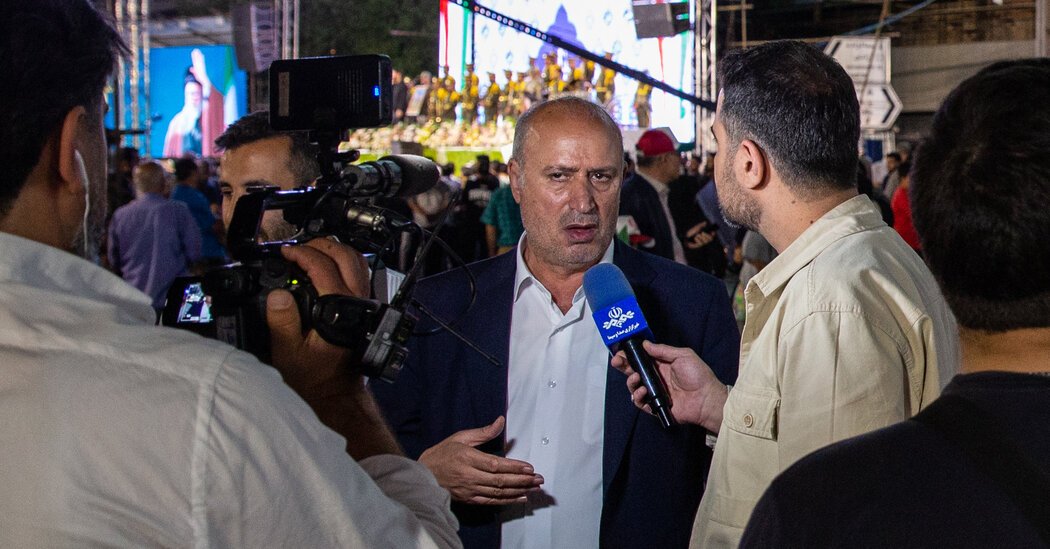
In a rare interview, Mr. Taj, a former commander in the Islamic Revolutionary Guards Corps, left little doubt whom he blames for the complications.
As Iran’s national team prepared to set off for Mexico instead of the United States, a last-minute change brought on amid continuing tension, Mr. Taj said the decision was made with FIFA to minimize the team’s time in the United States, which he blames for all of the uncertainty over Iran’s World Cup participation.
Speaking over a video call, Mr. Taj pointed out Iran had been the third team to qualify for what will be the biggest World Cup in history — spanning the United States, Canada and Mexico with 48 teams competing — and the first to feature a host at war with one of the competing nations.
Those preparations, he said, had been affected in ways that have disadvantaged his team. Most recently Iran’s soccer team abruptly changed its World Cup base from the United States to Tijuana following talks with FIFA in Turkey, where the team has been practicing for much of the past month.
Speaking from Tehran on Tuesday, Mr. Taj expressed deep disappointment that visa applications for the squad, which is slated to play three games on the American West Coast, had still not been approved.
The team has been preparing at a camp in southwestern Turkey. The World Cup begins June 11, and Iran’s first game is scheduled four days later against New Zealand in Los Angeles. Iran had planned to be based in Tucson, Ariz., before FIFA, soccer’s global governing body, announced the team would instead be in Tijuana, Mexico, near the United States border.
Iran’s presence at the tournament with no end in sight to the war with the United States is one of the biggest crises in the World Cup’s nearly 100-year history.
A host nation, Mr. Taj asserted, should not have the authority to disrupt the preparations of qualified teams. Since the war began in late February, both Iranian and American officials, including President Trump and even Mr. Taj, have sowed uncertainty with shifting claims.
Mr. Taj said the killing of Iran’s supreme leader at the start of the war and the bombing of a school that killed more than a hundred children had created a “cloud of ambiguity” over Iran’s participation. But he said Iranian officials had since held productive talks with FIFA’s leadership, including its president, Gianni Infantino, to lay the groundwork for the team to play.
Mr. Infantino, who has a close relationship with Mr. Trump, traveled to Turkey in March to show support to Iran’s team, and last month, FIFA’s top administrator, Mattias Grafström, met with Iranian officials, too.
“We are only in contact with FIFA and are not in contact with the United States and don’t know what their thoughts are,” Mr. Taj said.
Mr. Taj has encountered difficulty traveling in recent months. He was among officials denied credentials for the tournament draw in Washington in December. Last month, Canadian authorities revoked his documents as he was transiting to Vancouver via Toronto for FIFA’s annual meeting. Mr. Taj said that after several hours of talks with Canadian officials, he returned home in protest with the rest of Iran’s delegation.
He was formerly a commander in the Islamic Revolutionary Guards Corps, a group that the United States and Canada have designated a terrorist entity.
Mr. Taj said he no longer had any relationship with the group but argued it had widespread support in Iran for defending the country. In Canada, he said, he and others in Iran’s delegation “spent the time defending the country” under questioning from border officials in Toronto.
Secretary of State Marco Rubio said at a recent White House appearance alongside Mr. Trump that trainers and other officials with links to the Revolutionary Guards would not be allowed into the United States.
Several players on Iran’s roster, including its captain, have completed mandatory military service with the group, Mr. Taj said.
Visa troubles before the World Cup led the Iranians, Mr. Taj said, to “suspect that it was possible that the U.S. would create some serious problems for us.”
On Monday, the team released its official roster in a video on social media, and it has one more tuneup game, against Mali, before its planned departure to the base camp in Mexico. Sardar Azmoun, a star player who drew criticism for a social media post following the war that some officials branded disloyal, was left off the squad.
Mr. Taj spoke positively of the last-minute switch, saying Tijuana offered better conditions than Tucson because it was closer to Los Angeles, where two of Iran’s games will be played, and has a better climate and easier transport links.
He was less forthcoming about how the change came about. Mexico’s president, Claudia Sheinbaum, said FIFA had asked her country for help because the “United States does not want the Iranian team staying overnight in the country.”
Mr. Taj said he was unaware the United States had made any such request. “We came to the conclusion mutually with FIFA that we want our presence in the U.S. to be as minimum as possible,” he said.
For FIFA, the crisis requires careful navigation: satisfying an expectant host nation, reassuring a qualified team and maintaining political neutrality. That neutrality has already been questioned because of Mr. Infantino’s warm relationship with Mr. Trump.
Mr. Taj said that under FIFA’s “Fair Play” principles, all qualifying nations must be treated equally and that protecting that principle from political interference was FIFA’s responsibility, not Iran’s.
FIFA did not respond to a request for comment.
Asked whether he was confident that the opening game would take place, Mr. Taj offered no assurances.
“You should ask FIFA,” he said.