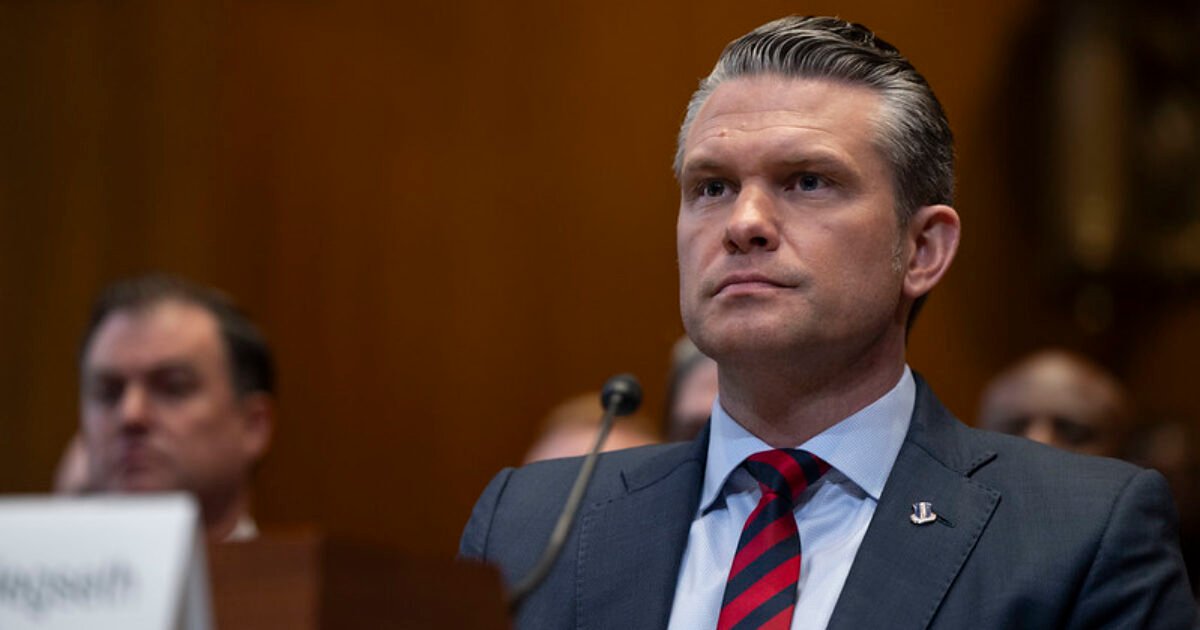

Secretary of War Pete Hegseth scored a significant legal victory Thursday after a federal appeals court overturned a lower court ruling and allowed the Pentagon to continue enforcing restrictions on press access inside the building while litigation proceeds.
The decision from the U.S. Court of Appeals for the District of Columbia Circuit means the Department of Defense may continue requiring credentialed journalists, including reporters from The New York Times, to be escorted inside the Pentagon rather than freely roam the halls without supervision.
The court found that the Trump administration is likely to prevail on appeal regarding the legality of the policy.
The ruling marks another win for the Trump administration’s effort to crack down on unauthorized leaks of sensitive military information after months of escalating tensions between Pentagon leadership and legacy media outlets.
Hegseth has repeatedly argued that unrestricted access inside one of the nation’s most sensitive military facilities presents an unnecessary security risk, particularly as classified information has repeatedly appeared in media reports citing anonymous government sources.
It can be recalled that in October, Pentagon reporters turned in their badges after they refused to sign Secretary of War Pete Hegseth’s new security rule.
“Defense Secretary Pete Hegseth demanded that reporters agree by 5 p.m. Tuesday to a new policy, under which they would need to pledge to not obtain or use any unauthorized material, even if the information is unclassified — or hand over their press badges in the next 24 hours,” The Hill previously reported.
By that afternoon, Pentagon reporters turned in their badges.
The Pentagon Press Association previously released a statement blasting Hegseth.
“Today, the Defense Department confiscated the badges of the Pentagon reporters from virtually every major media organization in America. It did this because reporters would not sign onto a new media policy over its implicit threat of criminalizing national security reporting and exposing those who sign it to potential prosecution,” the PPA said.
“The Pentagon Press Association’s members are still committed to reporting on the US military. But make no mistake, today, Oct. 15, 2025 is a dark day for press freedom that raises concerns about a weakening US commitment to transparency in governance, to public accountability at the Pentagon and to free speech for all,” the statement said.
The Pentagon press pool now includes conservative outlets, including The Gateway Pundit.
The New York Times filed a lawsuit to stop the Pentagon from enforcing its new policy.
US District Judge Paul Friedman, a Clinton appointee, blocked the Pentagon from enforcing its new policy and said it violated the First Amendment.
“The Court recognizes that national security must be protected, the security of our troops must be protected, and war plans must be protected. But especially in light of the country’s recent incursion into Venezuela and its ongoing war with Iran, it is more important than ever that the public have access to information from a variety of perspectives about what its government is doing—so that the public can support government policies, if it wants to support them; protest, if it wants to protest; and decide based on full, complete, and open information who they are going to vote for in the next election,” the judge wrote in a 40-page opinion.
Thursday’s appellate ruling reverses that victory.
According to Reuters, the three-judge appeals panel concluded that the Pentagon’s escort requirement does not amount to unconstitutional retaliation against journalists and may remain in effect while the broader appeal moves forward. The Pentagon has maintained that journalists who seek unauthorized disclosures of sensitive information can pose legitimate security concerns inside the building.
Ad block users: Some site features may not work correctly while an ad blocker is enabled, because they break scripts and content this website depends on. If you can’t see comments below, for example, please disable your ad blocker.