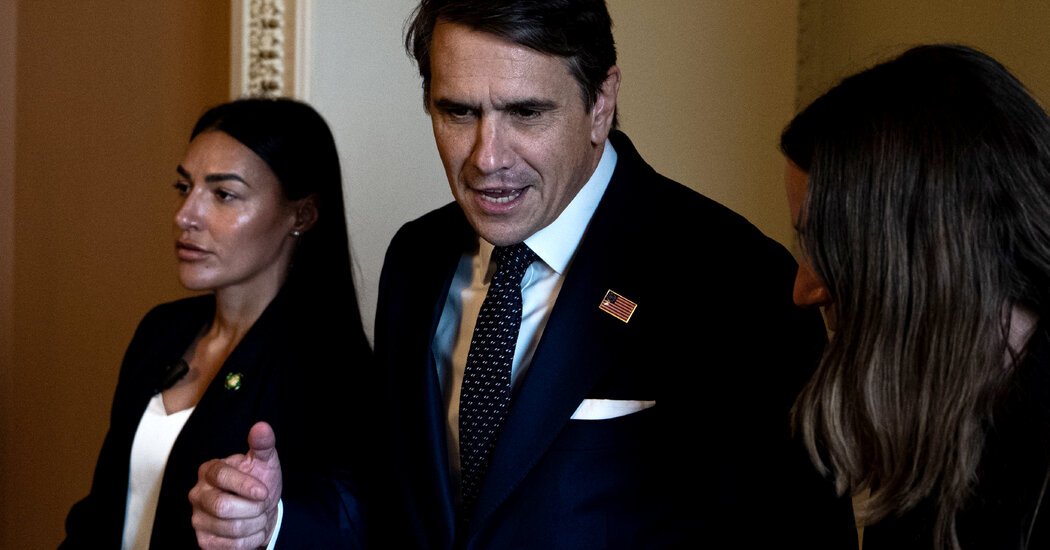
When Todd Blanche interviewed Ghislaine Maxwell at a Florida courthouse last summer, he said it was because she had never been given an opportunity to speak about her past with the convicted sex offender Jeffrey Epstein.
Mr. Blanche’s personal role in the Justice Department’s handling of the Epstein case will be front and center on Wednesday during his confirmation hearing to become attorney general, the nation’s top law enforcement official.
Mr. Epstein’s victims, lawmakers and others have criticized Mr. Blanche’s handling of the Epstein files. They say he badly bungled the work by revealing information about victims and failing to extract meaningful information from Ms. Maxwell, Mr. Epstein’s former assistant and ex-girlfriend, who was convicted of sex trafficking in 2021.
As the department’s No. 2 official, Mr. Blanche oversaw the release of the Epstein files. He also interviewed Ms. Maxwell as public anger mounted over the administration’s abrupt decision to no longer release documents about Mr. Epstein’s years of abuse of teenage girls.
It is highly unusual for such a high-ranking Justice Department official to personally conduct an investigative interview of a convicted criminal who remains in prison. The oddity was underscored by who was not there — neither the F.B.I. case agent, nor a detective for the New York Police Department, nor federal prosecutors who had worked the Maxwell case.
If any of those people had been in the interview, they could have told him that Ms. Maxwell explicitly rejected the chance to speak at her trial in 2021.
“Your Honor, the government has not proven its case beyond a reasonable doubt, and so there is no need for me to testify,” Ms. Maxwell said in court. When the judge pressed her on whether she was certain, she replied, “That is correct.”
Mr. Epstein died by suicide in 2019 in jail while awaiting trial on several charges, including sex trafficking of minors.
Ms. Maxwell had plenty of valid reasons to stay silent. Most defendants at trial choose not to testify, afraid that their answers might make them look more guilty. And she had already been charged with perjury, for claiming in a civil deposition in 2016 that she was unaware of Mr. Epstein’s sexual activity with others, and that she had not given him a massage, nor given one of his victims a massage.
Senator Richard Durbin of Illinois, the senior Democrat on the Senate Judiciary Committee, said the Maxwell interview was a topic of discussion when he met with Mr. Blanche privately on Tuesday before the confirmation hearing. “He was told that she wanted to talk, and he felt, ‘I better go and talk to her, there’s no excuse for not talking to her,’ so he did and apparently nothing came of it,” Mr. Durbin said.
David O. Markus, Ms. Maxwell’s lawyer, defended Mr. Blanche’s handling of the interview.
“People have lost their minds over” it, Mr. Markus said. “For years, everyone demanded that the government speak to Ghislaine Maxwell. When Todd Blanche finally did exactly that, the same people immediately criticized how he did it. Had he declined to interview her, they would now be condemning him for failing to pursue potentially important information.”
Ms. Maxwell’s credibility on the subject of Mr. Epstein has been in doubt for many years. Asked at the 2016 deposition whether Mr. Epstein had a scheme to recruit underage girls for sexual massages, she answered, “I don’t know what you are talking about.”
The trial evidence sharply undercut such claims, including testimony from one woman who said she first met Mr. Epstein and Ms. Maxwell at a summer camp when she was 14, and was later abused by him. Ms. Maxwell, the victim said, explained to her how Mr. Epstein liked to be massaged.
In her interview with Mr. Blanche, Ms. Maxwell insisted that she had nothing incriminating to say against President Trump, a longtime friend of Mr. Epstein’s.
“The president was never inappropriate with anybody,” she told Mr. Blanche, who previously worked as Mr. Trump’s lead defense lawyer. “In the times I was with him, he was a gentleman in all respects.”
In April 2011, however, Mr. Epstein sent Ms. Maxwell an email stating, “I want you to realize that that dog that hasn’t barked is trump.” Mr. Epstein added that one of his victims “spent hours at my house with him.”
Ms. Maxwell replied, “I have been thinking about that …”
Mr. Blanche, in his interview of Ms. Maxwell, did not press her on past accusations of lying. When she sought to deny some of the allegations against her — statements that could have undermined her credibility — he repeatedly cut her off.
“I don’t want to get into ‘he said, she said,’” Mr. Blanche told Ms. Maxwell when she tried to dispute accusations regarding the 14-year-old. At another point, when talking about the same victim, Mr. Blanche added, “Let’s not talk about individuals.”
Debra Lieberman, a psychologist whose company, RDQN Labs, built a linguistic tool to analyze interviews and depositions, said the transcript showed that Mr. Blanche was far more curious about former President Bill Clinton than Mr. Trump, noting that he asked questions about Mr. Clinton’s presence on Mr. Epstein’s plane and island, but never asked such questions about Mr. Trump.
(Both Mr. Clinton and Mr. Trump have denied wrongdoing.)
The analysis done by her company indicated that Mr. Blanche’s questions were “more about building a record than finding out facts,” she said.
Days after the interview with Mr. Blanche, Ms. Maxwell was transferred from her minimum-security prison in Florida to a less restrictive prison camp in Texas, contrary to the Bureau of Prison’s own rules.
“That was shocking,” said Robert Hood, a former warden at a Supermax federal prison, and a former head of internal affairs at the Federal Bureau of Prisons. He said he was aware of no instance, going back to 1930, when the agency had done such a transfer. “You don’t reward the person by sending them to the most liberal prison in America.”
Mr. Blanche has publicly defended Ms. Maxwell’s transfer, saying there had been threats to her safety. Mr. Hood and other law enforcement officials noted, however, that an inmate typically would be placed in a more restrictive environment, like a special housing unit, to safeguard against possible harm by other inmates. In Ms. Maxwell’s case, she was transferred to a facility with fewer restrictions.
The Bureau of Prisons has defended the decision, saying it made it independently and “based on these factors that required additional security measures.”
“Inmate safety is a key consideration, and we could no longer ensure her safety at her original facility,” it said, adding that the decision was not based on “preference, special treatment or political influence.”
On Tuesday, a Justice Department spokeswoman insisted that Ms. Maxwell was not transferred to a prison camp because of any proffer interview or cooperation, but out of concerns for her safety.
Carl Hulse contributed reporting.