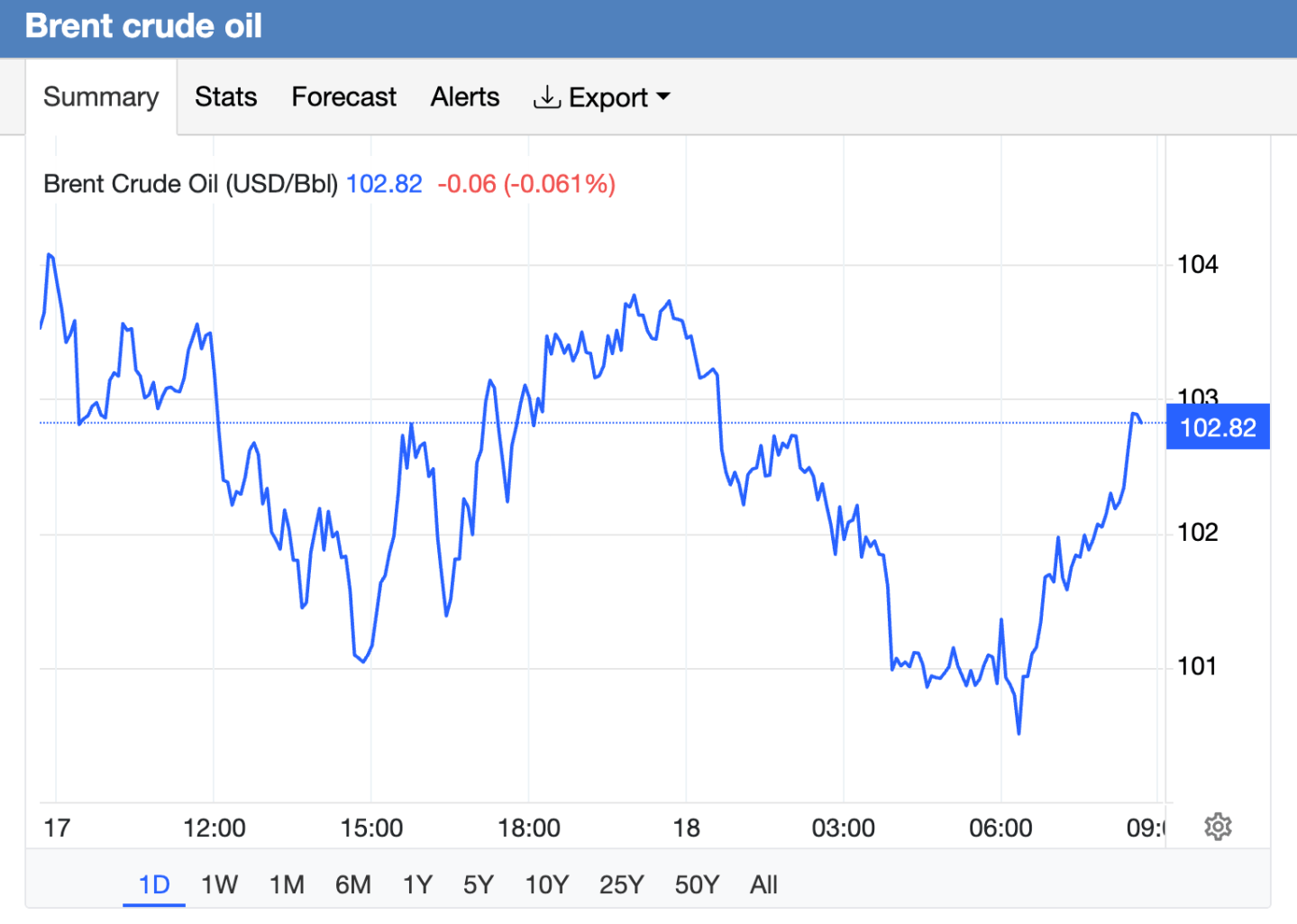
Oil was at $102 this morning and moderating downward after Iraq made a deal to export oil through Turkey, avoiding the Strait of Hormuz. S&P 500 futures were up 0.5% before the bell after the index closed up 0.25% yesterday. The optimism continued in Asia and Europe: South Korea’s KOSPI was up 5%, Japan’s Nikkei 225 was up 2.87%, Stoxx Europe 600 was up 0.57% in early trading, and the U.K.’s FTSE 100 was up 0.33% midmorning.
Powell will hold the line against oil-driven inflation: As UBS’s Paul Donovan told clients this morning, “The Federal Reserve is universally expected to leave policy unchanged. Fed Chair Powell’s press conference excites attention for three reasons. 1. Powell may stay as Fed Chair beyond May, so is a less lame ‘lame duck’ leader. 2. Markets want to know the Fed’s reaction to oil prices and the war. U.S. retail gasoline prices are almost exactly a dollar (35.5%) above 2026 lows, having risen every day for four weeks. The Fed’s concern is second-round effects. 3. Markets want to understand the Fed’s views of the underlying economy, as investors seem to expect the U.S. to exit the war and energy prices to normalize.”
If oil stayed above $100 per barrel for a full year, the tax benefits for Americans in the One Big Beautiful Bill Act ($800 per person) “will be fully wiped out” due to inflation, according to Wells Fargo’s estimates.
IRAN
No end in sight, but plenty of ‘butterfly effects’
The resignation of Joe Kent, the director of the White House’s National Counterterrorism Center, has focused attention on the Trump Administration’s strategy for winning, ending, or exiting the war with Iran. Kent said he resigned because the U.S. should have never been involved in the first place and that Iran “posed no imminent threat to our nation,” according to Fortune’s Catherina Gioino. (Kent also floated a conspiracy theory that the war was all Israel’s fault.) Republicans are becoming more open in their dissent against the war.
The problem is that the U.S. and Israel have two different aims in the conflict, according to Axios. The U.S. is focusing on destroying Iran’s military capabilities, but Israel is hunting down and killing as many top-level Tehran regime members as it can find. (Here is a list of the dead.)
The result is chaos, Axios reports: “Israel doesn’t hate the chaos. We do. We want stability. Netanyahu? Not so much, especially in Iran. They hate the Iranian government a lot more than we do,” a White House official told the site.
The chaos is producing “butterfly effects” across the world, which include unexpected “second-order effects” far from the Strait of Hormuz, according to Deutsche Bank’s George Saravelos. “First, a disruption to chip production in Taiwan given the industry’s reliance on Middle East energy production, including helium. Disruptions to the semiconductor supply chain could be highly relevant given the importance of AI in driving equity valuations,” he told clients in a note seen by Fortune. He is also watching “the broader knock-on influence on the credit cycle.”
- Shipping groups have invoked a 19th-century law that allows them to dump their clients’ cargoes at the nearest convenient port, and force the client to pay for moving it from there, according to the Financial Times. Containers destined for the Middle East have been dropped at in India, deliveries for Saudi Arabia have been dumped in the U.A.E.
- Don’t expect the Strait of Hormuz to reopen anytime soon. “It could take several weeks to secure the Strait of Hormuz,” said Bob McNally, president of Rapidan Energy Group told Bloomberg. “Until we’ve neutralized Iran’s layered, asymmetric capabilities—mines, fast attack craft, submarines and drones—we won’t want to put commercial or even escort ships through.”
President Trump is furious that NATO declined to send minesweepers to help the war effort. “WE DO NOT NEED THE HELP OF ANYONE!” he raged on social media last night.
The lack of minesweepers is a problem because four of the U.S. Navy’s anti-mining ships are heading to Philadelphia for decommissioning, and another four are in Japan, the Wall Street Journal reports.
ARTIFICIAL INTELLIGENCE
Nvidia might pay engineers in AI tokens
As business leaders aim to harness AI to boost worker productivity, Nvidia CEO Jensen Huang said his company is considering plans to pay engineers in tokens—the currency of AI—to amplify their output, according to Fortune’s Jake Angelo. “I could totally imagine in the future every single engineer in our company will need an annual token budget,” he said. “They’re going to make a few 100,000 a year as their base pay. I’m going to give them probably half of that on top of it as tokens so that they could be amplified 10 times.”
AI isn’t destroying consultants, Capgemini says
Not dead yet! Capgemini Chief Strategy Officer, Fernando Alvarez, says that despite the chatter that consultancies will be killed off by AI, clients aren’t giving up on humans yet. He told Fortune’s Jeremy Kahn that while every company wants to use AI agents, they also recognize the need to govern those agents, ensure cybersecurity around them, and enable them to interact with legacy systems and fragmented data sources. Advising clients on all of those topics has been Capgemini’s bread and butter. Alvarez says clients aren’t ready to hand it off to AI. “The conversation is, do you have the domain expertise to understand my problem?” he says.
In other AI news:
CHART OF THE DAY
Prediction markets see the war getting longer
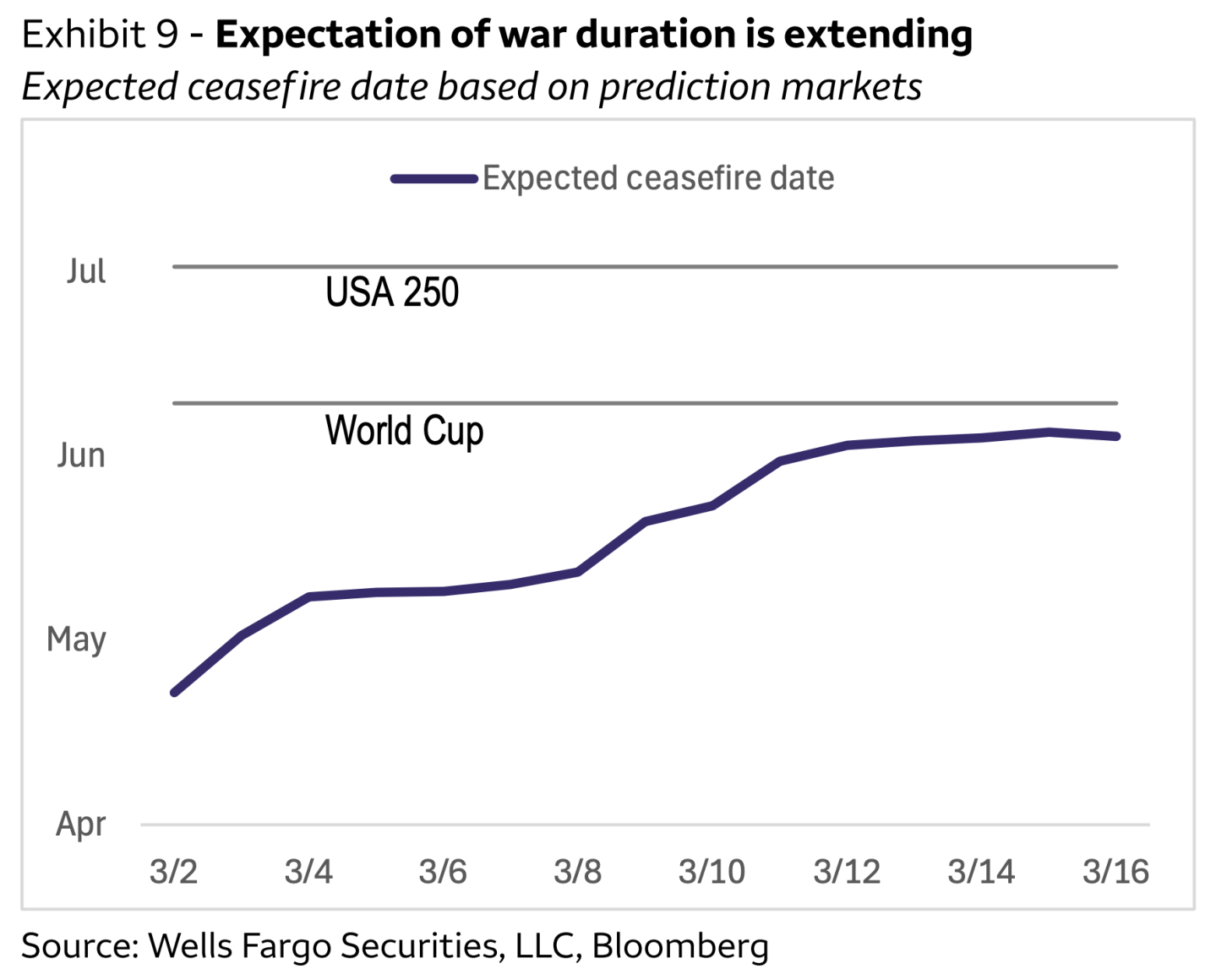
“The market seems to agree on one thing: the longer the war goes with Iran, the worse it gets for risk assets,” says Ohsung Kwon and his team at Wells Fargo. “Prediction markets don’t expect a ceasefire until early June, just before the World Cup starts, up from the third week in April at the start of the war.”
NUMBER OF THE DAY
$18 billion
The largest amount of outflows from exchange-traded funds covering the S&P 500 companies, as a percentage of % market cap, since March 2023, as tracked by Wells Fargo.
MORE FROM FORTUNE
McDonald’s newest $3 value menu is sounding an alarm about America’s K-shaped economy by Marco Quiroz-Gutierrez
Scott Galloway wants the stock market to crash. Gen Z is already betting like it will by Nick Lichtenberg
Stocks haven’t hit bottom yet, says the analyst who called a ‘rolling recession’ when everyone else saw a boom by Nick Lichtenberg
THE FRONT PAGES TODAY
France ready to help U.S. secure Strait of Hormuz—but not while ships are under attack – CNBC
Warner Bros chief David Zaslav in line for $700mn payday – FT
How a Deep State Bureaucrat Became Trump’s ‘Fake News’ Enforcer – Bloomberg
Netanyahu Posts ‘Proof of Life’ Video as A.I. Sows Doubts About What’s Real – NYT
ONE MORE THING
Hinge CEO thinks she can fix the ‘dating recession’

Everyone agrees that online (heterosexual) dating is awful. Women are overwhelmed by low-effort matches, and men frequently report few-to-zero dates. Lackluster conversations and aggressive upselling just to be visible on dating apps is the norm, Fortune’s Ellie Austin reports. People are turning away from online dating—Bumble saw revenue decline by 14.3% year-on-year in the last quarter of 2025. But Hinge’s revenue grew 26% in the same time period under new CEO Jackie Jantos. “I don’t see any group’s challenges in life or in relationships as sizably larger or smaller than another,” she says of the malaise. “Dating,” she says, “has never been easy.”