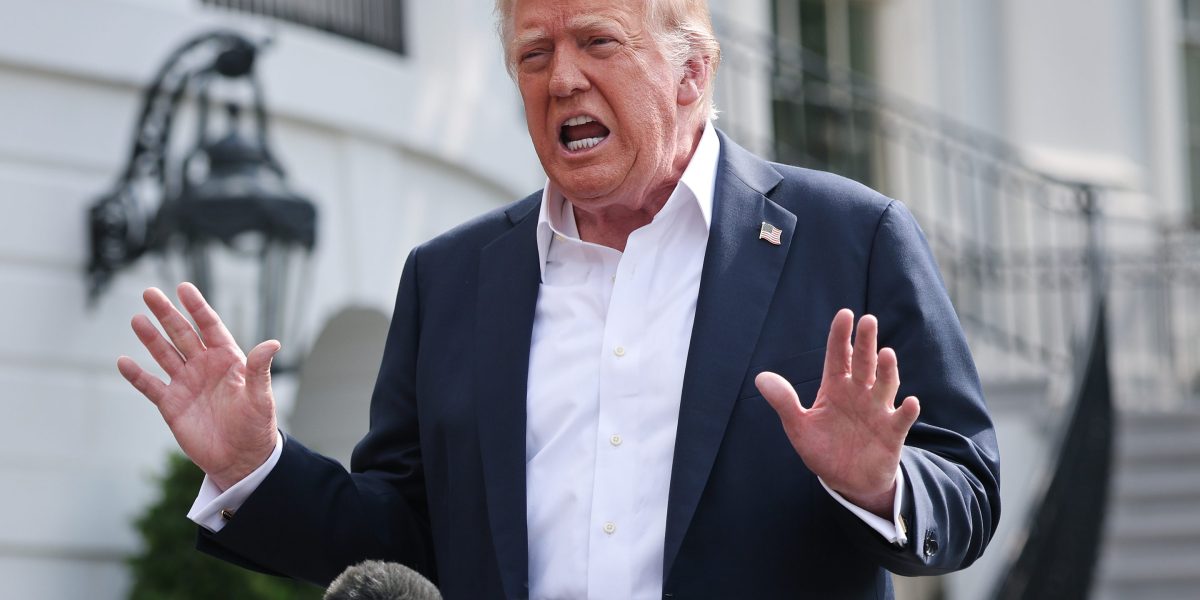
President Donald Trump announced Saturday that an agreement to reopen the Strait of Hormuz is near, but a top ally in Congress raised red flags about the implications for the balance of power in the Persian Gulf.
In a social media post, Trump said he spoke with the leaders of Saudi Arabia, the United Arab Emirates, Qatar, Pakistan, Turkey, Egypt, Jordan and Bahrain.
“An Agreement has been largely negotiated, subject to finalization between the United States of America, the Islamic Republic of Iran, and the various other Countries, as listed,” he wrote, adding he had a separate call with Israeli Prime Minister Benjamin Netanyahu.
Final details are being discussed and will be announced soon, but the deal would allow the Strait of Hormuz to be opened, among other provisions, Trump said.
Ahead of the announcement, reports said a deal to extend the ceasefire by 60 days would include Iran gradually reopening the strait and agreeing to discuss its uranium stockpile.
In return, the U.S. would ease its naval blockade while phasing in sanctions relief as well as the unfreezing Iranian assets held overseas.
But Trump ally Sen. Lindsey Graham, R-S.C., warned against a deal that would effectively recognize Tehran’s ability to control the strait.
“If a deal is struck to end the Iranian conflict because it is believed that the Strait of Hormuz cannot be protected from Iranian terrorism and Iran still possesses the capability to destroy major Gulf oil infrastructure, then Iran will be perceived as being a dominate [sic] force requiring a diplomatic solution,” he posted on X just before Trump’s announcement.
Such a perception would represent a major shift in the regional balance of power and eventually become a “nightmare” for Israel, he added.
“Also, it makes one wonder why the war started to begin with if these perceptions are accurate,” Graham said. “I personally am a skeptic of the idea that Iran cannot be denied the ability to terrorize the Strait and the region cannot protect itself against Iranian military capability. It is important we get this right.”
In a subsequent post, he predicted a deal with Iran that’s viewed as allowing the regime to survive and become more powerful, we will dramatically worsen the conflicts in Lebanon and Iraq.
Similarly, Sen. Roger Wicker, R-Miss., warned on Saturday that reports of 60-day ceasefire extension would be a disaster and that “Everything accomplished by Operation Epic Fury would be for naught!”
On Friday, he urged Trump to renew hostilities in the Iran war and open the Strait of Hormuz by force, saying the president is getting bad advice.
“Our commander-in-chief needs to allow America’s skilled armed forces to finish the destruction of Iran’s conventional military capabilities and reopen the strait,” Wicker posted on X. “Further pursuit of an agreement with Iran’s Islamist regime risks a perception of weakness. We must finish what we started. It is past time for action.”
Other Republicans piled on, including Mike Pompeo, who served as CIA director and secretary of state in Trump’s first term.
He dismissed the emerging agreement as a rehash of Democratic policies and tantamount to paying Iran to build nuclear weapons.
“Not remotely America First. It’s straightforward: Open the damned strait. Deny Iran access to money. Take out enough Iranian capability so it cannot threaten our allies in the region,” Pompeo said on X.
Iranian media said the Strait of Hormuz would remain under Tehran’s management. Days earlier, the regime created the Persian Gulf Strait Authority in an attempt to formalize its control.
After effectively closing off the narrow waterway soon after the U.S. and Israel started the war, Iran established a route near its territorial waters for ships to transit as long as they received approval from the Islamic Revolutionary Guard Corps.
The U.S. tried to create an alternate route near Oman’s waters while also clearing mines and sending destroyers through the strait to re-establish free navigation.
But the limit number of ships crossing the strait have followed the Iranian path, while Trump cut short a military effort to protect ships from Iranian attacks and get traffic moving again.
At the same time, the U.S. imposed its own blockade on ships leaving or entering Iranian ports as well as any “shadow fleet” tankers elsewhere in the world linked to Tehran.
The idea was to cut off the regime’s source of revenue and force it to shut down oil fields once storage capacity filled up as crude being pumped has nowhere to go.
Iran is still finding ways to store its oil and is gradually throttling output to further delay “tank tops,” when storage hits maximum levels.
As a result, the regime has remained defiant in the face of Trump’s repeated threats to bomb Iran again while giving little ground in negotiations.
Meanwhile, global oil markets are heading off a cliff as more than 10 million barrels a day have been erased from supplies.
The U.S. and other top oil-consuming countries are releasing crude reserves, but that hasn’t fully offset the missing Mideast barrels and stockpiles are rapidly heading toward dangerous lows.
JPMorgan predicted that commercial oil inventories in the developed world could “approach operational stress levels” by early June. Saudi Aramco said global inventories of gasoline and jet fuel could reach “critically low levels” ahead of the summer.
“But if the Strait remains effectively closed and commercial oil inventories in the OECD continue to be run down at the same pace as they were in April, oil stocks could reach critically low levels by the end of June,” Hamad Hussain, climate and commodities economist at Capital Economics, said in a note last week.
“That would be consistent with Brent crude prices reaching an all-time nominal peak, and could require more disorderly and economically damaging cuts to oil demand.”
Given the extent of supply losses from the Middle East, he added that the risk of a “non-linear” price spike will grow as long as the strait remains closed.
In other words, rather than oil prices following a straight-line trajectory higher, they could instead go parabolic, looking more like the curved end of a hockey stick.
Analysts at UBS also said oil inventories are approaching record lows, warning that “buffers have now largely been exhausted.”
As stockpiles go even lower, UBS said oil prices could become more volatile and highlighted the “risk of panic buying if physical dislocation intensifies and the Strait of Hormuz remains closed.”