The AUDUSD and NZDUSD often move together, but technically they are telling different stories right now.
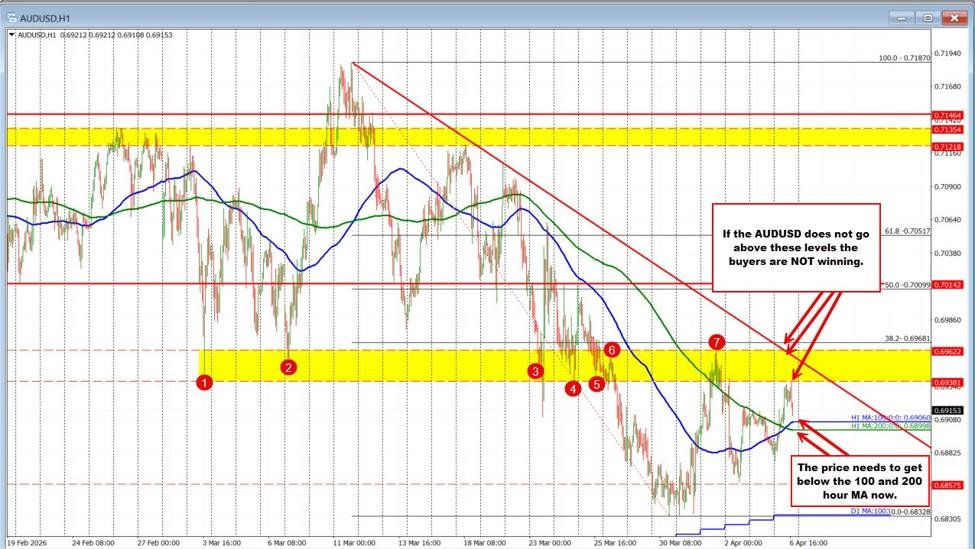
For the AUDUSD, the pair moved lower at the end of March and approached its rising 100-day moving average (0.6833), but held above that level and rebounded. Last week, price action was choppy, trading above and below the 100- and 200-hour moving averages, before ultimately closing below both. In today’s session, the pair has pushed back above those short-term MAs, tilting the bias more bullish in the near term.
However, the rally stalled ahead of key resistance, including a swing area between 0.6938 and 0.6962, and the 38.2% retracement at 0.6968. Sellers leaned against the lower end of that zone, pushing the price back down toward the 100-hour MA (0.6906) and 200-hour MA (0.6900 area). A break below 0.6900 with momentum would open the door for further downside. Until then, buyers remain in play—but they need to break through those resistance targets to take back more control.
In contrast, the NZDUSD remains more bearish technically. The pair broke below its 100-day moving average on March 25 and extended lower, reaching its weakest levels since late March before bouncing modestly. Today’s rebound saw the price test the 100-hour MA (0.5723), but momentum faded against a downward-sloping trendline and ahead of the 200-hour MA (0.5740).
To shift the bias, buyers need to get above and stay above both the trendline and 200-hour MA. Without that, sellers remain firmly in control—both from a longer-term perspective (below the 100- and 200-day MAs) and in the short term (below the 100- and 200-hour MAs).
Bottom line: The AUDUSD is showing early signs of stabilization with buyers trying to regain control, while the NZDUSD remains technically weaker, with rallies still being sold.