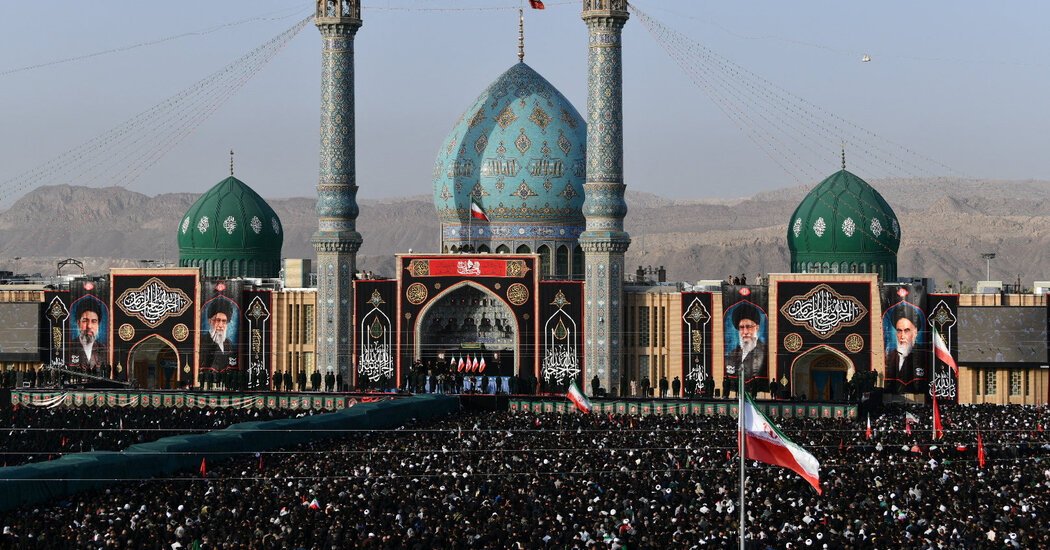
The body of Ayatollah Ali Khamenei was taken to Qom, the center of Shiite religious education in Iran, for an official prayer and street procession on Tuesday, the latest in a series of elaborate events staged by the Iranian authorities to mourn the country’s slain supreme leader.
The stop in Qom follows three days of public mourning in Tehran, the capital, where huge crowds gathered to view Ayatollah Khamenei’s casket, many erupting in tears or calling for vengeance for his killing in February at the outset of the U.S.-Israeli war. After Qom, his body will be taken to holy cities in Iraq before being buried on Thursday in his hometown, Mashhad.
A funeral service in Qom, at Jamkaran Mosque, a site considered sacred by many Shiites, was led by Ayatollah Abdullah Javadi Amoli, a conservative senior cleric and one of a handful of figures still alive from the generation that led Iran’s 1979 revolution. State news media showed images of large crowds that had come out in Qom to bid farewell to Ayatollah Khamenei.
Qom has played a significant role in Iran’s history and politics over the last century. It was home to some of the most strident opposition to Iran’s monarchy, particularly in the 1960s and ’70s. Clerics educated there under the leadership of Ayatollah Ruhollah Khomeini, Ayatollah Khamenei’s predecessor, emerged victorious during the revolution and the internal power struggle that followed.
In addition to being Iran’s most powerful political leader and commander of its armed forces, Ayatollah Khamenei claimed legitimacy as a high-ranking cleric whose religious pronouncements carried weight among the Shiite faithful. His authority under Iran’s system of government stemmed from the concept of velayat-e faqih, or guardianship of the Islamic jurist, which grants ultimate political power to a Shiite cleric.
On the eve of becoming Iran’s supreme leader in 1989, Ayatollah Khamenei was only a midranking cleric. But he was then elevated to an ayatollah, making him eligible for the position.
During his rule, Ayatollah Khamenei exerted a heavy hand over clerical finances, management and education, making Qom much more dependent on the Iranian state. He also formalized and supervised a special clerical court that critics have called unconstitutional and secretive, and that has been used to punish those who challenge the state on religious grounds.
One of the most significant religious dissenters during Ayatollah Khamenei’s tenure was Grand Ayatollah Hossein Ali Montazeri, who was once in line to become supreme leader before he criticized the treatment and execution of prisoners in the 1980s. He held the highest ranking possible in the Shiite clerical hierarchy.
During the 1990s, Ayatollah Khamenei placed Ayatollah Montazeri under house arrest for several years. Ayatollah Montazeri argued that Iran’s clerical leadership had turned its back on the revolution’s ideals and supported anti-government demonstrators in 2009, issuing edicts in favor of reform and human rights.
When Ayatollah Montazeri died in 2009, hundreds of thousands of supporters turned out for his funeral in Qom, turning it into an opposition protest.
Leily Nikounazar contributed reporting.