Summary:
-
Major banks are lifting gold price forecasts, with several now flagging $6,000/oz scenarios for 2026.
-
Deutsche Bank sees persistent investment and central bank demand driving further upside, with an upside scenario near $6,900/oz.
-
Societe Generale also targets $6,000/oz, warning its forecast may prove conservative.
-
Goldman Sachs, Morgan Stanley and Citi all see material upside risks, even after gold’s record-breaking rally.
-
Gold has surged more than 18% so far in 2026, following a 64% gain last year, as investors seek real assets.
Reuters summarised gold price forecasts across major investment banks earlier this week. Some of the forecasts have been supassed, some already were. Several are projecting prices could reach or exceed $6,000 per ounce in 2026, driven by sustained investment demand and growing diversification away from the U.S. dollar.
Deutsche Bank said on Tuesday that gold could climb to $6,000 per ounce next year, citing persistent demand from both central banks and private investors increasing allocations to real assets and non-dollar reserves. The bank added that, under alternative scenarios, prices closer to $6,900 per ounce would be more consistent with gold’s strong outperformance over the past two years.
Societe Generale echoed that bullish view, forecasting gold will reach $6,000 per ounce, while warning that even this level may prove conservative if current trends persist. Other major banks remain constructive, though with slightly lower central forecasts. Morgan Stanley highlighted a bull-case target of $5,700, while Goldman Sachs said it sees meaningful upside risks to its $5,400 forecast for December 2026, given structural demand dynamics.
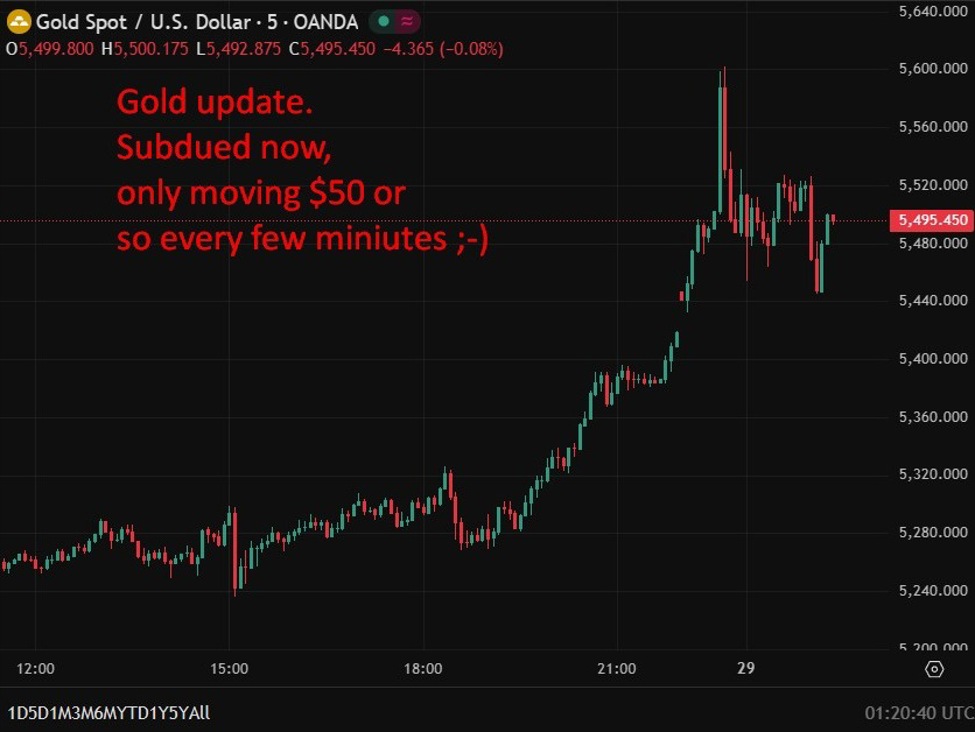
The renewed wave of forecast upgrades comes after spot gold surged to a fresh record high of $5,110.50 per ounce on Monday. The precious metal is already up more than 18% so far in 2026, extending a powerful rally that delivered a 64% gain in 2025.
Analysts broadly attribute gold’s strength to a combination of central bank reserve diversification, geopolitical uncertainty, and expectations that real interest rates could fall or move deeper into negative territory. Several banks also note that strong price momentum itself has attracted additional investor flows.
While forecasts vary in magnitude, the common theme across institutions is that downside risks appear limited under current macro conditions. With demand broadening beyond traditional safe-haven buying, analysts increasingly see gold’s rally as structural rather than cyclical.
—
In table format … the rapidly rising price has sprinted past most of these already.
| Institution | Central / Base Forecast | Upside / Bull Case | Timeframe / Notes |
|---|---|---|---|
| Deutsche Bank | $6,000 | ~$6,900 (alt scenario) | 2026; driven by central bank and investment demand |
| Societe Generale | $6,000 | Upside beyond $6,000 | End-2026; says forecast may be conservative |
| Goldman Sachs | $5,400 | Meaningful upside risk | December 2026 |
| Morgan Stanley | — | $5,700 | Bull-case scenario, H2 2026 |
| Citi Research | $5,000 | — | 0–3 month price target |
| JPMorgan | $4,753 (avg) | $5,055 | Average price with upside into Q4 2026 |
| HSBC | $4,587 | — | ~$4,450 by end-2026 |
| ANZ | $4,445 | $4,600 | $4,400 end-2026; $4,600 by mid-2026 |
| Bank of America | $4,438 | $5,000 | 2026 outlook raised |
| Commerzbank | $4,900 | — | ~$4,800 by mid-2026 |
| UBS | $3,825 | — | Declining real rates seen as key upside risk |
| Standard Chartered | $4,488 | — | 2026 outlook |