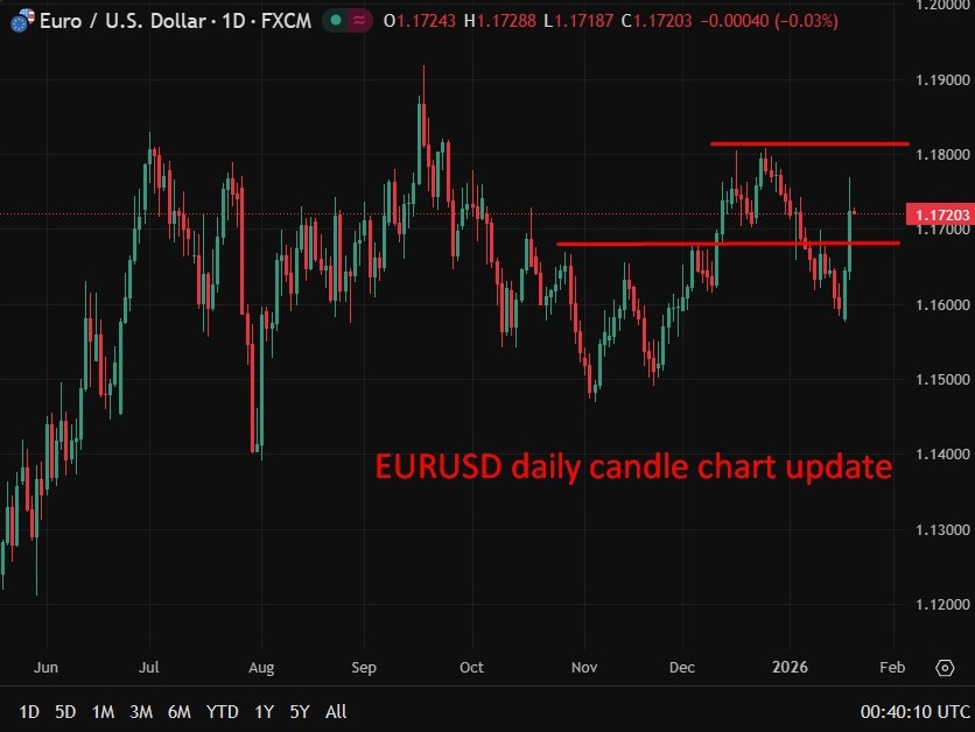
Barclays sees Greenland-related geopolitical risks as a bigger long-term threat to the euro than the dollar despite near-term USD weakness.
Summary:
-
The dollar weakened as Greenland tensions and tariff threats escalated.
-
Barclays warns euro faces greater risk in a severe US–EU fallout.
-
NATO cohesion and European defence spending are key concerns.
-
Export-heavy economies like Germany are seen as most exposed.
-
Analysts expect limited US asset divestment even in worst case.
The US dollar weakened on Tuesday as markets reacted to an escalation in geopolitical tensions linked to President Donald Trump’s renewed push to assert control over Greenland, including threats to impose tariffs on European countries opposing the move.
While the greenback softened on the day, some strategists argue the longer-term risks from a deterioration in US–Europe relations may fall more heavily on the euro. Analysts at Barclays said that in an extreme scenario, the Greenland dispute could become a far greater problem for Europe and the single currency than for the United States.
Barclays noted that the situation has sharpened investor focus on strains within the North Atlantic Treaty Organization, raising tail risks around alliance cohesion. European governments, already under pressure to lift defence spending following Russia’s 2022 invasion of Ukraine, have this month deployed troops to Greenland and now face the prospect of trade retaliation from Washington. In a worst-case outcome, Barclays warned that relations between the US and its NATO partners could deteriorate to the point where Washington effectively disengages from the alliance.
Other analysts echoed the view that a tougher trade environment would be more damaging for Europe than the US. Export-heavy economies such as Germany, the region’s largest, are seen as particularly exposed, with tariffs likely to hurt European corporates and growth prospects more than their US counterparts. That dynamic, strategists argue, would ultimately pressure the euro more than the dollar.
Market moves on Tuesday reflected near-term risk aversion. The ICE US Dollar Index fell around 0.8%, extending its decline over the past year to nearly 10%, while US equities and bonds also sold off sharply.
Barclays cautioned against over-interpreting these initial reactions, arguing that knee-jerk market moves often differ from longer-term outcomes. Its base case remains that the US and Europe eventually find a compromise allowing Washington to meet its security objectives in Greenland without a full rupture in relations.
Even in a more adverse scenario, the bank does not expect a wholesale exit from US assets. Instead, any dollar weakness would likely reflect low hedging ratios among foreign investors rather than a mass divestment. Barclays added that Europe’s fiscal constraints mean the bar for policy-driven euro support remains high unless there is coordinated joint issuance to fund common defence capabilities.