Good morning. The Walt Disney Company’s CEO transition is notable not just for who is ascending, but for how deliberately the company built financial stability around it by extending CFO Hugh Johnston’s contract months before a new CEO was even named.
Josh D’Amaro, a 28-year veteran of the company, took over as chief executive at Disney’s annual shareholders meeting on Wednesday, succeeding longtime CEO Bob Iger. Named to the role on Feb. 3, D’Amaro most recently served as head of Disney Experiences, which includes the company’s theme parks, cruise line, resorts and consumer products.
There was some praise for Iger on social media. “What you have built is not a career, it’s a LEGACY,” NBA star Chris Paul said in a post on LinkedIn.
Iger, who had a long career at Disney, served as CEO from 2005 to 2020, then returned in 2022 following the controversy-filled tenure of his first replacement, Bob Chapek. He will temporarily stay on as a senior advisor and board member, stepping down eight months ahead of schedule.
A potential merger between Paramount Global and Warner Bros. Discovery could increase competition for Disney (No. 46 on the Fortune 500). But D’Amaro could be well-positioned to lead growth. Under his leadership, Disney’s parks and experiences became the company’s primary profit engine, accounting for more than 70% of operating income despite representing under 40% of total revenue, Fortune reported. Streaming is the other major growth driver, following consecutive quarters of profitability.
In November, Disney extended Johnston’s contract through Jan. 31, 2029—before the new CEO was even announced. He joined Disney in 2023, following a long career at PepsiCo. Johnston has a “well-earned reputation as one of the best CFOs in America,” Iger said in a statement in 2023.
At the Morgan Stanley Technology, Media and Telecom Conference earlier this month, Johnston called Disney’s CEO succession process a strength. “I would tell you they looked internally, externally, they really pushed hard on the candidates, and came to a conclusion that is a terrific one,” he said.
He described both D’Amaro and Dana Walden, who will become the company’s president and chief creative officer, a new role, as “terrific growth-oriented executives.” Walden was widely reported to be a CEO contender.
“There’s a lot of energy there in terms of people being excited about Josh, being excited about the fact that this process was also handled so smoothly,” Johnston said. “You all know some of the history of Disney and CEO successions going all the way back to Michael Ovitz. This couldn’t have been more different than that. It was a really smooth, well-run process with minimal drama.”
Johnston reaffirmed guidance for double-digit EPS growth in both 2026 and 2027. On M&A, he said Disney doesn’t need to do significant deals. “We’re very fortunate that with the moves that Bob Iger made during his tenure as CEO, whether it was acquiring Pixar, Lucasfilm, Marvel, and then the Fox acquisition, we were kind of in front of the curve in terms of generating a large collection of IP,” he said.
Sheryl Estrada
sheryl.estrada@fortune.com
Leaderboard
Nitesh Sharan was appointed CFO of Quantinuum, a quantum computing company, effective April 6. Sharan brings more than 25 years of global finance experience. He joins the company after nearly five years as CFO of SoundHound AI, Inc., where he led the company through its public listing in 2022. Prior to joining SoundHound AI, Sharan spent more than five years at Nike, where he held several leadership roles, including VP of investor relations and treasurer, VP of corporate finance and treasurer, and CFO of global operations and technology. Before joining Nike, he spent 15 years in senior leadership roles at Hewlett-Packard.
Joe Bedewi was appointed CFO of Morse Micro, a Wi-Fi HaLow silicon provider. Bedewi brings more than 30 years of leadership experience. He previously served as CFO at digital imaging radar company Uhnder. Before that, he was CFO at ASX-listed Altium, where he also led operational and control improvements. Earlier in his career, Bedewi was corporate VP and CFO at Lattice Semiconductor. He also spent more than 15 years at Intel, holding finance and operational roles across fab, assembly and test, supply chain, and strategic systems implementation.
Big Deal
The Federal Reserve kept the federal funds rate unchanged at a target range of 3.50%–3.75% at the March 17–18 FOMC meeting. Only Governor Miran dissented in favor of additional easing, while Governor Waller—who had been seen as another likely dissenter given weak labor market conditions—aligned with the consensus, according to EY-Parthenon Chief Economist Gregory Daco.
“This signals increased concern among policymakers about the inflation implications of the Middle East conflict,” Daco wrote in an analysis shared with CFO Daily on Wednesday. “The current Fed stance is clear. With core inflation well above the Fed’s 2% target and little evidence of a decisive and sustained move toward that goal, policymakers will maintain their current policy setting.”
Looking ahead, Daco noted: “Our baseline features only one 25bp rate cut in 2026, likely in December.” He also said that it’s plausible that the Fed delivers no rate cuts this year. And there is a “non-negligible chance that a rate hike—not a cut—could be the next policy move.”
Going deeper
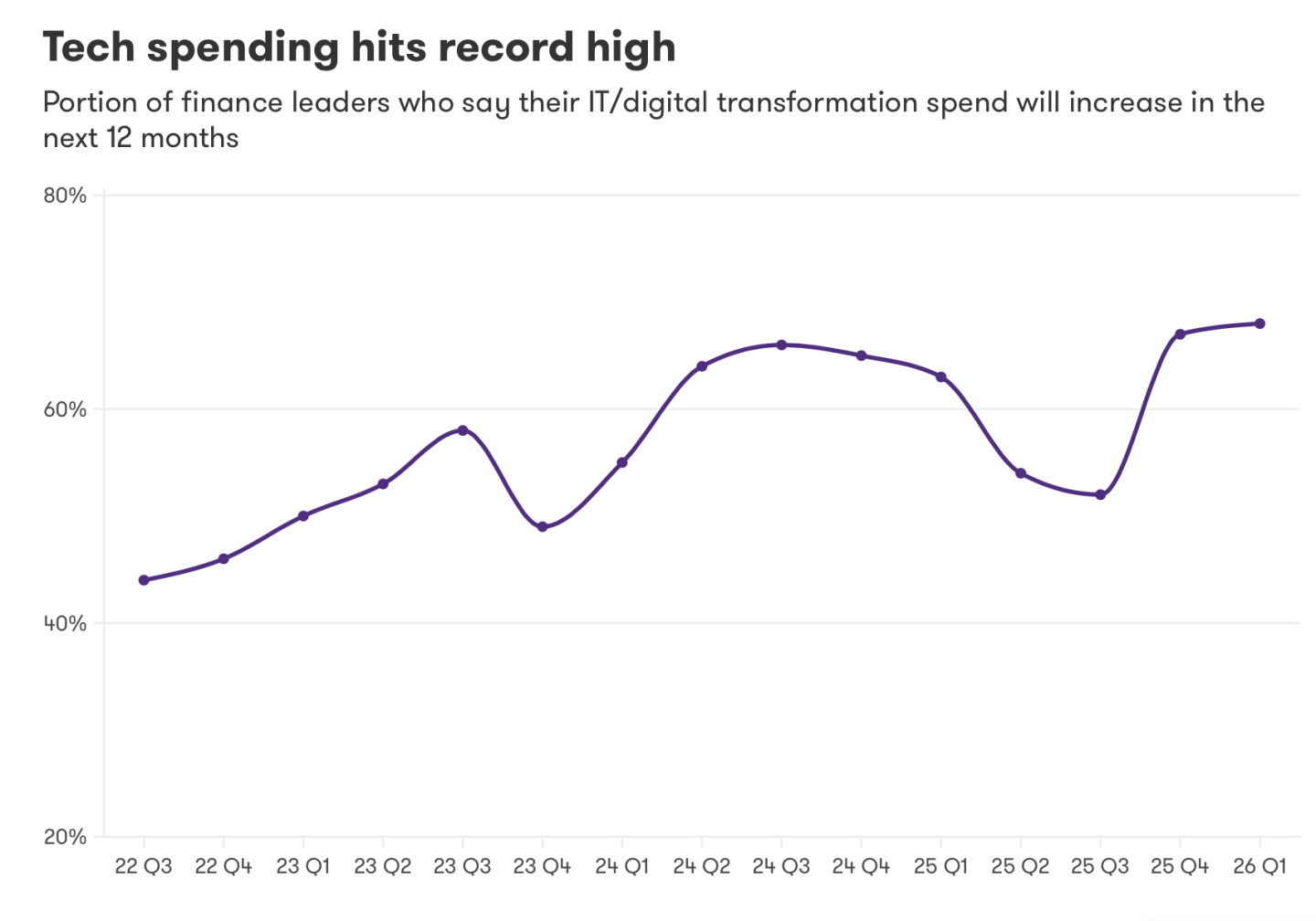
Another key finding is that nearly three-quarters (72%) expect net profit to increase over the next 12 months, up from 68% last quarter. However, more than half (54%) of finance leaders expect ongoing challenges attracting and retaining talent over the next six months. Outsourcing is emerging as a key strategy to address those gaps.
“Today, companies are turning to outsourcing to access specialized talent, support higher-complexity work and accelerate innovation — not simply to reduce costs,” Raul Vega, a partner in Grant Thornton’s Advisory practice and the CEO of Auxis, said in a statement.
The findings are based on a survey of more than 230 finance leaders across industries.
Overheard
“They’ll be working around the clock.”
—Nvidia CEO Jensen Huang said of AI agents in the company’s workforce, during a Q&A session for media at the Nvidia GTC conference this week, Fortune reported. Those AI agents won’t exactly replace workers, he said. Instead, they’ll be picking up the grunt work human employees don’t need to complete.