

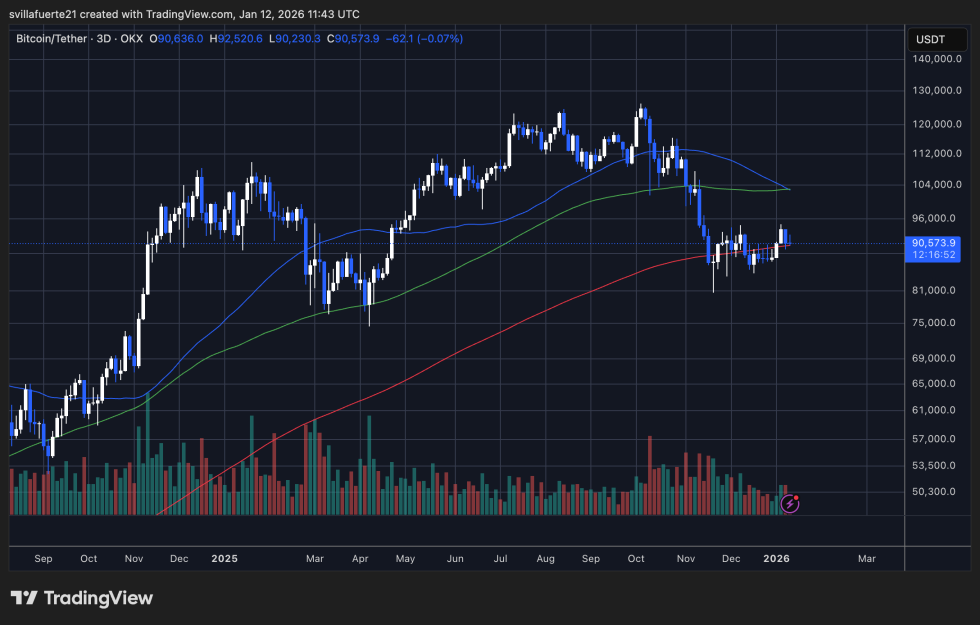
Bitcoin is attempting to stabilize above the $90,000 level as markets digest fresh comments from Jerome Powell, which briefly reintroduced macro uncertainty into an already fragile environment. Powell’s remarks reinforced the Federal Reserve’s commitment to policy independence and data-driven decisions, a message that rattled risk assets after weeks of consolidation.
Bitcoin reacted with a short burst of volatility, slipping from local highs before finding tentative support near the $90K zone. While the move was not structurally destructive, it underscored how sensitive BTC remains to shifts in macro narratives.
Beyond the headline-driven reaction, on-chain data suggests that underlying demand remains subdued. According to an analysis by Darkfost, current conditions do not yet resemble the extreme weakness typically seen at the early stages of a full bear market.
However, demand has clearly softened compared to prior expansion phases. The focus is on a metric that compares new Bitcoin issuance with supply that has remained inactive for more than one year, a framework used to estimate so-called “apparent demand.”
When this ratio falls below zero, it indicates that long-term dormant supply entering the market outweighs new demand, signaling net selling pressure. When it moves above zero, demand is considered positive and absorption is occurring.
At present, the indicator remains weak, suggesting that while panic is absent, conviction from buyers is still limited. As Bitcoin hovers above $90,000, the balance between macro uncertainty and on-chain demand will likely define the next decisive move.
Demand Weakness Signals Caution, Not Capitulation
Currently, Bitcoin’s apparent demand remains firmly negative, with roughly −106,000 BTC on a 30-day cumulative basis. This reading confirms that more supply is entering the market than is being absorbed by new buyers, a dynamic typically associated with cautious positioning rather than aggressive accumulation. Investors appear risk-averse, gradually reducing exposure as Bitcoin continues to be treated as a high-beta asset sensitive to macro uncertainty and policy signals.

This negative demand environment reflects a market that is defensive but not panicked. There is no evidence of forced liquidation or broad capitulation; instead, the data points to controlled distribution and a lack of urgency from buyers. In practical terms, participants are waiting for clearer confirmation—either from macro conditions, price structure, or on-chain metrics—before committing fresh capital.
Importantly, history shows that periods of weak or negative demand often coincide with zones where long-term opportunities begin to form. When interest is low and sentiment is muted, prices tend to stabilize rather than trend aggressively, allowing patient investors to build positions with reduced competition. However, these conditions favor long-term, risk-managed strategies, not short-term speculation.
Betting aggressively against the prevailing demand trend remains risky. As long as apparent demand stays negative, upside moves are more likely to be corrective rather than impulsive. For now, Bitcoin sits in a phase where discipline matters more than conviction, and time—not momentum—becomes the primary ally.
Editorial Process for bitcoinist is centered on delivering thoroughly researched, accurate, and unbiased content. We uphold strict sourcing standards, and each page undergoes diligent review by our team of top technology experts and seasoned editors. This process ensures the integrity, relevance, and value of our content for our readers.