
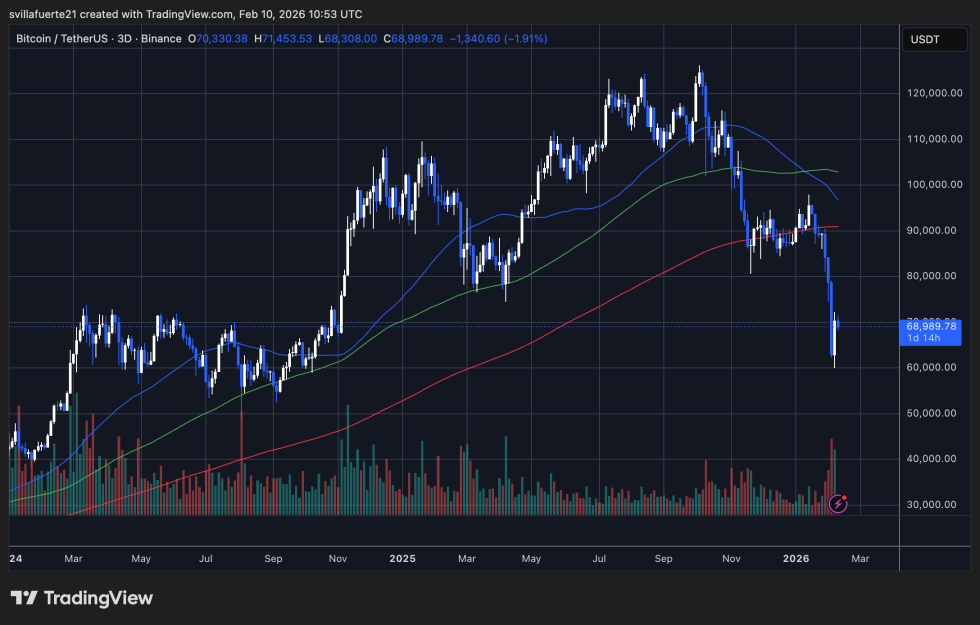
Bitcoin continues to struggle below the $70,000 threshold, reflecting persistent market pressure after weeks of volatility and weak recovery attempts. Despite occasional rebounds from the $60,000 region, upside momentum remains limited, suggesting that demand has yet to return in a meaningful way. Market sentiment has shifted toward caution, with traders increasingly focused on downside risk rather than breakout potential.
Recent on-chain analysis from Darkfost indicates that realized losses are still dominating market activity. This imbalance implies that a large portion of investors entered positions near recent highs and are now exiting at a loss. Such behavior typically emerges during late-stage corrections, when conviction weakens, and participants prioritize capital preservation over long-term positioning.
Notably, some digital asset treasuries and large investors who accumulated Bitcoin at significantly higher levels are also reducing exposure. While this does not necessarily indicate structural capitulation, it reinforces the perception that confidence remains fragile. Historically, phases where realized losses outweigh profits often coincide with transitional market periods, either preceding deeper corrections or setting the stage for eventual accumulation.
Realized Losses Signal Ongoing Market Stress
On-chain analysis shared by Darkfost highlights a notable deterioration in Bitcoin’s profit-to-loss dynamics. The realized profit-to-loss ratio currently stands near 0.25, meaning that for every $1 of profit realized on-chain, roughly $4 in losses are being locked in. Such a skewed balance reflects a market still processing recent drawdowns, where a significant portion of participants are exiting underwater positions rather than securing gains.

The seven-day moving average of this ratio is now approaching levels typically associated with bear market conditions. This shift suggests that short-term sentiment remains fragile and that selling pressure continues to dominate recent transaction flows. For context, the annual average ratio sits around 6.33, indicating that, over longer horizons, profit realization still outweighs losses due to the inertia embedded in yearly data.
Importantly, realized profits have recently begun to slightly exceed losses after several weeks of persistent deficit, hinting at tentative stabilization rather than confirmed recovery. Historically, periods characterized by panic selling or capitulation can extend for months, particularly during broader bearish phases.
For a durable recovery to emerge, this ongoing purge of weaker hands must likely conclude, allowing unrealized profits to rebuild and restore investor confidence.
Editorial Process for bitcoinist is centered on delivering thoroughly researched, accurate, and unbiased content. We uphold strict sourcing standards, and each page undergoes diligent review by our team of top technology experts and seasoned editors. This process ensures the integrity, relevance, and value of our content for our readers.