
Coinbase CEO Brian Armstrong argued that Bitcoin ultimately strengthens the US dollar by acting as a market-based constraint on fiscal and monetary excess, framing the asset as a “check and balance” that could help the US retain reserve-currency credibility.
In a Dec. 28 post on X accompanied by a short voice recording, Armstrong pushed back on the idea that Bitcoin is inherently a threat to the dollar. “Bitcoin is good for USD,” he wrote, saying it “It creates competition in a way that’s healthy for the dollar, which helps to provide a check and balance against high inflation and deficit spending.”
Bitcoin is good for USD.
It creates competition in a way that’s healthy for the dollar, which helps to provide a check and balance against high inflation and deficit spending. pic.twitter.com/iHjQCJVqCb
— Brian Armstrong (@brian_armstrong) December 28, 2025
Bitcoin Acts As A Check On Dollar Inflation
Armstrong’s core claim is that the existence of a credible alternative store of value increases the political and economic cost of letting inflation or debt dynamics deteriorate. In the recording, he said that if the US veers into “too much deficit spending or inflation,” capital can “flee to Bitcoin in times of uncertainty,” creating external pressure on policymakers and, by extension, a stronger incentive to maintain currency stability.
He situated the argument inside a broader critique of budgeting incentives in democratic systems. “Democracies around the world, including the United States… are trying to figure out how to fix deficit spending,” he said, adding that “the incentives are just not aligned to actually balance the budget.” The implication, as Armstrong laid it out, is not that Bitcoin repairs those incentives directly, but that it makes ignoring them more costly by offering an exit valve when credibility erodes.
Armstrong also tied reserve-currency status to the relationship between inflation and real growth. “It might be okay to have 2% to 3% inflation if the economy is growing 2% to 3%,” he said. But if “inflation outstrips the growth of the economy,” Armstrong warned the US could “eventually lose the reserve currency status,” which he described as “a massive blow” to the country.
He added a geopolitical layer, arguing that reserve-currency privilege is not static. “China, these other superpowers are coming in trying to compete for that over time,” Armstrong said, positioning monetary credibility as an axis of long-run strategic competition.
The conclusion he offered was a reframing of Bitcoin’s role: less an adversary to the dollar than a disciplining force that could lengthen the runway for US financial leadership. “So I actually think in a strange way, Bitcoin is helping extend the American experiment,” he said.
Armstrong’s comments land in the middle of a growing debate inside crypto about whether Bitcoin’s maturation makes it a parallel system or a pressure mechanism within existing ones. If his framing resonates, it could reinforce an emerging narrative among institutional allocators and policy-adjacent crypto advocates: that Bitcoin’s competitive presence may be compatible with, rather than corrosive to, dollar dominance, so long as it keeps signaling costs when confidence starts to slip.
At press time, BTC traded at $87,604.
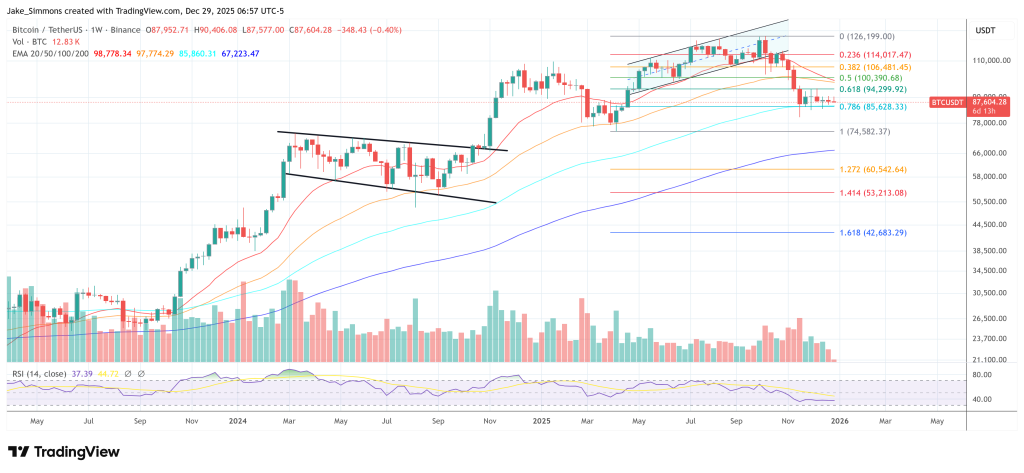
Featured image created with DALL.E, chart from TradingView.com
Editorial Process for bitcoinist is centered on delivering thoroughly researched, accurate, and unbiased content. We uphold strict sourcing standards, and each page undergoes diligent review by our team of top technology experts and seasoned editors. This process ensures the integrity, relevance, and value of our content for our readers.