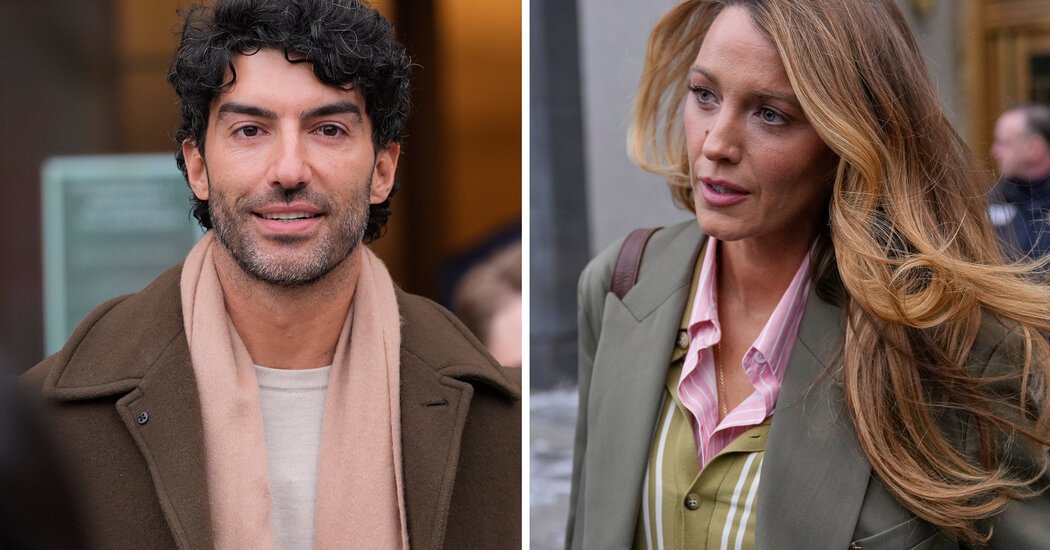
A lawyer for Justin Baldoni confirmed in a court filing on Friday that Blake Lively will receive no financial payout under the settlement she reached with the actor’s production company. But the agreement embraces that she can continue to seek compensation through a related legal avenue.
A joint statement announcing the settlement this week spoke of how the parties hoped the agreement would bring closure to the dispute. But since then, lawyers for both sides have claimed victory and highlighted parts of the agreement that they view as beneficial to their client.
In a letter filed on Friday in the federal civil case in Manhattan, Ellyn Garofalo, who represents Mr. Baldoni and his company, Wayfarer Studios, described the settlement as one in which Ms. Lively “dismissed her three remaining claims without the Wayfarer defendants paying a cent of the $300 million in damages she was demanding.”
That filing confirmed earlier reports that no money would change hands as part of the settlement agreement.
But the deal still allows Ms. Lively to pursue a significant payout through a motion that seeks to penalize Mr. Baldoni and his associates for filing what she has described as a baseless and retaliatory defamation countersuit against her. The countersuit was dismissed last year.
Under the agreement, Mr. Baldoni gave up the right to appeal if the judge overseeing the case decides to award Ms. Lively damages and lawyers’ fees. Her motion seeks to make use of a fairly new California law that was enacted to discourage lawsuits that could intimidate people who complain of sexual misconduct or harassment.
The law, passed in the wake of the #MeToo movement, is relatively untested, but Ms. Lively’s legal team has described it as an efficient avenue for her to receive compensation, independent of the damages she had hoped to receive through her own lawsuit.
“Ms. Lively got the right to pursue her damages claim in a setting that is faster and final via a groundbreaking statute that provides for mandatory monetary awards,” Esra Hudson, a lawyer for Ms. Lively, said in a statement on Friday.
Ms. Hudson also noted that Mr. Baldoni’s side gave up its right to appeal the judge’s dismissal of its defamation suit, which asked for at least $400 million.
The trial that was averted by the settlement agreement would have centered on Ms. Lively’s allegations that Mr. Baldoni and his associates waged a retaliatory online campaign aimed at disparaging her after she raised sexual harassment complaints that stemmed from the set of the movie “It Ends With Us.”
In his defamation suit, Mr. Baldoni had accused Ms. Lively of twisting benign interactions into allegations of harassment in an effort to assert control over the movie.
Ahead of the trial, Judge Lewis J. Liman had significantly narrowed Ms. Lively’s case. He dismissed her sexual harassment claims, finding that she qualified as an independent contractor, with more power than a subordinate employee.
The judge’s decision focused the case on the accusations that Mr. Baldoni’s production company hired a team that seeded and amplified negative online commentary about Ms. Lively in an effort to publicly discredit her. Mr. Baldoni’s side described the efforts as focused on protecting him and his company from false allegations.
The news of a settlement came just two weeks before the trial was scheduled to start in Federal District Court in Manhattan. A joint statement from the two sides struck a conciliatory tone, saying that they “recognize concerns raised by Ms. Lively deserved to be heard.”
It soon became clear that the fight was not over.
The continuing dispute over whether damages are due under the California law presents some level of risk for both sides.
Mr. Baldoni’s lawyers have asserted that damages are unwarranted, and that the actor had every right to seek his own legal recourse for what he considered wrongdoing by Ms. Lively. But a ruling in her favor could put significant compensation on the line, without him having the option to appeal.
Both sides have spent heavily to retain top-shelf legal teams. The California statute that is now the new focus of the dispute specifically outlines the circumstances under which those who are found to have been wrongly sued can be compensated.