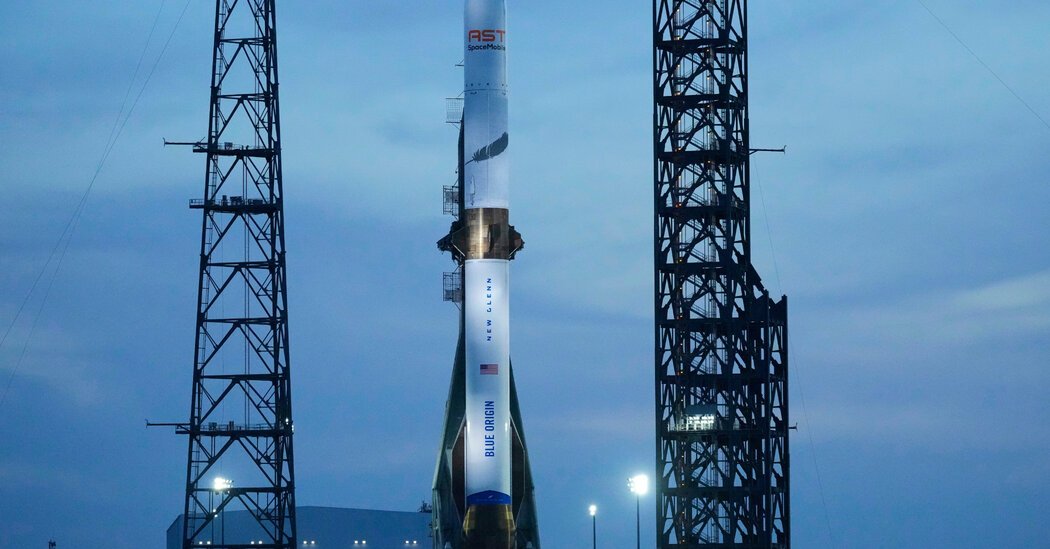
A rocket built by the Jeff Bezos-owned space company Blue Origin blew up on the launchpad in Florida on Thursday night.
The explosion occurred at about 9 p.m. during a test being conducted in advance of an upcoming launch.
“We experienced an anomaly during today’s hotfire test,” Blue Origin reported on social media. “All personnel have been accounted for.”
The test was to fire the seven engines in the booster stage, while keeping the rocket firmly held down on the launchpad. Flames began rising up the sides of the rocket and a massive explosion enveloped the launchpad.
The fireball badly damaged the launchpad and surrounding equipment at the Cape Canaveral Space Force Station. It is the only launchpad that Blue Origin has for its 322-foot-tall New Glenn rocket, which is named after John Glenn, the first American astronaut to orbit Earth. Repairs will most likely take months, at the least.
The rocket had been set to carry 48 satellites for Amazon’s internet constellation, Leo, an acronym for “low-Earth orbit.” Leo is a competitor to SpaceX’s Starlink network. The Amazon satellites were not onboard.
“It’s too early to know the root cause but we’re already working to find it,” Mr. Bezos wrote on social media. “Very rough day, but we’ll rebuild whatever needs rebuilding and get back to flying. It’s worth it.”
Mr. Bezos’ billionaire space competitor, Elon Musk, the chief executive of SpaceX, expressed sympathy: “Sorry to see this, I hope you recover quickly,” he wrote on X.
The failure will affect NASA’s moon plans, which already include little margin for error.
Blue Origin is one of two companies — SpaceX is the other — that NASA has hired to take astronauts from lunar orbit to the moon’s surface. That plan depends on multiple New Glenn launches to get that lander to the moon.
NASA’s Artemis III mission, scheduled to launch next year, is intended to allow NASA astronauts to practice docking their Orion capsule with the SpaceX and Blue Origin landers while remaining in orbit around Earth.
With the destruction of the launchpad, Blue Origin may not be able to participate in Artemis III.
“Spaceflight is unforgiving, and developing new heavy-lift launch capability is extraordinarily difficult,” the NASA administrator, Jared Isaacman, wrote on X. “We will work with our partners to support a thorough investigation of this anomaly, assess near-term mission impacts, and get back to launching rockets.”
He added, “We will provide information on any impacts to the Artemis and Moon Base programs as it becomes available.”
A smaller Blue Origin robotic lunar lander, known as Blue Moon Mark 1, was scheduled to launch later this year on a New Glenn rocket. On Tuesday, NASA also announced that it had awarded contracts to Blue Origin for two New Glenn rockets to take rovers to the moon as soon as 2028, for astronauts to drive during the Artemis IV and Artemis V moon missions.
Mike Haridopolos, a Republican congressman who represents Cape Canaveral, wrote on X, “I am grateful there were no reported injuries and thankful for the first responders, engineers and launch crews who acted quickly. Praying for Florida’s Space Coast and everyone involved.”
New Glenn has launched three times so far, with a mixed record. Its debut mission lifted off in January 2025, successfully putting a test satellite in orbit, although an attempt to land the booster on a barge in the Atlantic Ocean failed.
The second launch was a success, sending NASA’s ESCAPADE mission on the path to Mars and in landing the booster.
The third launch reused the booster from the second flight and landed it a second time. But because of a malfunction with the second stage, the payload — a satellite for the company AST SpaceMobile — ended up in an orbit much lower than intended and burned up in the atmosphere.
Karen Weise contributed reporting from Seattle.