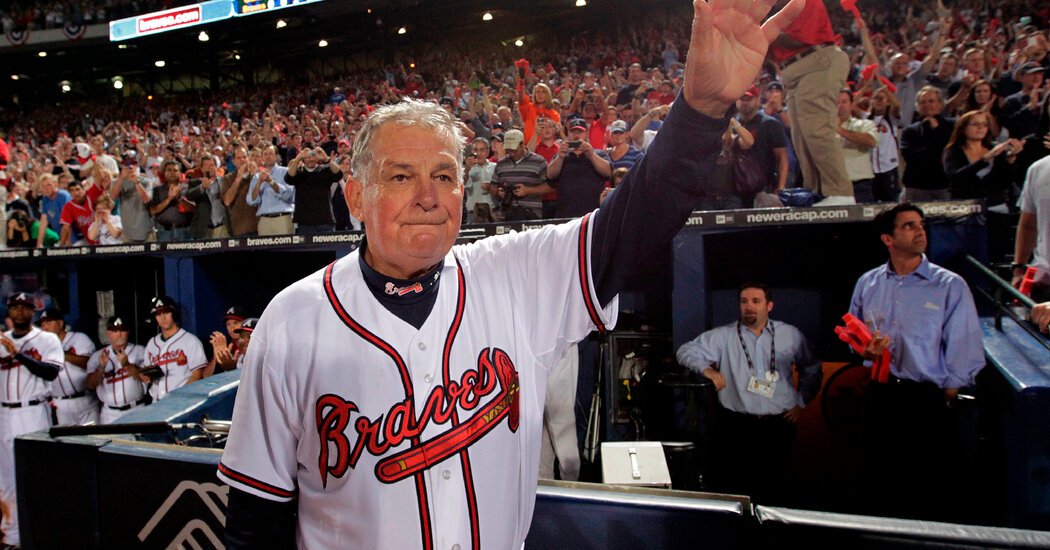
Bobby Cox, the Baseball Hall of Fame manager who led the Atlanta Braves to five National League pennants and a World Series championship in the 1990s and was ranked No. 4 for career victories among major league managers, died on Saturday in Marietta, Ga. He was 84.
The team announced the death but provided no further details. Cox had a stroke in 2019 that impaired the use of his right arm.
Cox himself was a major league player whose career consisted of two seasons, mostly at third base, with the Yankees in 1968 and 1969. He batted .225 overall in 220 games and was hampered by knee problems.
He found his niche as a manager, mostly for the Braves in two stints surrounding a stretch with the Toronto Blue Jays. He was inducted into the Baseball Hall of Fame in 2014 as “one of the most successful managers in history” for steering the Braves to dominance in the 1990s.
Cox’s 2,504 victories in 29 seasons have been exceeded only by three others: Connie Mack, with 3,731, managing the Philadelphia Athletics for 50 years, followed by John McGraw with 2,763 and Tony La Russa with 2,728. Cox was voted manager of the year four times by the Baseball Writers’ Association of America.
Cox’s Braves boasted strong pitching, most notably from the Hall of Famers Tom Glavine, Greg Maddux and John Smoltz. His Atlanta teams won division championships 14 consecutive times, from 1991 to 2005, a players’ strike having curtailed the 1994 season.
But they didn’t capture his lone World Series championship until 1995, when they defeated the Cleveland Indians in six games, with the clincher coming on a 1-0 victory behind Glavine’s one-hitter and David Justice’s sixth-inning home run.
The Braves were bested in the Series by the Minnesota Twins in 1991, the Blue Jays in 1992 and the Yankees in 1996 and 1999.
After the Braves captured the 1995 Series title, Cox expressed resentment over frequent references in previous years to his never having reached baseball’s pinnacle.
“That’s all they ever talk about,” he told The New York Times. “Fran Tarkenton never won a Super Bowl. He’s one of the greatest quarterbacks ever. He talks about having a little luck occasionally, too.”
Cox regarded himself as a players’ manager and was well liked by his teams.
“I can get on a player, and have, as good as anybody in the world,” he told The Times during the 1999 World Series. “But certainly, when we leave, we understand each other, and it hasn’t been printed and nobody knows about it. At least most of the cases.”
Robert Joe Cox was born on May 21, 1941, in Tulsa, Okla., and grew up in Selma, Calif., near Fresno. His father, J.T. Cox, was an electrician for a pump company, and his mother, Willie Mae (Hendrix) Cox, was a store clerk.
Bobby played for his high school baseball team, and the Los Angeles Dodgers’ organization signed him in 1959 as an amateur free agent. He remained in the minor leagues until the Yankees obtained him in a December 1967 trade from the Braves’ organization. He debuted in the major leagues the following year.
Cox managed in the Yankee farm system from 1971 to 1976. He then became the Yankees’ first-base coach under the manager, Billy Martin, in 1977 when the team defeated the Dodgers in the World Series.
He replaced Dave Bristol as the manager of the floundering Braves in 1978. The Braves’ only winning season under Cox came in 1980, when they were 81-80. He was fired after the strike-shortened 1981 season.
He had better success managing the Blue Jays, which had entered the American League as a 1977 expansion team. He took them to 99-62 record in 1985, though they lost to the Kansas City Royals in the seven-game league championship series after taking a 3-to-1 game lead.
Cox was fired afterward, then served as the Braves’ general manager from 1985 to 1990. During that tenure, he drafted third baseman Chipper Jones, another future Hall of Famer, and traded for Smoltz.
Cox replaced Russ Nixon as the Braves’ manager in June 1990 while remaining as general manager. John Schuerholz took over the front office after that season, and they proved to be a highly successful tandem.
While 1995 was a triumphant season for Cox, he was in the news in connection with a troubling family matter in May of that year. His wife, Pamela, called the police to their home after they had argued the night following a game. The police said she told an officer that her husband had hit her in the face. Cox was arrested on a battery charge, then quickly released on $1,000 bail.
The next day, at a news conference arranged by the Braves, Pamela Cox retracted the allegation. Under a court arrangement, Cox enrolled in anger-management counseling, and his wife attended a program for battered women. Early in September, upon completion of those obligations, the charge against Cox was dismissed.
He and his wife, Pamela (Boswell) Cox, had three daughters. He also had five children from an earlier marriage, to Mary Xavier, that ended in divorce. A complete list of survivors was not immediately available.
Cox retired as the Braves’ manager following the 2010 season but continued to serve as an adviser. He also became an executive with a bank in the Rome, Ga., area.
Apart from the wins-losses column, Cox set a record for an arcane statistic, having been ejected from 162 games long before managerial challenges of most questionable calls could be settled by video replays, avoiding chest-to-chest arguments.
Most of the time, Cox was protecting his players from ejections by shouldering their anger, and there were evidently no hard feelings on the part of the umps.
“The umpires have the utmost respect for Bobby Cox,” the umpire Richie Garcia told The Associated Press in 2007. “What happens one night isn’t carried over to the next.”
As the umpire Bob Davidson put it, “If I was a ballplayer, I’d want to play for Bobby Cox.”