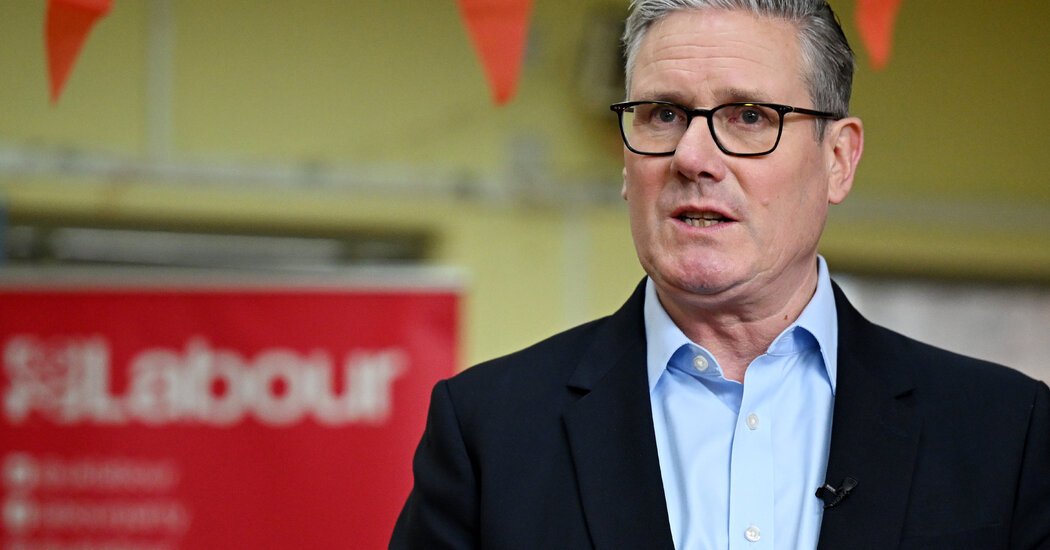
If British voters wanted to send a message to Prime Minister Keir Starmer, Thursday’s elections were practically a primal scream.
Across England, Britons ushered more than 1,300 Reform U.K. candidates into municipal office, cementing the populist anti-immigration party of Nigel Farage as the new political force on the right.
At the same time, left-leaning voters shouted their dismay with Mr. Starmer on economic inequality, Palestinian rights and his hard-line approach to immigration by ousting about 1,400 members of his Labour Party from local councils and voting for an insurgent Green Party, the centrist Liberal Democrats and independent candidates.
In Wales, Labour lost control of the national parliament it had led since 1999. In Scotland, the party’s waning influence dimmed further as the Scottish National Party remained dominant and Labour tied for second place with Reform.
“The electorate are fed up with the fact that their lives aren’t changing quickly enough,” Mr. Starmer admitted on Friday morning, after the first results rolled in. But amid fierce speculation that his Labour rivals were scheming to replace him, the prime minister vowed to fight.
“I’m not going to walk away and plunge the country into chaos,” he said. “We were elected to deal with these challenges, and that’s what we will do.”
The prime minister was not on the ballot. Thursday’s elections were to municipal councils across England, and to the Scottish and Welsh Parliaments, which have responsibility for some issues, including education and health care.
But when it was all over, there was little doubt about what voters thought of Britain’s long-established political duopoly, made up of two parties — Labour and the Conservatives, or Tories, once led by Margaret Thatcher — that have long competed for control of Parliament and No. 10 Downing Street.
The elections underscored a new political reality in Britain — an ideological free-for-all, given the country’s “first-past-the-post” electoral system, which allows a candidate to clinch victory without needing to win a majority.
The results are an echo of similar political upheavals around the world, where the rise of the right has been accompanied by a collapse of the center. In Germany and France, establishment leaders have sagged in popularity amid a surge of support for nationalist, right-wing rivals. In the United States, President Trump’s MAGA movement has consumed center-right Republican support while Democrats have lost traction.
But unlike in places like Germany, the Netherlands or Israel, where proportional voting has led to decades of experience with coalition governments, the election rules in most of Britain allow individual candidates to win with a simple plurality of the votes cast. In Thursday’s election, that meant that many candidates with just 30, 25 or even 20 percent of the vote were declared winners because their rivals all ended up with slightly lower totals.
Reform’s victory in Havering, a borough of about 280,000 people on the eastern edge of London, is a prime example. The party started the week with no representation on the 55-member council, and it received about 36 percent of the vote overall on Thursday.
But because several other parties split the rest of the vote, the candidates running under the Reform banner won 39 of the seats, giving them a 71 percent majority and control of a London council for the first time. All 23 Conservative Party councilors lost their seats on the panel, leaving them with no representation in the borough.
A century of two-party dominance, disrupted
With its system built around the “party in power” and the “party opposite,” the British Parliament has had few coalition governments — since the Second World War, there has been only one — and little experience in governing a fragmented electorate.
Even the architecture of the country’s governing institutions are symbols of that system. In the House of Commons, the party of the prime minister sits directly across from the party with the second-highest number of lawmakers. Each Wednesday, the prime minister and the leader of that party stand and face each other in “Prime Minister’s Questions,” an often bruising encounter.
“You have votes splintering in multiple different directions and no one in our political culture is used to dealing with that,” said Rob Ford, a professor of political science at the University of Manchester. He said the British system was designed for a binary, two-party composition — incumbent and opposition.
“It breaks down when you have four or five parties, all with a substantial amount of the vote,” Professor Ford said. “It’s just very, very messy and confusing.”
For now, that mess is confined to municipal councils in communities around England and to the devolved Parliaments that are partially empowered to govern Scotland and Wales. In many of those places, the parties will be forced to work together.
That is not yet the case in the British Parliament, where Reform still has only eight of the 650 seats. Labour, which on Thursday saw its deepest-ever losses in a set of local elections, remains firmly in control of the central government, with 403 seats, or 62 percent of the total.
But the pattern of voting on Thursday is the best evidence yet that change may be coming to the seat of Britain’s government as well.
Starmer holds on — for now
Mr. Starmer’s Labour Party will have to call another general election by 2029, and it could do so earlier if it decides that would be to the party’s advantage. The conversation now reverberating inside the party is about who should replace Mr. Starmer to lead them when that time comes around.
Despite Labour’s crushing defeat, the prime minister’s most prominent rivals in the party have not immediately called for his ouster. But more than two dozen Labour lawmakers urged him to step aside in the wake of the results, saying Mr. Starmer was damaging for the party’s future.
Mr. Starmer made it clear on Friday that he has no intention of stepping aside. He is expected to lay out a reset of his approach on Wednesday in the King’s Speech, a ceremonial opening of the parliamentary session in which the king formally delivers the government’s agenda for the upcoming year.
On Saturday morning, the prime minister announced that he was appointing two veteran Labour politicians as unpaid advisers: Gordon Brown, a former prime minister, and Harriet Harman, a former member of Parliament.
But many defeated Labour candidates acknowledged on Friday that anger and frustration with Mr. Starmer, personally, had helped to ensure their losses, and that his name had come up repeatedly on doorsteps when they were out campaigning.
Keeping a deeply unpopular prime minister in office in the face of that reality could be very damaging to the party’s chances in a general election.
When Mr. Farage was asked on Friday morning whether he thought Mr. Starmer would be forced out of office, he predicted a “rebellion” among Labour politicians once all of the votes were counted over the weekend. But he joked that he was in no rush to see that happen.
“Personally, I’d be very sad to see the prime minister go,” he said, flashing a broad smile. “Very, very sad indeed. He’s the greatest asset we’ve got.”