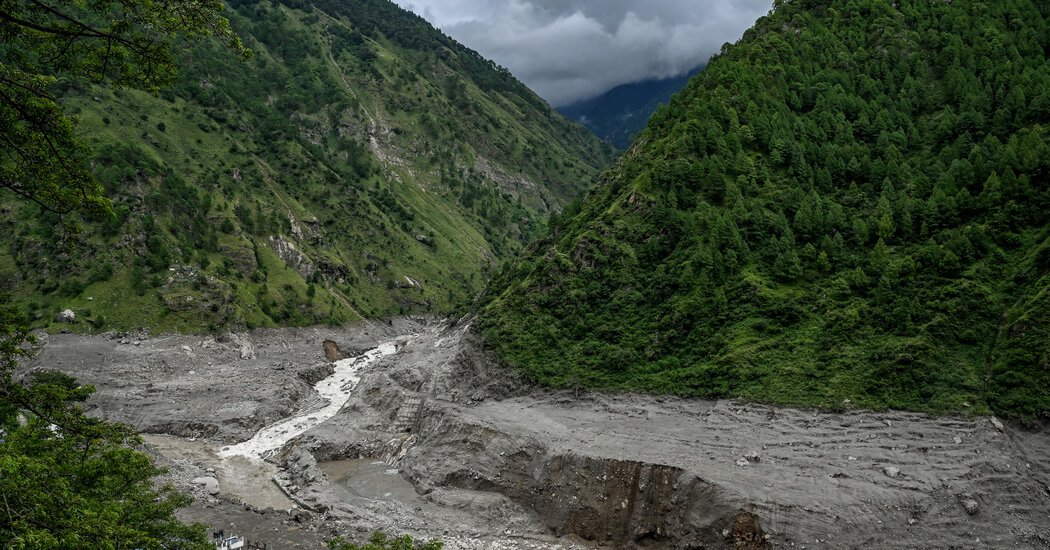
The blast of earth, water and ice that rushed through a region of Nepal knocked out more than a tenth of the country’s hydropower capacity within minutes, striking at an industry Nepal has made central to its economic future.
The floods in the Bhotekoshi and Trishuli valleys damaged or destroyed 14 hydroelectric projects, including six under construction. After the deluge on Wednesday, 431 megawatts of generating capacity had gone dark, according to the Nepal Electricity Authority — more than 12 percent of the country’s total capacity.
The toll was far greater when including projects under construction. Counting those plants, now halted or in some cases swept away, would roughly double the capacity lost. Among them was the Trishuli-1 project, where 63 Indians were rescued from a construction tunnel and more than 100 workers remain unaccounted for.
The destruction was part of a much larger human catastrophe. More than 600 people were killed, more than 2,400 remained missing, and 93,000 needed assistance.
But the loss of so much hydropower infrastructure also exposed a vulnerability at the heart of Nepal’s economic development strategy. The country is betting heavily on the rivers plunging from the Himalayas to turn itself into a major producer and exporter of renewable electricity. Companies from India, China and elsewhere have rushed into the sector in recent years.
“Nepal sits on two very important risks,” said Puspa Sharma, a Nepali research fellow at the Institute of South Asian Studies at the National University of Singapore.
One is the natural hazards inherent in its mountainous terrain, risks that appear to be worsening as the climate warms. The other, he said, “is its dependence on India, because without India I don’t think its hydropower can go anywhere.”
India is Nepal’s essential market for surplus electricity and its only practical route to other buyers, while New Delhi’s rivalry with China has also complicated Nepal’s efforts to attract investment.
Nepal’s spectacular but unforgiving geography has long made hydropower seem like a natural resource waiting to be exploited. Rivers fed by Himalayan snow and glaciers plunge toward the plains of India, carrying enormous amounts of potential energy.
Nepal has about 83 gigawatts of hydropower potential, of which 43 gigawatts — roughly the output of 30 to 40 nuclear reactors — can be developed. But only a fraction of that has been harnessed, partly because the country would need billions of dollars for dams, transmission lines and other infrastructure. In Nepal, indebted and landlocked, the average annual income is about $1,600.
Nepal’s installed hydropower capacity has grown to more than 4,000 megawatts from about 3,000 megawatts in 2024. The government aims to reach 28,500 megawatts by 2035, far more than Nepal itself would consume.
Last month, Nepal confirmed a deal to send 10,000 megawatts of electricity to India over a 10-year period. India’s demand for electricity is surging as the needs of its 1.4 billion people grow, even as the country rapidly expands solar, wind and nuclear power generation. But the Indian government has been reluctant to depend on hydropower projects backed by China, its rival across the Himalayas.
The two countries have competing territorial claims, and their troops fought a deadly border clash in 2020.
“India is hesitant about Chinese investment coming in,” Mr. Sharma said. He pointed to rules established in 2018 and strengthened after the 2020 clash that restricted investments involving companies from countries sharing a land border with India, including China.
In a paper published last year, Anup Kumar Upadhyay, Nepal’s former energy secretary, said the region had missed an opportunity to develop 20 to 25 gigawatts of generating capacity over the previous eight years. More investment, he wrote, “could have generated significant mutual benefits, supporting India’s growing demand for clean energy while advancing Nepal’s development goals.”
India has recently shown signs of easing some restrictions, while becoming a more important investor in Nepal’s hydropower sector. Indian-backed projects include Arun-3, a 900-megawatt plant under construction in eastern Nepal.
Bangladesh is another hopeful customer. Its reliance on imported gas has left it vulnerable to disruptions in Persian Gulf supplies during the war in Iran, with energy shortages weighing on its garment industry, the backbone of the Bangladeshi economy.
Yet geography again leaves Nepal dependent on India. Although Nepal and Bangladesh come within 14 miles of each other, a narrow strip of Indian territory separates them. Electricity traded between the two countries must therefore cross India, which has restricted Bangladesh’s access to Nepali power during periods of diplomatic tension.
This week’s destruction exposes a more fundamental uncertainty: whether Nepal can safely build the hydropower system on which those export ambitions depend.
The Himalayas are highly vulnerable to landslides, avalanches and glacial outbreaks. As the climate warms, some of those hazards are expected to intensify, sharpening debate over where Nepal should build hydropower projects, how they should be engineered, and whether smaller plants might prove more resilient.
Nepal was already debating building reservoirs, which could store water and provide electricity year-round, rather than relying heavily on seasonal river flows.
The disaster also highlighted another difficult trade-off. Nepal needs hydropower at home, but electricity exports bring in money that the country badly needs for development. If future disasters disrupt generation, which should take priority?
“Projects on a river, if they get washed away,” Mr. Sharma said, “do you export to India, and keep your own country in the dark?”
Climate change raises an even longer-term question. With the Himalayas warming rapidly, Mr. Sharma said, the region may eventually have to reconsider its assumptions about the rivers themselves.
“If global warming will not be contained,” he said, “maybe the glaciers will just dry up, and we will not have water in these systems.”