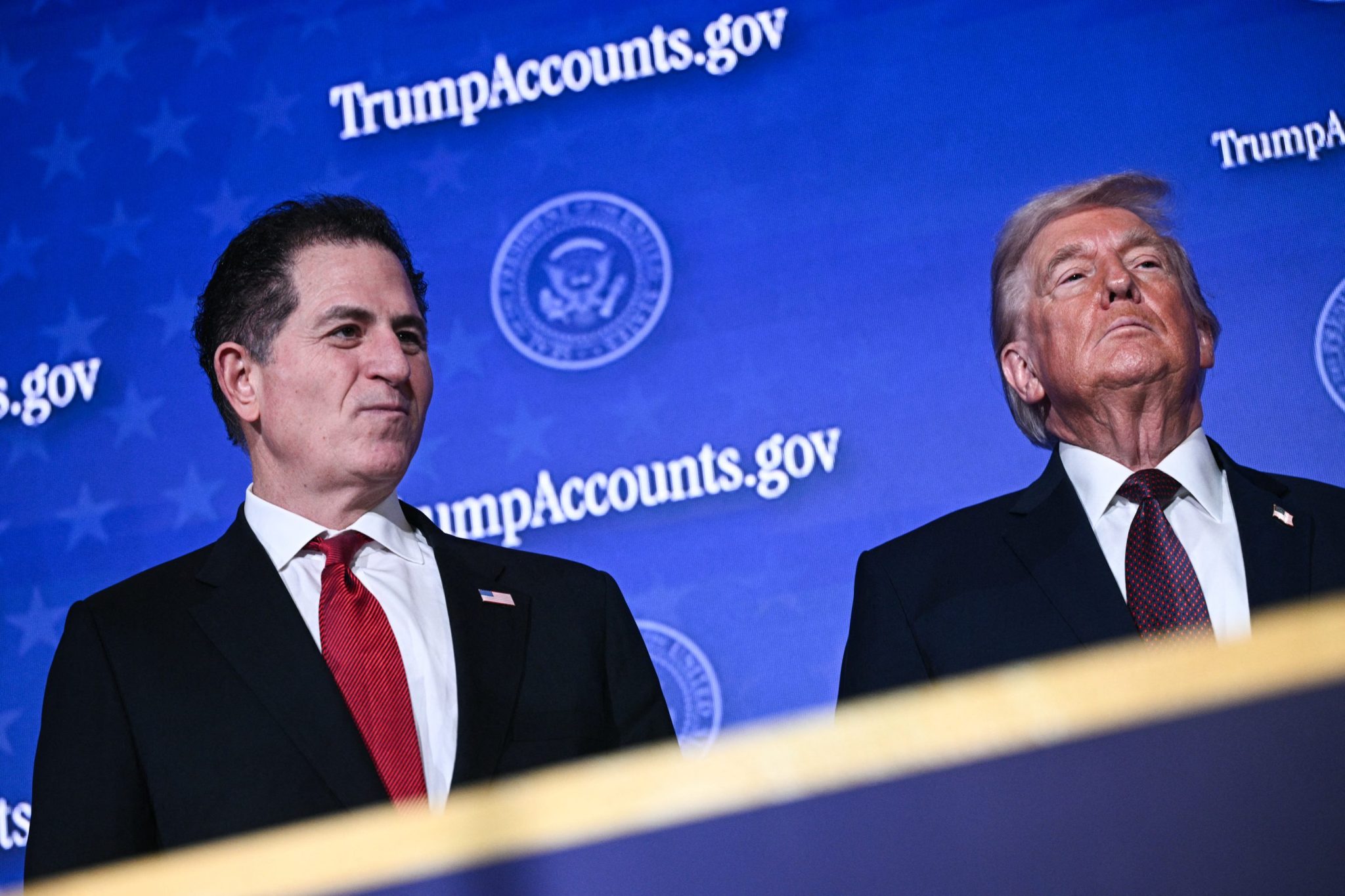
Good morning. The Treasury Department announced yesterday that BNY Mellon and Robinhood will build and run the app for Trump’s tax-deferred investing accounts for kids, which is due to launch in July and be seeded with $1,000 of federal money for babies born between 2025 and 2028. While critics say there are better places to deploy that cash, investing early is a time-tested way to build wealth. That may be why companies like Nvidia, JPMorgan Chase, BlackRock, Intel, Citigroup, Chipotle, Delta Air Lines, and Coinbase have pledged to match the Treasury grant for employees’ children. It’s why Dell Technologies CEO Michael Dell and his wife Susan stepped up to donate $6.25 billion to fund the accounts. Amid growing concerns about AI job loss and the wealth gap, should other leaders promote this product, too? A few things to consider:
A way to promote financial wellness: Saddled with debt, stagnant wages and rising home costs—and tools that enable impulse investing—younger investors gravitate towards risky bets. “We could afford a house at 27 or 28. These kids can’t, so they look to quick‑buck flips, and that’s just not how markets work,” says Bill Capuzzi, CEO of Apex Fintech Solutions, which runs the infrastructure for many investing apps, reaching 41 million consumers. While the typical age for first-time home buyers has risen to 40, Gen Z is saving earlier for retirement. The Trump accounts could show the next generation of parents (and their kids) the power of prudent investing early on. Said Capuzzi: “Take this $1,000, don’t touch it, watch it compound over 18 years and learn how the markets really work.” (With parental contributions, Trump Account holders could have $270,000 by the age of 18.)
A family-friendly signal to talent: Some companies offer scholarships for employees’ children, but that can turn out to be a tax headache or source of resentment. Turns out it’s also not so easy to do a company match on Trump Accounts, which enable employers to deposit up to $2,500 into an account for each employee’s eligible child. Seventy percent of employers polled by Plan Sponsor Council of America last year said they didn’t plan to participate, citing the administrative burden, concerns about favoritism and lack of clarity around implementation. (Some already contribute to state 529 accounts.) BNY CEO Robin Vince signed on in December, praising the accounts as “a head start” for employees’ children. When I asked another leader yesterday about their plans, they waved away the topic, saying “we’re focused on improving what we already have.”
A long-term bet: Four million children have already signed up, according to IRS figures. The Dells plan to put $250 in accounts for 25 million kids, with Michael Dell telling me he hopes it “inspires children to want to learn more about compound interest.” I hope so, too. But any account bearing the name of a sitting president does carry another risk. As US Bank CEO Ganjan Kedia noted when I asked her about it yesterday: “Whether this survives after three years, the next Congress will have a point of view on that.” Indeed. With national debt topping $39 trillion, future presidents may decide to deploy that capital in a different way.
Contact CEO Daily via Diane Brady at diane.brady@fortune.com
Top leadership news
In conversation with H&R Block’s new CEO
H&R Block’s new CEO Curtis Campbell told Fortune that his path to the top had less to do with being the smartest person in the room and more to do with persistence and a driven mindset. He argues that emotions like fear of rejection, intimidation, and self-restraint are what separates people from being “caught in mid-level management and getting to higher levels of the organization.”
Jamie Dimon’s annual letter
In his annual shareholder letter, JPMorgan CEO Jamie Dimon said his army of 300,000 employees work best when they are on “small and authorized” teams where they can act like “Navy SEALs or the Army’s Delta Force.” He also reiterated that AI will eventually “reduce the workweek.”
Where AI can automate
These are the industries most exposed to AI automation, and the industries where AI can get a lot better. Anthropic’s top economist told Fortune that vulnerability to the technology isn’t the end of the world.
The markets
S&P 500 futures are up 0.08% this morning. The last session closed up 0.44%. The STOXX Europe 600 was up 0.69% in early trading. The U.K.’s FTSE 100 was up 0.38% in early trading. Japan’s Nikkei 225 was up 0.03%. China’s CSI 300 was flat. Hong Kong’s Hang Seng was down 0.70%. South Korea’s KOSPI was up 0.82%. India’s NIFTY 50 is up 0.28% today. Bitcoin is at $69K.
Around the watercooler
Commentary: America’s CEOs have become reluctant guardians of democracy by Jeffrey Sonnenfeld and Stephen Henriques
‘No one’s raising their hand’: Japan’s labor crisis is making the case for robots taking the jobs that you don’t want by Catherina Gioino
Trump threatens to ‘take out’ all of Iran in one night. From blackout bombs to ‘discombobulators,’ here’s what that could actually mean by Eva Roytburg
AI is cutting 16,000 U.S. jobs a month—and Gen Z is taking the brunt, Goldman Sachs says by Nick Lichtenberg
CEO Daily is curated and edited by Joey Abrams, Claire Zillman and Lee Clifford.