

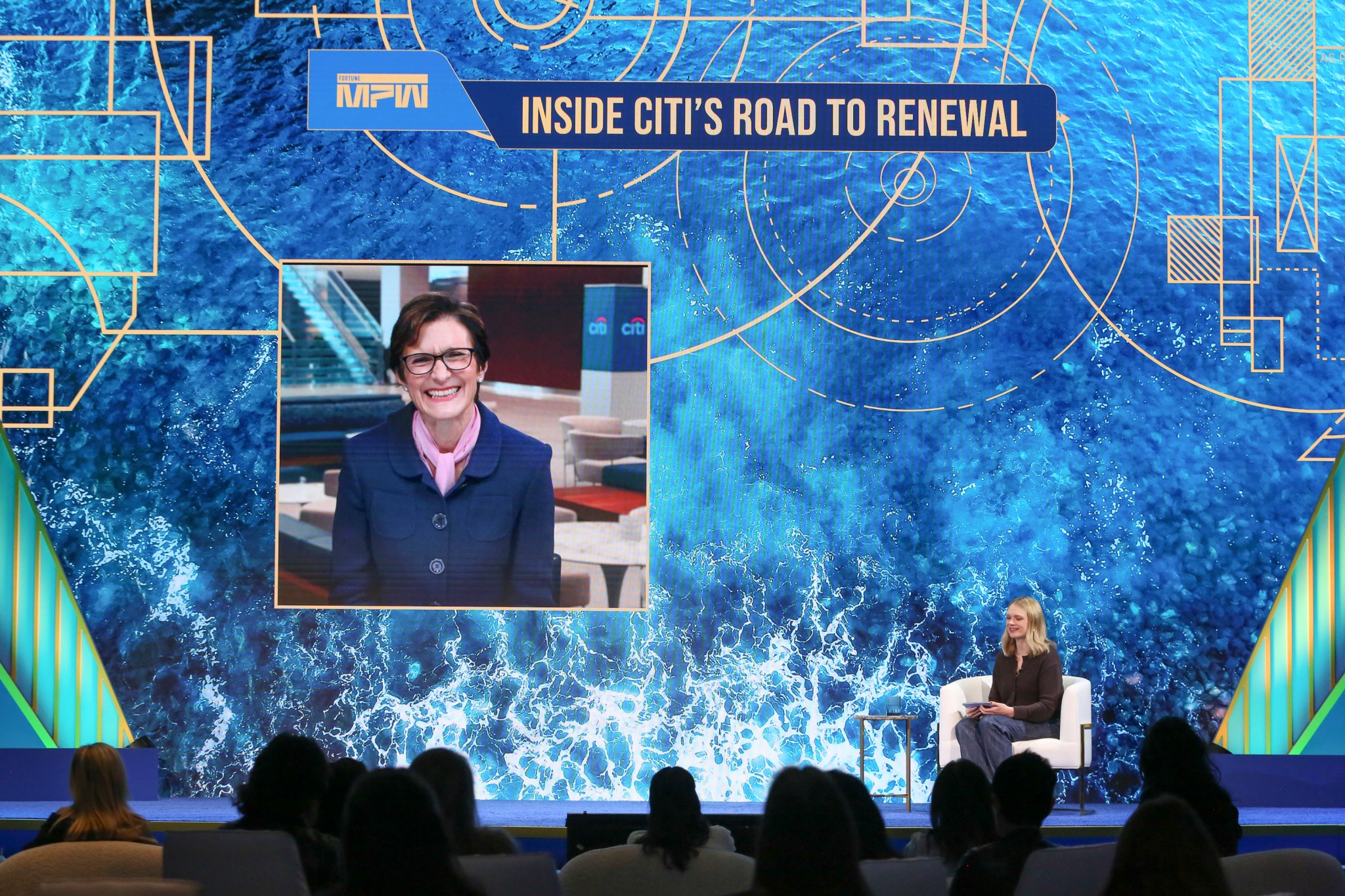
Yesterday, Citigroup posted its best third-quarter revenue in a decade—yet another sign CEO Jane Fraser’s turnaround keeps paying off. Fraser, the first woman to run a major Wall Street bank and No. 1 on this year’s Most Powerful Women list, appeared virtually at Fortune’s Most Powerful Women Summit on Wednesday to speak about how she plans to sustain that momentum.
“We’re definitely in the more fun part of everything that’s going on. We’ve got a lot of the heavy lifting behind us,” Fraser said in conversation with leadership editor and MPW Summit co-chair Claire Zillman. “Now what I’ve said to the firm is, if we are going to be the best in the businesses we’re in, we have to beat the best.”
“So it’s that mindset of excellence, and that’s the next phase of the journey,” she continued.
When Fraser became CEO in 2021, her job was to simplify an expansive global bank. Since then, she has reorganized Citi into five core businesses, cut layers of management, and started exiting consumer banking in 14 markets outside the U.S. The overhaul also includes 20,000 job cuts slated to wrap up before 2027.
When reflecting on five years into her tenure in an interview this spring with Zillman, Fraser said: “I think you can make tough decisions. It does not mean you need to be an asshole.” On Wednesday, she traced that philosophy to a restructuring she led in Citi’s mortgage business. Employees want to hear “the hard truth,” she said, along with what the company will do to help them.
“You do not have to be tough and unpleasant about it, but you do have to be straight,” she added.
‘Move fast and retain trust’
Like most other businesses, Citi’s next phase hinges on how AI will change its business. Fraser said AI’s effects on her business are three-fold: It “can help you earn money. It can help you save money. It can help you secure the bank.”
“We have to move fast and retain trust,” she added.
One example is an AI avatar agent for Citi’s wealth business, developed with help from Google DeepMind’s team, that can talk with clients at any hour of the night, “when our bankers hopefully are getting some beauty sleep,” Fraser said, adding “it’s not a replacement team member.”
Whether AI will shrink Citi’s headcount is still an open question.
“Honestly, we don’t know yet,” Fraser said, describing “puts and takes” as some jobs are created and others are automated due to the technology.
Moving fast applies to risk with AI, too.
“When you’re innovating at speed, you have to manage risk at the same speed,” she said, adding that big banks are working together to find and patch vulnerabilities.
“You don’t compete on cyber,” she said. “You collaborate on cyber.”
Citi now requires AI training for 175,000 of its employees, with a focus on writing prompts.
“I never think people perform well if they’re fearful,” Fraser said.