For decades, the federal government has funneled big-ticket grants to local communities to help them take on ambitious construction projects to expand public transit. The grants, sometimes in the billions of dollars, have funded new railroad tracks, train stations and roads rebuilt for modern bus service. Today, they’re funding extensions of the Second Avenue Subway in New York and the Red Line in Chicago, as well as the Gateway Tunnel under the Hudson River and bus infrastructure in Indianapolis and San Antonio.
But since President Trump returned to office, the Federal Transit Administration has not signed a single new agreement under the program, known as Capital Investment Grants. Large projects ready to enter the final phase of the program’s yearslong pipeline have stalled there. The administration also tried halting payments to the New York and Chicago projects, forcing courts to intervene.
As the number of pending projects builds up, so has anxiety about the federal government’s support for major transit infrastructure. Money that Congress designated for that purpose is accumulating too: More than $7 billion hasn’t been obligated to any project.
“It’s hard to look at the last year and see anything other than a deliberate slowdown of these grants,” said Steve Davis, director of the advocacy group Transportation for America.
The program illustrates a subtler tactic in how the Trump administration is managing federal funds: not just terminating grants, as it did in droves last year, but quietly declining to give out new ones.
That absence of action is harder to trace, and harder for communities to contest. More than a dozen transit agencies and local governments seeking grants declined interviews or would not comment about the program, amid fears that a fleeting phrase could anger the administration with millions of dollars on the line.
The Department of Transportation, which includes the transit agency, said in a statement that projects were working their way through the multistage grant process required by law. And the agency noted that it has supported transit in other ways, including with funds to World Cup host cities and with oversight pushing transit agencies to lower crime.
As the administration tries to wrest more control from Congress over federal spending, the potential consequences for infrastructure grants are acute. Delays compound rising construction costs that outpace overall inflation. Without the certainty of federal funding, it’s harder for communities to pursue bonds and other financing for big projects.
And any unspent grant money is something tangible not built — a subway station without elevators for accessibility, a bus line without dedicated lanes for faster travel, a commuter rail that can’t carry enough trains.
“It’s just a little bit anathema to me that you would have a program that isn’t getting the money to the projects,” said Derek Miller, the president and C.E.O. of the Salt Lake Chamber in Utah, who also worked for the transportation and infrastructure committee in the U.S. House in the 2000s.
Utah is up against a deadline to host the 2034 Olympics. That may sound far off, Mr. Miller said, but the state needs to start on infrastructure next year. And the top priority is the FrontRunner 2X project now in the pipeline seeking a $2.4 billion grant. It would add parallel track to sections of an 83-mile-long commuter rail, enabling more trains for more frequent service and more riders.
It’s a “head-scratcher,” Mr. Miller said of the slow process.
‘Just no way’ local projects can be built alone
It’s not unusual for an administration to complete few of these grant agreements in its first year (the Biden administration signed six in its final weeks in office, clearing the decks as outgoing officials often do). But people who follow the program say the drought has grown more conspicuous.
“The concern here is that we’re 18 months without a signed” agreement, said Ward McCarragher, the vice president for government affairs and advocacy for the American Public Transportation Association. And 10 projects pursuing grants already have all their funding ready in the F.T.A.’s internal accounting, he noted, including $375 million for bus rapid transit service in Charleston, S.C., and $150 million each for bus projects in Los Angeles and Columbus, Ohio.
Communities can’t count on that money, though, until the F.T.A. reviews engineering plans, environmental assessments, ridership and cost data and local funding commitments. Projects spend years in that review — some never make it to the end — and no money is guaranteed until an agreement is signed.
Smaller communities would be hurt most by delays or grants that never materialize, said Yonah Freemark, a researcher at the Urban Institute. They may not have dedicated taxes to fund transit or state programs to step in. Of the 46 projects in the pipeline, most aren’t trying to dig a tunnel under a major river — they’re seeking $50 million to $150 million for bus rapid transit.
“There is just no way that local communities can afford these changes by themselves,” said Natali Fani-González, the county council president in Montgomery County, Md., in the Washington suburbs.
The county is seeking $150 million toward a nearly $200 million project to revamp Veirs Mill Road, a wide thruway that has been surrounded over the years by homes, schools and businesses. “Imagine a highway in the heart of a neighborhood,” Ms. Fani-González said. The corridor is dotted with makeshift memorials to pedestrians who have died.
The county wants to put in a bus rapid transit line with dedicated bus lanes, boarding stations and priority signals, as well as better sidewalks and cycling access. The county has been expecting a grant by the end of the fiscal year on Sept. 30, Ms. Fani-González said.
For the largest projects in the program, proponents argue that the federal government has an interest in major infrastructure in the nation’s economic engines.
“Greater Boston is what it is today because of the federal partnership on mega projects,” said Tom Ryan, a senior adviser at A Better City, a greater Boston business organization. The federal government, through other programs, helped fund the Big Dig that transformed downtown Boston and the cleanup of Boston Harbor.
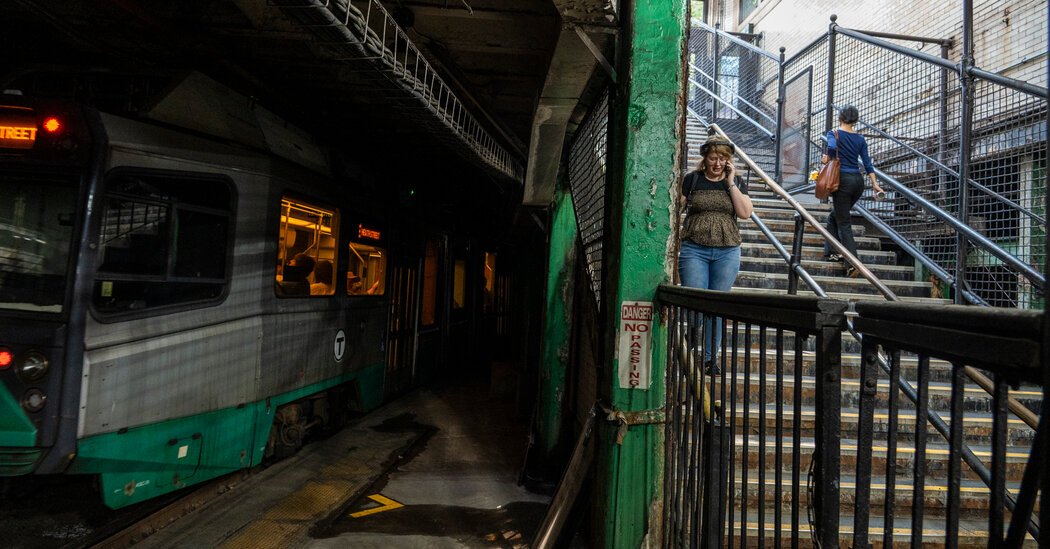
Today the region wants to modernize the oldest subway system in North America, the Green Line on the Boston T. Some sections date to 1897, and the track signals to 1915. Twenty-five stations aren’t fully accessible. The Massachusetts Bay Transportation Authority has begun to order a new generation of trains for the line, but much of the system needs updating to support them.
It’s asking the federal government to contribute about $2 billion toward a roughly $4 billion investment (to be paid over many years).
Such large projects must go through a final “engineering” phase of the grant pipeline. And when the F.T.A. admits projects to that phase, it signals the maximum amount the program would likely fund. The Boston project, along with Utah’s and a light rail project in Los Angeles, have been waiting at that gate.
Skepticism at the top
There are other signs of the administration’s disregard for these grants, even if it can’t end a program Congress created. The first Trump Administration proposed eliminating its funding at one point (Congress funded it anyway).
The grants then made an appearance in Project 2025 as a poor use of funds.
“In terms of bang for your buck, these projects are a lot more expensive than is necessary, and they provide a form of transportation that is increasingly obsolete,” said Diana Furchtgott-Roth, a transportation official in the first Trump administration who wrote the Project 2025 chapter on transportation. These projects rely on fixed infrastructure, she said, in a world with ride-share apps, e-bikes, bike-share systems, electric scooters and even autonomous cars.
The transportation secretary, Sean Duffy, also released an early memo proposing to prioritize transportation funding to communities with high rates of marriages and births, naming one program in particular — Capital Investment Grants.
Then last fall, the White House budget director, Russell Vought, announced he was freezing payments to New York for the Gateway Tunnel and Second Avenue Subway for potentially violating new rules on disadvantaged business contractors. Two days later, he said he was doing the same with the Chicago Transit Authority.
“It’s very hard to ignore what happened when Gateway, the Second Avenue Subway and Chicago got their money cut off,” said Peter Rogoff, a former F.T.A. administrator and former head of Sound Transit in Seattle. What he takes from that: This grant program “has a very special place in their heart, and it’s probably not a good place.”
Judges later ordered the administration to resume funding. But Mr. Vought’s Office of Management and Budget, which doles out appropriated money to agencies, has continued to make unusual moves with the program. Of its nearly $7.9 billion in available resources, the budget office has designated more than $5.2 billion for next fiscal year — effectively putting it out of reach should the F.T.A. want to use it to sign a grant today.
“I have never seen a situation where the F.T.A. says, ‘Oh, we don’t need $5 billion because we’re not going to have projects ready for that,’” said Sarah Kline, a transportation consultant who earlier worked on transit legislation in the Senate Banking Committee. “That just doesn’t happen.”
When the new fiscal year begins Oct. 1, the White House budget office could simply push that money into the future again. The office did not respond to questions about how it has handled the program.
While communities wait, voters’ expectations are at stake, too.
In 2024, voters around Columbus passed a sales tax increase to help fund an $8 billion transportation plan, called LinkUS, designed around bus rapid transit.
“I tell people in Columbus that you will know Columbus before and after LinkUS,” said Shannon Hardin, the Columbus City Council president. “It will literally transform how folks not just get around, but how this city grows.”
When voters opted to raise their own taxes in tight times to do it, he said, it was with the expectation that the federal government would be there, too.
Francesca Paris contributed graphics.