Standard Chartered trimmed its 2026 Solana target but kept a bullish long-term view, arguing the network is shifting from memecoin speculation toward stablecoin-driven micropayments.
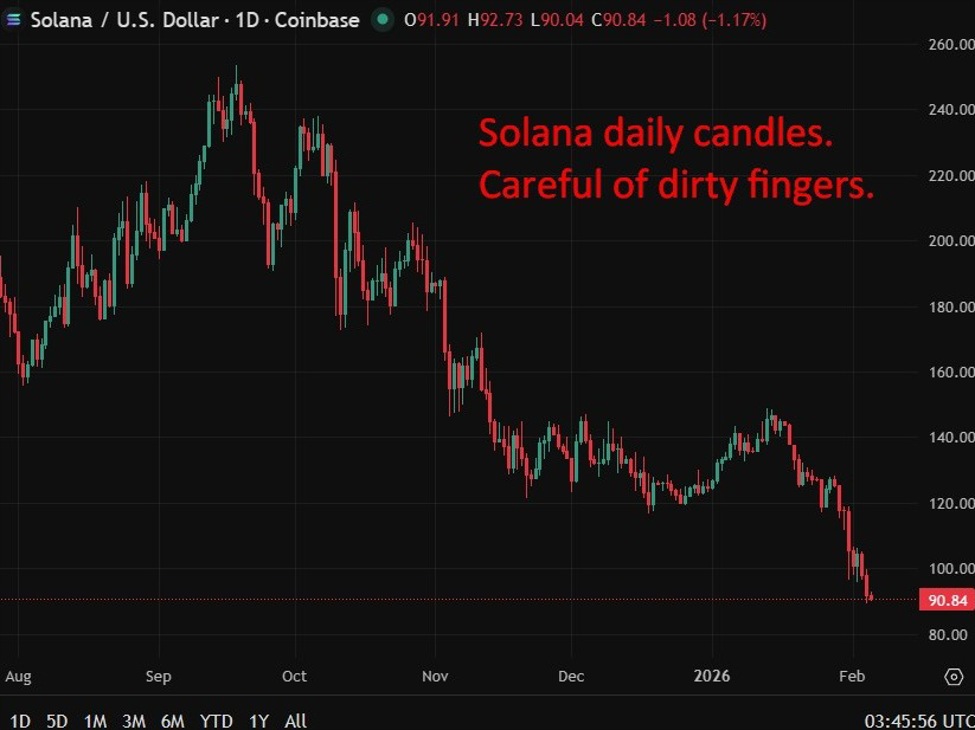
The BTC plunge may mess with this forecasts:
—
Summary:
-
Standard Chartered cuts its end-2026 Solana target to $250 from $310
-
Long-term roadmap unchanged, with $2,000 still pencilled in for 2030
-
Bank sees Solana transitioning away from memecoin-driven activity
-
Stablecoin and micropayment use cases viewed as key long-run drivers
-
Near-term lag vs Ethereum expected as the narrative shift takes hold
Standard Chartered has lowered its end-2026 price target for Solana, trimming its forecast to $250 from $310, while leaving its longer-term outlook unchanged as the bank argues the network is undergoing a structural shift rather than a cyclical collapse.
The downgrade reflects a more cautious view on how quickly Solana can convert its technical advantages — notably low transaction costs and high throughput — into durable, fee-generating economic activity. Standard Chartered’s digital assets research team framed the current drawdown as a phase where “performance differentiation” across cryptoassets should become more visible, instead of markets trading as a single risk-on or risk-off block.
At the heart of the revision is a changing activity mix on the Solana network. According to Geoffrey Kendrick, decentralised exchange activity is rotating away from memecoin-led speculation toward stablecoin-based trading pairs. When the bank initiated coverage in mid-2025, Solana’s on-chain activity was heavily skewed toward memecoin trading. Since then, flows have increasingly shifted toward SOL–stablecoin pairs as speculative intensity cooled.
Standard Chartered argues that this transition is strategically positive but slower to monetise in market terms. While memecoin trading can generate sharp bursts of volume, it is unstable and cyclical. Stablecoin-based flows, by contrast, are more consistent but take longer to scale into meaningful revenue.
The bank highlighted Solana’s ultra-low fees as a key advantage for emerging micropayment use cases, including AI-driven transactions, where even small costs can undermine viability. One metric cited in the report shows stablecoin turnover on Solana already running at two to three times the velocity seen on Ethereum, suggesting the chain may be carving out a niche in high-frequency, low-value transfers.
That potential is tied to the emergence of internet-native payment protocols, including Coinbase-backed x402, though Standard Chartered cautioned that adoption will take time to translate into market leadership.
As a result, the bank expects Solana to lag Ethereum through 2026–2027, even as it becomes more constructive on Solana’s longer-run upside if micropayment demand compounds. Despite the near-term trim, Standard Chartered reiterated its aggressive long-term path, projecting $400 in 2027, $700 in 2028, $1,200 in 2029 and $2,000 by end-2030, with Solana expected to outperform Bitcoin later in the cycle.
—
Solana is a high-throughput blockchain designed for fast, low-cost transactions. Its architecture allows thousands of transactions per second at minimal fees, making it attractive for decentralised trading, stablecoin transfers and emerging micropayment use cases.